

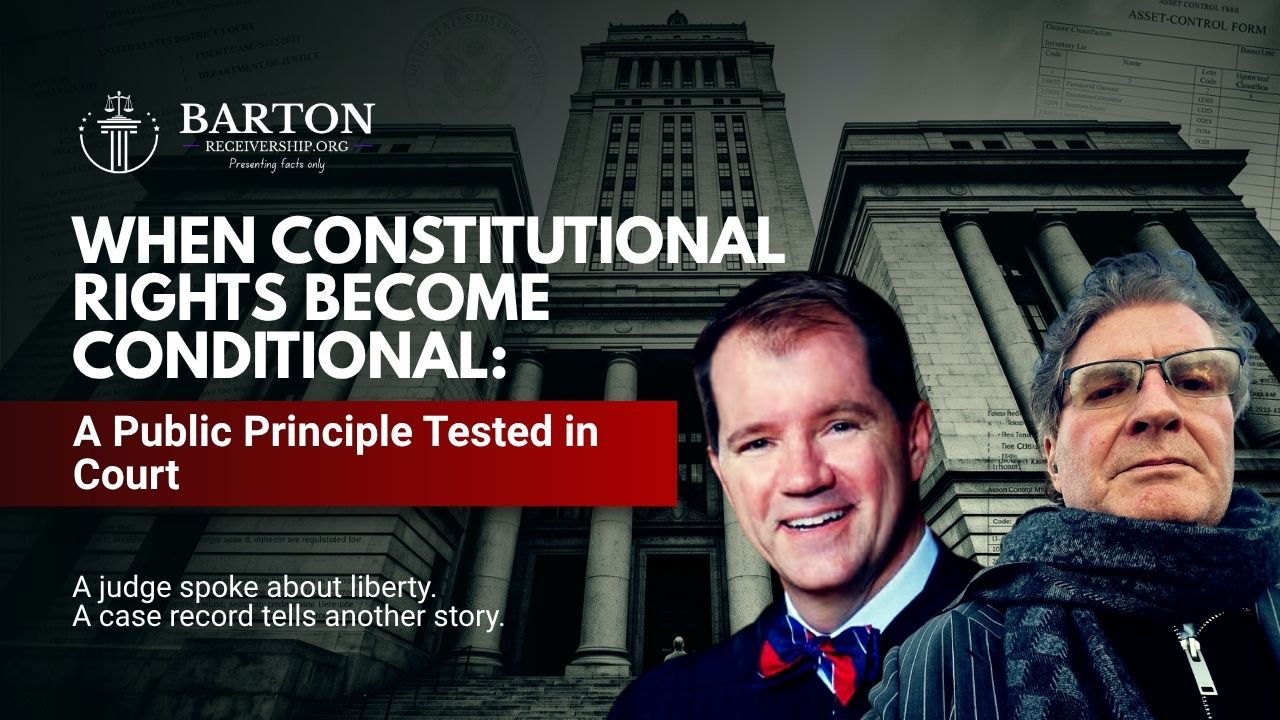
At a recent public event ahead of America’s 250th anniversary, Judge Don Willett delivered remarks during Israel on Trial with U.S. District Judge Roy Altman on the foundations of American liberty. This article examines constitutional rights in court through the contrast between public judicial rhetoric and what happened in Timothy Barton’s case. The message was unmistakable: rights come first, government comes second, and courts exist to protect what does not belong to the state in the first place.
Here is what he said, in substance and in plain terms:
- “Governments derive their just powers from the consent of the governed.”
- “The people are sovereign.”
- “These rights belong to us as individuals… they are fixed… God-given… they can’t be taken by man.”
- “The ultimate end of government is to secure these pre-existing rights.”
- “Rights don’t flow from the government—they are not bestowed.”
Those are not controversial ideas. They are the foundation of the American constitutional order.
Constitutional Rights in Court Cannot Be Conditional
They establish a simple sequence:
Rights → Government → Judicial Enforcement
In that framework, government is not the source of liberty. It is the servant of liberty. Courts, in turn, are not supposed to ratify power first and justify it later. Their role is to ensure that power stays within constitutional boundaries.
That is why the contrast with what happened in my case is so serious.
Before any trial. Before any jury determination. Before disputed facts were tested through a full evidentiary process, the machinery of judicial power was already in motion.
What followed included:
- assets seized before any trial or jury finding;
- control of companies taken without a final adjudication of liability;
- disputed facts treated as if already resolved;
- judicial authority exercised while core jurisdictional questions remained contested; and
- equitable remedies used in ways that bypassed basic constitutional protections.
That is not the constitutional sequence.
That is this:
Allegation → Seizure → Justification
And that inversion matters.
If rights are truly fixed and unrelinquishable, they do not disappear the moment the government makes an accusation. If government exists to secure rights, it cannot take them first and explain later. If the people are sovereign, their liberties cannot depend on post hoc process after the damage is already done.
This is the real constitutional question: are rights actual limits on power, or are they merely ideals recited in public speeches and suspended in real cases?
A legal system cannot honestly celebrate the principle that rights are untouchable while operating as though they are temporary, conditional, and subject to immediate override. Constitutional fidelity is not measured by ceremonial language. It is measured by conduct when the stakes are real.
That is where rhetoric meets record.
It is easy to defend liberty in the abstract. It is harder to honor it when due process slows the government down, when juries must decide disputed facts, when property cannot be controlled without lawful adjudication, and when courts must respect the limits of their own authority.
But that is exactly when constitutional commitments matter most.
If judges, lawyers, and institutions publicly affirm that rights are pre-political and God-given, then those same principles must govern in practice. Otherwise the message becomes impossible to ignore: rights are treated as permanent in theory and provisional in court.
That is not constitutional order. That is contradiction.
Say it in speeches.
Do it in court.
For more background on the case and related filings, visit BartonReceivership.net