

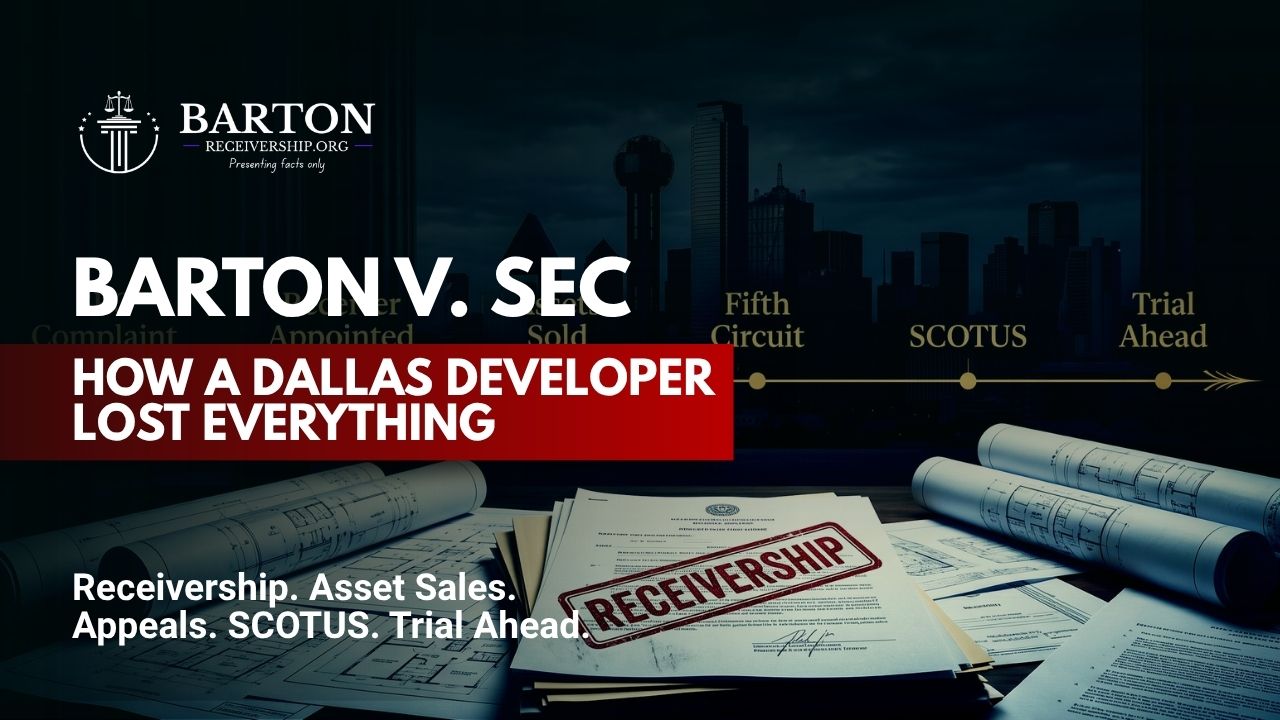
When the Securities and Exchange Commission filed its complaint against Tim Barton on September 23, 2022, it set in motion one of the most aggressive federal receivership actions in recent Texas history. What began as an enforcement action over real estate investment offerings has become a four-year legal battle that has consumed more than 25 companies, tens of millions of dollars in real estate, and one man’s ability to defend himself in his own criminal trial.
This is the full story of SEC v. Barton, No. 3:22-cv-02118-X — from the SEC’s allegations through Fifth Circuit appeals, a U.S. Supreme Court certiorari petition, and a receivership that critics say destroyed far more value than it preserved.
Who Is Tim Barton?
Timothy Lynch Barton is a Dallas-based real estate developer who founded JMJ Development in 1990 and served as CEO of Carnegie Development, LLC. Over three decades, Barton’s companies completed more than 1,100 residential units, 450,000 square feet of commercial space, and developments valued at over $600 million. His portfolio included the planned $395 million Mandarin Oriental hotel and condominium tower at 2999 Turtle Creek Boulevard — one of the most prominent development sites in Uptown Dallas.
Barton’s career intersected with high-profile figures in real estate and politics. Court filings include promotional materials showing Barton alongside figures from the Trump Organization during the mid-2000s, and JMJ Development served as a brand manager for Ivanka Trump’s real estate projects in 2008. These connections would later become part of the broader narrative surrounding the case.
The SEC’s Allegations
The SEC’s complaint alleged that from approximately March 2017 through June 2019, Barton worked with home builder Stephen T. Wall and Chinese national Haoqiang Fu (a/k/a Michael Fu) to raise approximately $26 million from over 100 investors — most of them Chinese nationals — through unregistered securities offerings tied to real estate development in the Dallas–Fort Worth area.
According to the SEC, the defendants created a series of single-purpose “Wall” entities (Wall007 through Wall019) designed to capitalize on Wall’s existing relationships with Chinese homebuyers. The offerings promised investors their funds would purchase specific parcels of land for residential development, with full repayment plus interest within two years.
The Receivership Order
On October 18, 2022 — less than a month after the complaint was filed — U.S. District Judge Brantley Starr entered an Order Appointing Receiver over more than 25 entities connected to Barton [Dkt. 29]. The court appointed Cortney C. Thomas of Brown Fox PLLC, Dallas, to serve as receiver “without bond.”
The receivership entities included not just the Wall entities named in the SEC complaint, but also companies like Goldmark Hospitality LLC, JMJ Development LLC, Mansions Apartment Homes at Marine Creek LLC, Orchard Farms Village LLC, Villita Towers LLC, and numerous others [Dkt. 29, pp. 2–3]. The receiver was granted “all powers, authorities, rights, and privileges” previously held by the entities’ officers and directors, under 28 U.S.C. §§ 754, 959 and Fed. R. Civ. P. 66.
The scope was sweeping. The SEC had sought receivership over 82 entities; Judge Starr ultimately included 54. Still, the order covered entities that — according to Barton’s defense — had no connection to the alleged fraud and were operating, revenue-generating businesses.
Property Sales and Valuations
Once in control, the receiver moved to liquidate the estate’s real estate holdings. The pattern repeated across multiple properties: the receiver filed a motion to sell, published notice in the Dallas Morning News, received no competing offers, and the court approved the sale.
Rock Creek property (Dallas): The receiver sought approval to sell the property at approximately 4109 Rock Creek Drive. The court applied the standard that “the proposed sale price exceeds two-thirds of the appraised value” and noted that “the Receiver received no competing offers” [Dkt. 104]. When Barton filed a cross-motion to prohibit the sale, the court denied it and ordered Barton to pay $1,200 to the receiver [Dkt. 91, 104].
Amerigold Suites and Hall Street properties: Sold following a July 23, 2024 hearing before Judge Starr, over Barton’s objections. The receiver’s motions [Dkt. 500, 502] were approved after publication in the Dallas Morning News on July 1, 2024 [Dkt. 561].
Bear Creek Road (Parker County): An independent appraisal by Lowery Property Advisors valued this 1,531.75-acre tract at $27,500,658 ($17,954 per acre) [Dkt. 155-1]. Yet the receiver’s own status reports estimated the net value to the entire receivership estate at between $15 million and $18 million — less than the appraised value of a single parcel.
The DLP Capital Settlement
Perhaps the most controversial transaction in the entire receivership was the DLP Capital settlement. The receiver ratified an agreement with DLP Capital and related entities that transferred assets valued at over $40 million for approximately $750,000 — less than two cents on the dollar [Dkt. 109].
Receiver Fees and Accountability
The receiver and Brown Fox PLLC billed $2.8 million or more in fees across quarterly fee applications [Dkt. Nos. 176, 256, 300, 539]. For an estate the receiver’s own reports valued at $15–18 million, that fee burden represents a significant percentage of total recoverable value.
Critics have raised concerns about the receiver’s fee applications, including charges for Microsoft 365 licenses and inflated administrative costs. The receiver filed over 400 motions during the case — all approved by Judge Starr, with not a single one denied. For a deeper examination of what receiver accountability should look like in federal receiverships, that billing record demands scrutiny.
The Fifth Circuit: Vacated, Then Affirmed
Barton’s first appeal produced a landmark result. On August 31, 2023, the Fifth Circuit issued a published opinion in SEC v. Barton, 79 F.4th 573 (5th Cir. 2023), that vacated the receivership order. The court found that Judge Starr had used the wrong legal standard and failed to apply the test from Netsphere, Inc. v. Baron, which requires: (1) clear necessity for a receiver, (2) inadequacy of less drastic remedies, and (3) that the benefits of receivership outweigh the burdens.
The Fifth Circuit also found the receivership’s scope too broad, covering entities without sufficient connection to the alleged fraud. The court granted a partial stay: the receiver’s power to sell or dispose of property was suspended, though sales already approved could proceed.
On remand, the district court applied the Netsphere standard and reappointed the receivership with a narrower scope. Barton appealed again. On April 17, 2025, the Fifth Circuit affirmed the reimposed receivership in SEC v. Barton, 135 F.4th 206 (5th Cir. 2025), finding that the district court had not abused its discretion. The court also refused to reassign the case to a different judge. Rehearing was denied on June 16, 2025.
The Supreme Court Petition
On October 14, 2025, Barton filed a petition for certiorari with the U.S. Supreme Court, docketed as No. 25-465. The petition raised a fundamental constitutional question: whether 15 U.S.C. § 78u(d)(5) — authorizing the SEC to seek “equitable relief” — permits courts to order receiverships that seize every company a defendant owns and deprive the defendant of resources to mount a criminal defense.
The New Civil Liberties Alliance (NCLA) filed an amicus brief arguing that SEC-appointed receivers violate the Appointments Clause, that no congressional statute grants courts the power to appoint receivers in this manner, and that receiverships have become “the SEC’s go-to end run around the bankruptcy laws enacted by Congress.”
On March 30, 2026, the Supreme Court denied the petition [Dkt. 722]. The denial forecloses Barton’s last avenue of appellate relief on the receivership itself.
The Criminal Case
Parallel to the civil receivership, the U.S. Attorney’s Office for the Northern District of Texas brought criminal charges in United States v. Barton, No. 3:22-cr-00352-K. Barton was indicted on seven counts of wire fraud, one count of conspiracy to commit wire fraud, and one count of securities fraud. He has pleaded not guilty.
Co-defendant Haoqiang Fu pleaded guilty to one count of sale of unregistered securities in December 2022 and agreed to provide “complete and truthful” information about his participation in the scheme. Stephen T. Wall was also charged.
A jury trial is currently scheduled for November 2026 before Judge Ed Kinkeade. Barton’s defense team — faces the challenge of mounting a defense while the receivership has consumed virtually all of the defendant’s business assets and revenue streams.
Where the Case Stands Now
As of April 2026, the Barton receivership remains active. The receiver has filed fourteen quarterly status reports. The criminal trial looms in November 2026.
Every structural force described across this site — forced-sale timelines, limited buyer pools, deferential review, the owner frozen out — is present in the Barton record. The case raises questions that extend beyond one developer’s fortunes: about the constitutional limits of SEC receivership power, the accountability of court-appointed receivers, and whether the current system adequately protects the rights of defendants who have not yet been convicted of any crime.
Read more about receivership in real estate, how commercial property in receivership operates under structural forces that produce below-market outcomes, and what receiver accountability should look like in federal cases.
Frequently Asked Questions
What is the Barton v. SEC case about?
SEC v. Barton (No. 3:22-cv-02118-X) is a federal enforcement action in which the SEC alleged that Dallas developer Tim Barton, along with co-defendants Michael Fu and Stephen Wall, raised $26 million from Chinese investors through fraudulent, unregistered securities offerings tied to Texas real estate. The case resulted in one of the largest receivership actions in the Northern District of Texas.
Who is the receiver in the Barton case?
Cortney C. Thomas of Brown Fox PLLC, Dallas, was appointed receiver without bond on October 18, 2022 [Dkt. 29]. Thomas was granted full operational authority over more than 25 entities.
Did the Fifth Circuit vacate the receivership?
Yes. On August 31, 2023, the Fifth Circuit vacated the original receivership order in SEC v. Barton, 79 F.4th 573, finding that the district court applied the wrong legal standard. However, on remand, the receivership was reimposed, and the Fifth Circuit affirmed the new order in 135 F.4th 206 (5th Cir. 2025).
Did the Supreme Court hear the case?
No. Barton filed a petition for certiorari (No. 25-465) on October 14, 2025. The Supreme Court denied the petition on March 30, 2026 [Dkt. 722]. The Barton team is now moving for the rehearing petition.
What is the DLP Capital settlement?
The receiver ratified a settlement with DLP Capital that transferred assets valued at over $40 million for approximately $750,000 — less than two cents on the dollar [Dkt. 109]. Barton opposed the settlement.
How much has the receiver billed in fees?
The receiver and Brown Fox PLLC have billed $2.8 million or more across quarterly fee applications against an estate the receiver valued at $15–18 million.
Is Tim Barton facing criminal charges?
Yes. Barton was indicted on nine counts (seven wire fraud, one conspiracy, one securities fraud) in U.S. v. Barton, No. 3:22-cr-00352-K. He has pleaded not guilty, and a jury trial is scheduled for November 2026.
What role did the NCLA play?
The New Civil Liberties Alliance filed an amicus brief supporting Barton’s SCOTUS petition, arguing that SEC-appointed receivers violate the Appointments Clause and represent an end-run around congressional bankruptcy authority.
What happens next?
The receivership continues. The criminal trial is set for November 2026.