

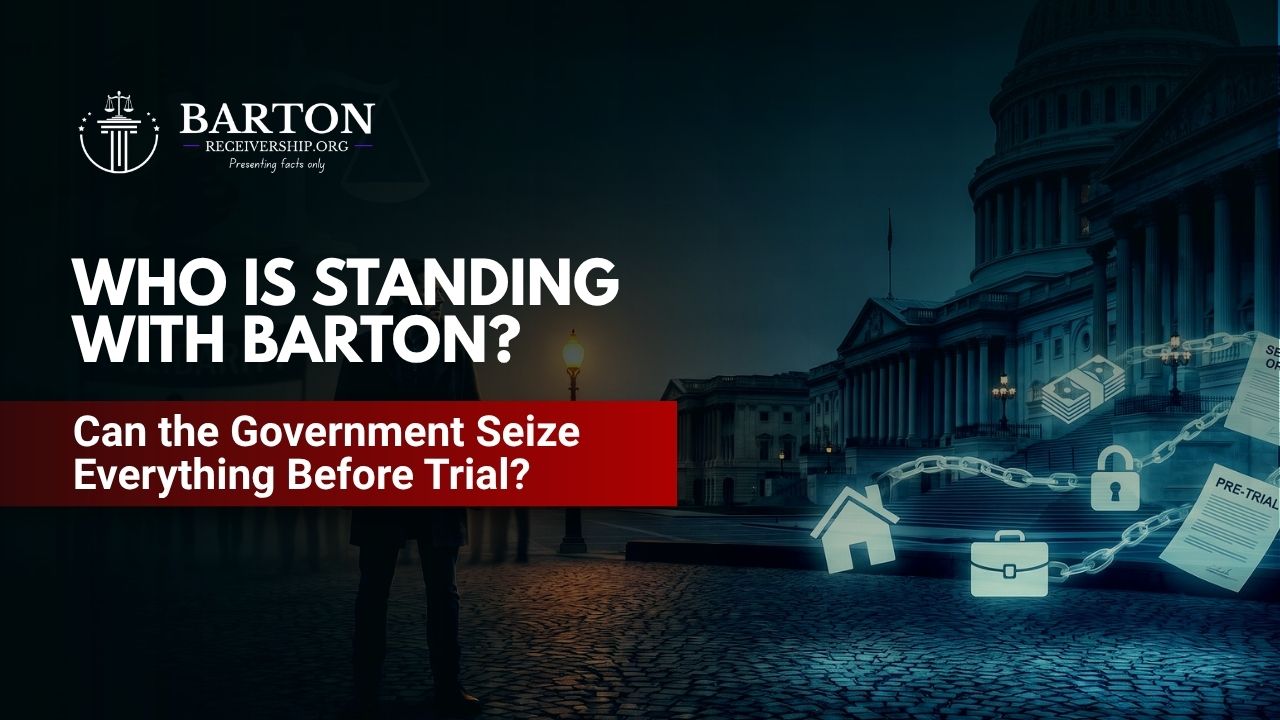
A cross-ideological coalition urges the Supreme Court to act
Barton v. SEC has drawn attention far beyond the parties directly involved in the case. What might appear at first to be a dispute between one defendant and a federal enforcement agency has instead become a broader constitutional and civil-liberties question. A wide-ranging coalition of political organizations, civil-liberties advocates, financial-privacy groups, policy organizations, state officials, and elected representatives has urged the Supreme Court to take up the case.
A petition has been filed in the Supreme Court asking the Court to review the issues raised in Barton v. SEC. Click here to view
Supporters of the petition argue that the case raises serious structural questions about how far federal enforcement agencies may go when seeking control over private property before a final judgment has been entered. At the center of the concern is whether government enforcement power can be used in a way that effectively controls, freezes, or manages private property based on allegations, before the accused has received a full trial.
Nine state Libertarian Parties, joined by We The People Party of Pennsylvania, filed an amicus brief, framing the SEC’s actions as analogous to civil asset forfeiture.
They argue that property seizures based solely on allegations invert the presumption of innocence and force individuals into years of costly litigation simply to regain control of what they already own.
The Libertarian Party of Oregon and other advocacy groups have emphasized that such practices undermine the presumption of innocence and bypass the right to a jury trial by resolving core property rights in civil proceedings.
The New Civil Liberties Alliance has taken a prominent role in challenging the legality of SEC receiverships. NCLA argues that federal courts lack clear statutory authority to appoint receivers to run private companies.
According to NCLA, receivers exercise executive power without the constitutional safeguards required by the Appointments Clause, raising serious concerns about accountability.
Financial-privacy advocates, including organizations associated with the Bitcoin community, have also expressed concern, as shown by the Bitcoin Foundation’s amicus brief in Barton v. SEC. They warn that enforcement regimes funded by seized assets can distort incentives and weaken democratic oversight by blurring the line between regulation and punishment.
Members of Congress and state officials have also weighed in urging the Court to clarify that equitable relief does not grant unlimited authority to seize and manage private enterprises. Among those filing amicus briefs is Texas Attorney General Ken Paxton. Click here to view
What has drawn such a wide and unlikely coalition to Barton v. SEC is not personal loyalty to one defendant. Rather, it is a shared concern about a system that may decide major property and business outcomes before a trial ever begins. Libertarians, civil-liberties advocates, financial-privacy groups, state officials, and elected representatives do not always agree on policy questions. Yet in this case, they are united by concern that federal enforcement power may be expanding faster than the safeguards designed to control it.
As the Supreme Court weighs whether to hear the case, the importance of the issue extends beyond the courtroom. Millions of Americans may never read a court brief, but they can still understand the basic concern. If property can be controlled, managed, or effectively taken before trial, then the rules applied in cases like this do not remain limited to one defendant or one enforcement action. They quietly shape what protection any citizen, business owner, or property holder can expect when the government comes knocking.
As public attention around Barton v. SEC continues to grow, Mr. Barton has also spoken publicly about the case and the broader issues it raises. Mr. Barton, in an interview with Ed Henry on Newsmax, discussed the impact of the SEC receivership, the fight for property rights, and why the case has drawn concern from such a broad coalition. His appearance adds another public-facing dimension to the debate, helping explain why this case matters not only to the parties involved, but also to Americans concerned about due process, government accountability, and constitutional limits on enforcement power.
Mr. Barton Speaks with Ed Henry on Newsmax