

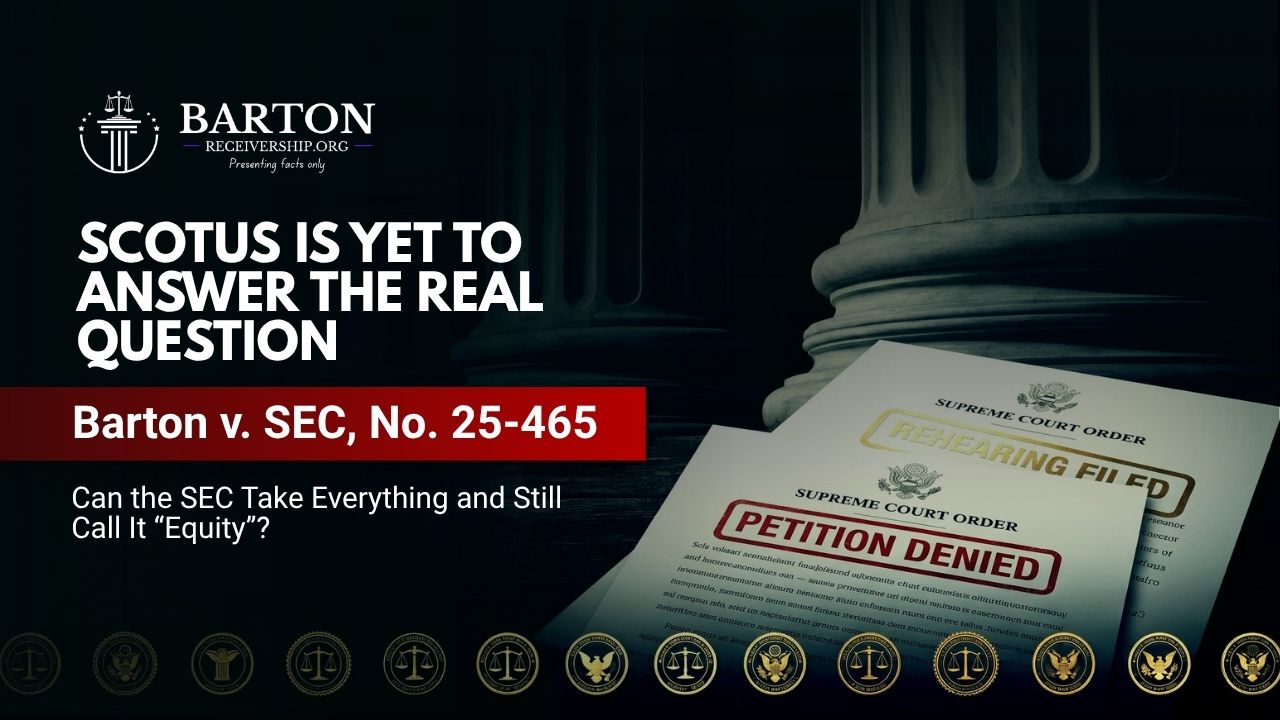
On March 30, 2026, the Supreme Court passed on Barton v. SEC on a day when it called up only one cert petition for full review. But the Court still did not answer the question at the center of the case: whether the SEC can use a general grant of “equitable relief” to support a receivership so sweeping that it takes every business allegedly touched by proceeds and leaves a defendant unable to fund his own defense in a parallel criminal case.
Start here: the core documents
- The March 30 Supreme Court order list
- Barton’s cert petition
- The SEC’s opposition brief
- Barton’s reply brief
- Barton’s petition for rehearing
- The full Supreme Court docket
On March 30, 2026, the Supreme Court’s order list moved through a stack of cert petitions and called up exactly one case for full review. Barton v. SEC was not that case. Out of 69 cert matters disposed of that day, the Court granted one, denied 67, and dismissed one. That headline matters. But it is not the whole story, and it is not the story readers should walk away with.
Most people do not spend their mornings reading Supreme Court dockets, so it is worth slowing down here. A petition for certiorari is not the final round of a case. It is a request asking the Court to take the case. Four votes are needed to grant review. When the Court denies cert, it usually says only one thing: not this case, not now. It does not mean the Court has endorsed every ruling below, blessed every government theory, or answered every constitutional problem raised by the petition.
And that distinction is the entire point in Barton v. SEC.
The question presented
The cert petition, filed October 14, 2025 by Michael J. Edney of Hunton Andrews Kurth LLP, framed the issue with surgical precision:
“Whether 15 U.S.C. § 78u(d)(5) and its authorization for the Securities and Exchange Commission to seek “equitable relief” allow the SEC and a district court to use that general equitable authority to order a receivership — seizing every company owned by a defendant that benefitted to the slightest degree from the proceeds of his allegedly illegal acts — and thereby deprive the defendant of the resources to defend himself in a parallel criminal trial.”
The petition’s argument rested on three pillars. First, Grupo Mexicano de Desarrollo, S.A. v. Alliance Bond Fund, Inc., 527 U.S. 308 (1999) — the Court has repeatedly held that federal equity is bounded by the traditional powers of the English Court of Chancery as they existed in 1789, and that lower courts may not “invent” new equitable remedies by judicial fiat. Second, Luis v. United States, 578 U.S. 5 (2016) — the Court struck down pretrial seizures of untainted assets that left a criminal defendant unable to retain counsel of choice, holding that even when Congress commands a forfeiture, the Sixth Amendment imposes a limit. Third, Starbucks Corp. v. McKinney, 602 U.S. 339 (2024) — the Court’s most recent restatement of the principle that statutory grants of “equitable relief” do not authorize lower courts to dispense with the traditional four-factor test for extraordinary remedies.
Barton’s argument was not that the SEC categorically lacks authority to seek receiverships. It was narrower and harder to dismiss: that this receivership, of this scope, with this effect on a parallel criminal defense, exceeded the boundary of what § 78u(d)(5)’s general “equitable relief” language could be read to authorize without a clearer statement from Congress. As Justice Gorsuch observed in his SEC v. Jarkesy concurrence, 603 U.S. 109, 144 (2024), the SEC’s expanding use of equitable mechanisms to circumvent constitutional limits has been a matter of growing judicial concern — and the petition pressed exactly this concern into a vehicle the Court could grant.
The question Barton put before the Court was not technical, small, or academic. It was direct: can the SEC, under a general grant of “equitable relief,” support a receivership so sweeping that it takes every business allegedly touched by proceeds and leaves a defendant unable to fund his own defense in a parallel criminal case?
That is the question the Court did not answer on March 30.
To understand why the case drew attention, readers need the background. In 2022, Barton was hit with parallel civil and criminal proceedings. On Barton’s side of the story, the civil case quickly became the mechanism for something much larger than ordinary asset preservation: the SEC sought a receiver over Barton-linked companies and assets, and the practical result was that Barton says he was left without the resources needed to defend himself in the parallel criminal prosecution. That is the pressure point that turned this case into more than a dispute about one enforcement action.
What the SEC did first — and why it mattered
Here is the part of the procedural history that most observers missed.
On November 13, 2025 — exactly thirty days after the petition was filed — the Securities and Exchange Commission waived its right to respond. The government formally told the Court it would not file a brief in opposition. In Supreme Court practice, this is normal in a great many cases — most cert petitions never warrant a response, and the Solicitor General’s office routinely waives.
But four days later, the dam broke.
On November 17, 2025, nine amicus curiae briefs were filed in support of Barton’s petition. And on November 25, 2025, eight days after that, the Court did something it does in only a small fraction of cases: it requested a response from the government. When a Court that had been told the government did not need to respond itself asks the government to respond, it signals interest. The signal was loud enough that the SEC then sought two extensions of time — first from December 26, 2025 to January 26, 2026, and then a second extension to February 25, 2026 — before finally filing its Brief in Opposition, signed by Solicitor General D. John Sauer, on the very last day of the second extension.
The petition was distributed for the Court’s December 5, 2025 conference. After the response was received, it was redistributed for the March 27, 2026 conference. Three days after that conference, on March 30, 2026, the Court denied review.
This is not the ordinary trajectory of a routine cert denial. It is the trajectory of a petition that received serious internal consideration and was, in the end, not answered on the merits.
The amicus coalition: twelve filings, across the spectrum
The breadth of the amicus coalition that joined Barton’s petition was not partisan and not narrow. It crossed left, right, libertarian, civil liberties, technology, religious-liberty-adjacent, and sovereign-state lines. Twelve briefs were filed in total — nine on November 17, 2025, one in late December, and two more after the SEC’s opposition.
November 17, 2025 — the nine
1. The New Civil Liberties Alliance (NCLA), the nonpartisan civil-rights group founded by Columbia Law professor Philip Hamburger to challenge the administrative state, filed its amicus brief through senior litigation counsel Russ Ryan. The brief made the structural argument with the most weight: that court-appointed receivers, given the powers Congress has not enumerated, have effectively become “officers of the United States” under the Appointments Clause without ever having been authorized by statute. The brief contended that the SEC has used receiverships to construct what it called an unconstitutional “shadow process” — a system in which receivers exercise both judicial and executive power without supervision by anyone in the Executive Branch the Constitution actually charges with that supervision. NCLA’s full case page is here.
2. The Bitcoin Foundation filed its brief through counsel Paul A. Rossi. The Foundation’s argument was that unbounded equitable receivership powers create a chilling effect across the digital-asset economy — that if the government can later invoke “equity” to seize assets retroactively without proving violation, “the entire architecture of decentralized trust collapses.” The brief leaned heavily on Loper Bright Enterprises v. Raimondo, 603 U.S. 369 (2024) and the Jarkesy concurrence, framing receivership overreach as a structural threat to predictability in emerging-technology markets.
3. The Open-Source AI Foundation (O-SAIF) filed an amicus brief raising parallel concerns from the artificial-intelligence sector — that broad receivership powers create paralyzing uncertainty for technology entrepreneurs and that emerging industries need predictable, constitutionally grounded enforcement, not expansive equitable remedies that can destroy companies before any determination of wrongdoing.
4. Ten Libertarian state parties — the Libertarian Parties of Idaho, Kentucky, Maine, Maryland, Mississippi, Nebraska, Oregon, Pennsylvania, and Tennessee, plus the We the People Party of Pennsylvania — filed a joint amicus brief framing the issue as part of a broader pattern of civil asset forfeiture abuse. Their argument invoked the Fourth, Fifth, Eighth, and Fourteenth Amendments and the Court’s Youngstown Sheet & Tube Co. v. Sawyer principle that even well-intentioned executive improvisation must be curbed when it exceeds lawful channels.
5. Texas Attorney General Ken Paxton filed an amicus brief, through William R. Peterson of the Office of the Texas Attorney General, focused squarely on Sixth Amendment right-to-counsel concerns. The brief emphasized that the receivership had seized all of Mr. Barton’s assets, leaving him unable to pay lawyers in his parallel DOJ criminal prosecution and forcing him to rely on his children for shelter. Texas’s brief framed the asset-tracing question — whether an entire company becomes “tainted” simply because it received some benefit from allegedly illegal proceeds — as a constitutional question the Court has never squarely addressed.
6. Four members of Congress — Representatives Nancy Mace, Randy Weber, Jeff Van Drew, and Lance Gooden — filed a joint amicus brief expressing legislative-branch concern that SEC enforcement was operating outside the statutory bounds Congress had set. The brief argued that when an agency invokes general equitable language to seize assets in ways Congress never authorized, it undermines the constitutional structure that vests lawmaking power exclusively in the legislative branch.
7. Project Veritas filed an amicus brief drawing the historical parallel to England’s Court of Star Chamber — abolished by the Star Chamber Act of 1640 — which prosecuted dissenters under the guise of “good governance.” The brief argued that unchecked equitable powers invite political retaliation and that public oversight depends on the separation of powers the Court protected in Grupo Mexicano.
8. The Rio Grande Foundation filed a brief anchored in property rights and economic liberty, arguing that the broad receivership power threatens the constitutional foundation of private ownership and that seizure of property without clear statutory authorization undermines the economic liberty essential to a free society.
9. Young Americans for Liberty, Savannah Chrisley, and the Private Property Rights Institute filed a joint amicus brief framing the case in generational terms — that the Take Care Clause preserves liberty through accountability, that the nondelegation doctrine protects self-government, and that no property should be taken without clear statutory authorization. Ms. Chrisley’s involvement, drawing from her family’s own experience with federal prosecution, lent a public dimension to a brief otherwise grounded in constitutional first principles.
December 29, 2025 — the senator
10. United States Senator Cynthia Lummis of Wyoming filed her amicus brief on December 29, 2025, through counsel Christopher E. Mills of Spero Law LLC. Senator Lummis’s filing brought the institutional voice of the United States Senate — and its Banking Committee oversight of the SEC — into the case at the cert stage. Her brief addressed the constitutional limits on the SEC’s expansion of equitable remedies and the chilling effect on lawful financial activity created by an agency that can seize first and prove later.
February 27, 2026 — the final two
After the Solicitor General’s opposition was filed on February 25, 2026, two additional amicus briefs landed within forty-eight hours:
11. The Libertarian Party of New York and additional state affiliates filed a supplemental amicus brief responding directly to the government’s opposition arguments.
12. United States Representatives Anna Paulina Luna and Lauren Boebert filed a separate joint amicus brief, bringing the total congressional voice on the petition to six elected federal lawmakers — a notable cross-section, particularly given the Court’s recent attention to legislative-branch concerns about agency overreach.
The Solicitor General’s opposition
On February 25, 2026, after two extensions of time, Solicitor General D. John Sauer filed the Brief for the Respondent in Opposition, signed jointly with the SEC’s General Counsel, Deputy General Counsel, Solicitor, Assistant General Counsel, and Appellate Counsel.
The government’s argument was procedural before it was substantive. The Solicitor General argued that Mr. Barton had not preserved the specific statutory and Sixth Amendment claims he was now pressing — that his Fifth Circuit briefing had not cited 15 U.S.C. § 78u(d)(5) by section number, and had not invoked Luis v. United States or the Sixth Amendment by name.
On the merits, the government argued there was no circuit split warranting review, and that Caplin & Drysdale, Chartered v. United States, 491 U.S. 617 (1989) and United States v. Monsanto, 491 U.S. 600 (1989), established that asset seizures preceding judgment do not categorically violate the Sixth Amendment. The government also pointed to longstanding statutory recognition of receivership as an equitable mechanism — citing 28 U.S.C. §§ 754 and 959 and Federal Rule of Civil Procedure 66 — and argued that Deckert v. Independence Shares Corp., 311 U.S. 282, 288 (1940), supplied the equitable foundation the petition disputed.
In effect, the government’s brief told the Court two things: that Barton had forfeited his strongest arguments by not labeling them with the right citations, and that even on the merits, settled precedent foreclosed review.
The reply: Jonathan Mitchell joins the case
On March 19, 2026, Mr. Barton’s counsel filed the Reply Brief. The most significant fact about it was on the cover page: alongside Michael J. Edney of Hunton Andrews Kurth, the brief listed Jonathan F. Mitchell of Mitchell Law PLLC in Austin, Texas. Mitchell, a former Solicitor General of Texas and one of the most successful conservative appellate lawyers of the past decade, joined the case at the reply stage.
The Reply Brief did three things in twelve pages. First, it dismantled the forfeiture argument by walking the Court through the actual text of Barton’s Fifth Circuit briefing — citing chapter and verse the passages where Barton had argued that “a pre-judgment receivership is not a remedy in personam … Instead, a receivership is a remedy in rem, against property”; that the district court’s rule allowing seizure of an entire company that “benefitted in the slightest” from lender funds was “a recipe for the Government avoiding any adversarial testing of its allegations of wrongdoing”; and that the district court should have “set aside a portion of assets for Mr. Barton to pay his defense costs.” As the Reply Brief observed, citing Yee v. Escondido, 503 U.S. 519, 534 (1992), “Once a federal claim is properly presented, a party can make any argument in support of that claim; parties are not limited to the precise arguments they made below.”
Second, the Reply distinguished Caplin & Drysdale and Monsanto. Both of those cases involved seizures specifically authorized by congressional legislation that allowed the seizure only of property “constituting” or “derived from” the proceeds of a drug offense. The statutes in those cases did not permit the seizure of property that merely received a benefit from the proceeds of allegedly illegal activity. Luis — decided after Caplin and Monsanto — established that the Sixth Amendment can constrain even congressionally authorized asset seizures.
Third, the Reply addressed the government’s most cynical suggestion — that Mr. Barton should simply “ask” the district court to release money from the receivership for his criminal defense. Mr. Barton had asked. The district court had ignored the request entirely, refusing even to discuss it when imposing the receivership.
The respondent’s suggestion is simply a delay tactic to maximize the government’s leverage in the civil and criminal proceedings and force Mr. Barton to settle or plead while he remains unable to fund his defense.
Eleven days later, the Court denied certiorari without any comment on merit.
What happened on March 30?
The Court issued a one-line disposition: “the petition was denied”. No explanation. No merits discussion. No opinion telling the country that the SEC’s theory was right. No opinion saying a receiver can swallow every company touched “to the slightest degree” by disputed proceeds and still fit comfortably inside traditional equity. Just a pass.
That is why calling March 30 a substantive defeat misses the real point. If you read the SEC’s opposition brief, the government spent much of its energy on threshold arguments—preservation, vehicle problems, and the claim that the case did not present the kind of split the Court usually wants before stepping in. The Court’s order did not say which arguments mattered, and nobody outside the conference room can know exactly why fewer than four Justices voted to hear the case. But the public record makes one thing plain: the Court did not answer the underlying constitutional question.
That matters because Barton’s core question is not going away. If the SEC can invoke a general grant of equitable relief to back a receivership this broad, then the federal government has found a devastating kind of leverage. It can freeze, control, and liquidate first, while a criminal case runs on a separate track, and then tell the defendant to fight with whatever is left—if anything is left. Barton’s side says that is not equity. It is pre-judgment economic disarmament.
What Comes Next?
Barton’s team did not stop on March 30. Barton’s team filed a petition for rehearing on April 24, 2026, under Supreme Court Rule 44.2, which was later distributed for the May 21, 2026 conference. That matters because rehearing is not about pretending the March 30 order never happened. It is about putting the unanswered question back on the Court’s desk and forcing one more look at whether this case is really the kind of dispute the Court should keep ducking.
For readers who are new to Supreme Court practice, rehearing petitions are rare and even more rarely granted. Nobody should confuse a rehearing petition with a guaranteed second chance. But that is not the point. The point is that the legal issue is still alive, the filing is now part of the case record, and the Court has another formal chance to confront what it declined to confront on March 30.
And the bigger story here is not just about procedure in Washington. It is about what kind of power federal courts and federal agencies can exercise in the name of “equity.” Barton’s side has argued from the start that there must be a constitutional stopping point—especially when a sweeping civil receivership leaves a defendant trying to defend a criminal case without control of the businesses and money that would ordinarily fund that defense. The criminal trial is scheduled for November 2026. The receiver continues to bill. The family lawsuits continue to grind through stayed dockets. Tim Barton, the man who reported a suspected CCP money-laundering operation to the Department of Homeland Security in 2019, remains the defendant — while Michael Fu, the man who pled guilty in October 2022, has been convicted and is awaiting sentencing. Whether one agrees with Barton on every fact or not, that question is not frivolous, not technical, and not resolved.
So yes, March 30 was a setback. But it was a cert-stage setback, not a merits answer. On a day when the Supreme Court called up only one cert petition, the Justices did not take Barton’s. That is a procedural fact. It is not a national answer to whether the SEC can stretch a general equitable statute into a receivership so broad that it swallows everything and leaves a defendant unable to finance his own defense.
Until the Court actually answers that question, this story is not over. The fight is still alive. The rehearing petition is still part of the case. And the most important part in this entire dispute remains the same: SCOTUS yet has to answer the Ordinary American Concern about what kind of power federal courts and federal agencies can exercise in the name of “equity”.
Frequently Asked Questions
Q: What happened in Barton v. SEC on March 30, 2026?
A: The Supreme Court denied Timothy Barton’s petition for certiorari. The denial did not include an explanation or merits ruling.
Q: Did the Supreme Court answer the main question in Barton v. SEC?
A: No. The article argues that the Court did not answer whether the SEC can use general “equitable relief” authority to support a receivership that takes assets needed for a parallel criminal defense.
Q: What was the core issue in Barton’s cert petition?
A: The core issue was whether 15 U.S.C. § 78u(d)(5) allows the SEC and a district court to use “equitable relief” to impose a sweeping receivership over companies allegedly touched by proceeds.
Q: Has Barton filed a petition for rehearing?
A: Yes. Barton’s team filed a petition for rehearing on April 24, 2026, and the article states it was later distributed for the May 21, 2026 conference.
Q: Why does the Barton v. SEC case matter?
A: The case raises broader questions about SEC enforcement power, federal receiverships, due process, property rights, and whether a defendant can be left without resources to fund a criminal defense.
Further reading
- Barton v. SEC: How a Dallas Developer Lost Everything
- Federal Court Receiverships
- What Is a Court-Appointed Receiver?
- SCOTUS Appeal Filed — Barton v. SEC
- Can the Government Seize Everything Without Due Process?
- The Due Process Problem with Pre-Judgment Receiverships