

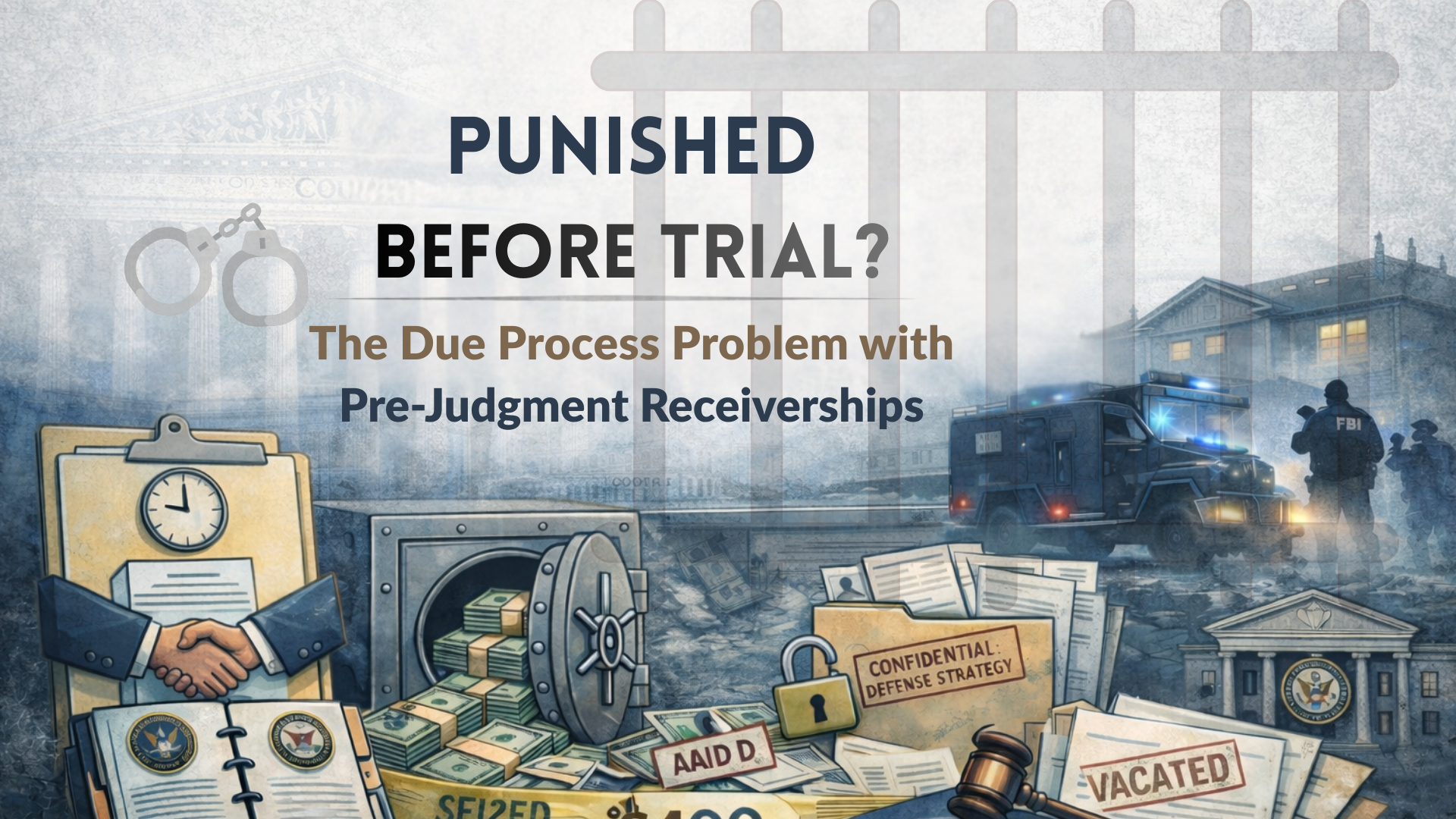
What does “due process” mean if someone can lose control of their assets before any jury trial?
That question sits at the center of a recent interview with Timothy Barton and Evan Turk, CEO of the American Rights Alliance. The host introduces Barton’s situation as part of a broader enforcement “playbook,” arguing that what happened in prior cases “is not an outlier.”
Barton’s headline claim is simple and explosive: he says he has never had a jury trial and has no fraud verdict, yet alleges the government used a pre-judgment receivership to take control of roughly $400 million in assets—effectively stripping “possession and control” before final judgment.
“Take everything first”: how a pre-judgment receivership becomes the battlefield
In the interview, Barton describes pre-judgment receivership as the moment the fight changes. It’s no longer just a legal dispute on paper—it becomes a real-world takeover. Once a receiver is installed, Barton claims he no longer controls the assets and can’t meaningfully steer outcomes the way an ordinary defendant would.
Turk frames this as a constitutional problem. He argues that basic protections tied to property and fair process are supposed to prevent forfeiture-like outcomes without a fair trial. His point isn’t that enforcement should stop—it’s that procedure is the guardrail. Remove it, and “accountability” starts to look like raw power.
The leverage engine: “180 years” and why most people don’t go to trial
Barton says he faced threats of up to 180 years in federal prison. He describes that as the kind of leverage designed to break defendants psychologically and financially.
In the interview, Barton argues that this is why the government can claim overwhelming success rates: most people plead rather than risk catastrophic sentencing exposure. Turk adds that the metrics he reviewed show 93–94% “found guilty” largely because of plea deals, and he also references an 83–85% range—presenting the point that the overwhelming majority of cases never test the government’s allegations in a full trial setting.
The interview uses a vivid analogy: you wouldn’t jump out of a plane with survival odds like that—yet defendants are often expected to gamble their entire lives on trial while the system holds extreme leverage.
Even if a reader takes those numbers with caution, the practical logic is familiar in modern criminal justice debate:
- Higher exposure = more plea pressure
- More plea pressure = fewer trials
- Fewer trials = fewer allegations truly tested
And when that pressure coincides with pre-judgment asset control, defendants may also lose the resources that would make a trial feasible in the first place.
Escalation pressure: more cases, superseding indictments, and a foreign-coercion claim
The interview also raises escalation tactics. Barton and the host describe a pattern of pressure where, if one case doesn’t “work,” the government can threaten additional charges or additional cases—keeping the target under constant leverage.
Barton goes further and alleges coercion involving the CCP and questions why, in his view, U.S. agencies would be supporting that dynamic. Turk treats that as a serious claim that would require close scrutiny if supported by evidence.
“Showtime”: the raid, the optics, and reputational punishment
Barton emphasizes he wasn’t charged with a violent crime, yet describes a high-impact raid that looked like a SWAT-style operation.
The interview highlights several details:
- Barton says there were two years of SEC interaction through counsel and voluntary cooperation.
- He describes a 5 a.m. raid on a Friday, framed as intimidation designed to keep someone in jail over the weekend.
- He claims agents taunted him afterward—referring to it as “showtime” and citing “blue lights” and “bullhorns.”
The host and Turk connect this to the concept of “political theater,” comparing the optics to those of other high-profile raids. Their argument is that, even without a verdict, the spectacle itself can deliver lasting damage—financial, reputational, and strategic.
The privilege flashpoint: “eight law firms” and the defense-file allegation
One of the most serious allegations in the interview involves attorney-client privilege and defense strategy.
The host states that eight law firms representing Barton were sued, and alleges the government obtained Barton’s defense-related files—materials prepared with counsel. Turk calls that scenario unconstitutional and unheard of, arguing it undermines the ability to defend oneself in any meaningful way, especially against a federal opponent with virtually unlimited resources.
“He won on appeal” — and Barton says the receivership continued anyway
The interview concludes with what may be the most frustrating theme for ordinary readers: Barton claims he won on appeal, with the Fifth Circuit vacating what he describes as an illegal order.
But Barton alleges the district court (he names Judge Starr) effectively did it again—reissuing the same practical outcome across the same set of companies. He also describes what he calls a “blessing order,” which he says retroactively validates actions taken under the earlier, vacated order.
For Barton, the takeaway is brutal: even when the appellate court said “no,” the punishment continued in practice.
Why This Matters Beyond One Person
You don’t have to accept every allegation in this interview to see why the broader debate matters.
If civil enforcement tools can:
- remove control of assets before judgment,
- apply extreme leverage through sentencing exposure,
- escalate pressure via threatened superseding charges,
- create irreversible reputational harm through raid optics, and
- undermine defense integrity through privilege-related actions,
Then the legal system risks drifting toward a model where process becomes punishment.
And if that model is normalized—if it becomes the “playbook” the host claims—it won’t stay confined to one defendant, one industry, or one political era.
It becomes precedent in practice.
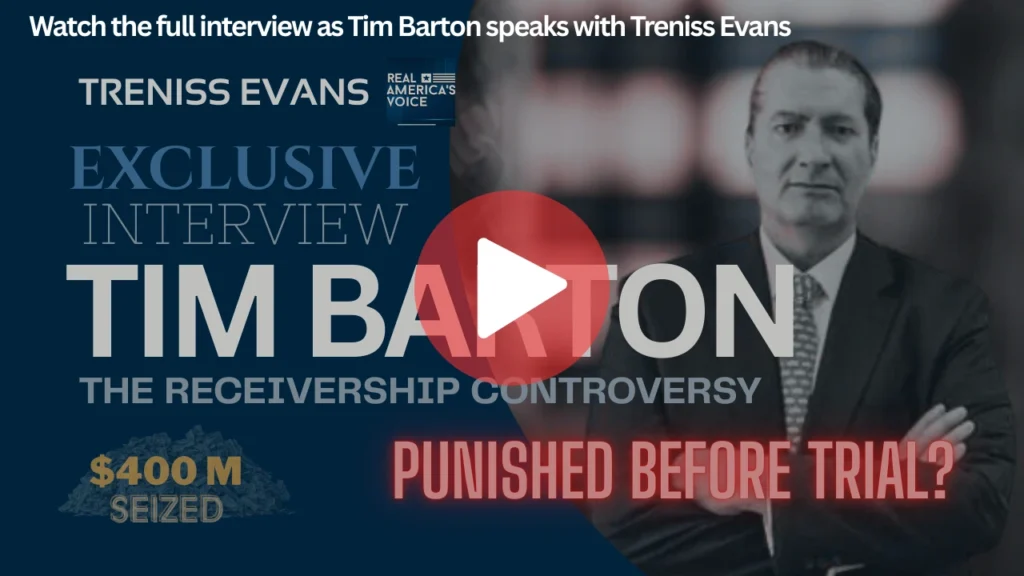
Watch the full interview as Tim Barton speaks with Treniss Evans about the controversial use of pre-judgment receiverships, due process concerns, and the events surrounding the federal investigation that reshaped his case.