

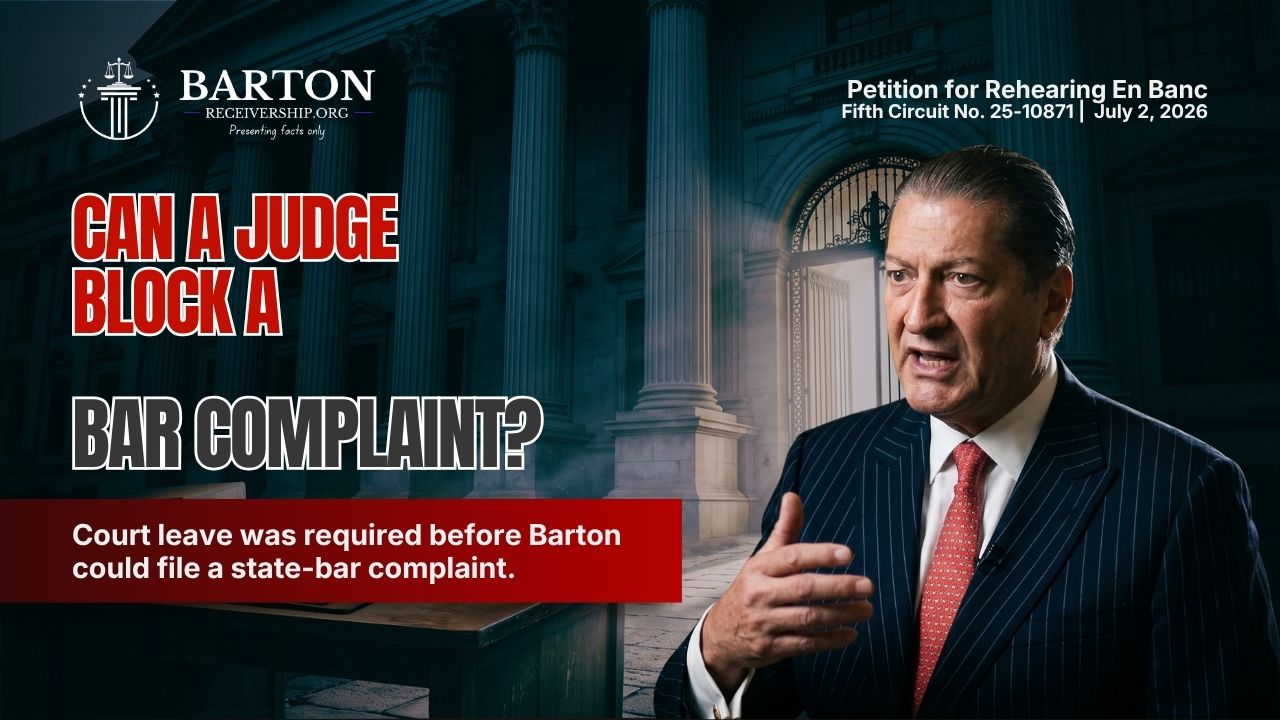
Timothy Barton’s latest Fifth Circuit filing asks a direct question: can the federal court supervising a receiver require permission before a citizen files a bar complaint against the receiver or the receiver’s lawyer?
For years, public discussion of SEC v. Barton has focused on receivership power, due process, property rights, and a defendant’s ability to meaningfully defend himself. A new filing brings one concrete issue into sharp focus: Mr. Barton was barred from filing a bar complaint unless the court first granted leave.
On July 2, 2026, Timothy L. Barton filed a Petition for Rehearing En Banc in Fifth Circuit Case No. 25-10871. He asks the full court – not just the original three-judge panel – to reconsider whether that prior-permission requirement can stand. The order at issue requires Mr. Barton to seek the federal court’s leave before filing a grievance or complaint with a state bar.
The petition argues that this is not case management. It is a prior restraint on the right to file a bar complaint and seek redress. The filing does not ask whether any particular bar complaint is valid. It asks whether a federal court may stop a complaint at the threshold before the State Bar has an opportunity to receive it.
| THE QUESTION BEFORE THE FIFTH CIRCUIT May a federal court require a litigant to obtain court permission before filing a state bar complaint? Mr. Barton’s petition says no, particularly where the complaint could concern the receiver or receiver’s counsel appointed by that court. |
Why a Bar Complaint Matters
A bar complaint is a defined legal accountability process. It asks the relevant state bar and its attorney-disciplinary system to receive and evaluate an allegation of attorney misconduct. It is not a request for receivership money or litigation relief; it is a request for a separate disciplinary authority to examine a lawyer’s conduct.
The petition asks why the federal court that appointed and supervises the receiver and receiver’s counsel should decide whether a bar complaint against them may even be filed. It argues that the court has been placed between Mr. Barton and the State Bar, despite the State Bar’s separate authority over attorney discipline. The petition’s core point is direct: a federal judge should not be the gatekeeper to a bar complaint against that judge’s own appointee.
Why There May Be No Meaningful Alternative
BartonReceivership.net frames the broader case as a multi-year dispute over receivership power, property, due process, and the practical consequences of losing access to resources needed to defend oneself. The present petition addresses a distinct but connected accountability issue: whether a person can reach the State Bar without first persuading the appointing court to let the complaint be filed.
The petition identifies a practical reason this restriction deserves close attention. It notes that receivers and receiver’s counsel can have layers of judicial protection, including possible quasi-judicial immunity and limits on suits without court leave. In that setting, the petition argues that a bar complaint may be the remaining independent avenue for asking whether a lawyer’s professional conduct should be examined.
Blocking a bar complaint before it can be filed therefore does more than delay a form. According to the petition, it can prevent an independent state disciplinary authority from ever receiving the complaint at all.
Why en banc review matters
En banc review is reserved for issues of exceptional importance or for circumstances in which full-court consideration is needed to maintain consistency in the law. Mr. Barton’s filing argues that this is such a case because it concerns the First Amendment right to petition and the relationship between federal receivership authority and state-bar discipline.
The question is straightforward: can the court supervising a lawyer also refuse to let a citizen file a bar complaint about that lawyer? The Fifth Circuit now has the opportunity to determine whether that line has been crossed.
A bar complaint is not a request for a judge to decide the merits of the complaint. It is the initiation of a State Bar process. Mr. Barton asks the Fifth Circuit to hold that this process cannot be placed behind a judicial permission slip.
Read and follow the public case record at BartonReceivership.net.