

How proxy remitters, mirror transfers, mules, shell companies, and real estate fit together.
Quick Answer
The Chinese money-laundering playbook described by federal authorities is built around a market match: one side needs U.S. dollars cleaned or moved, and another side wants U.S. dollars outside China. The facilitator sits in the middle. That facilitator may use mirror transfers, trade-based transactions, money mules, shell companies, false documentation, and real estate purchases to convert difficult money into usable value.
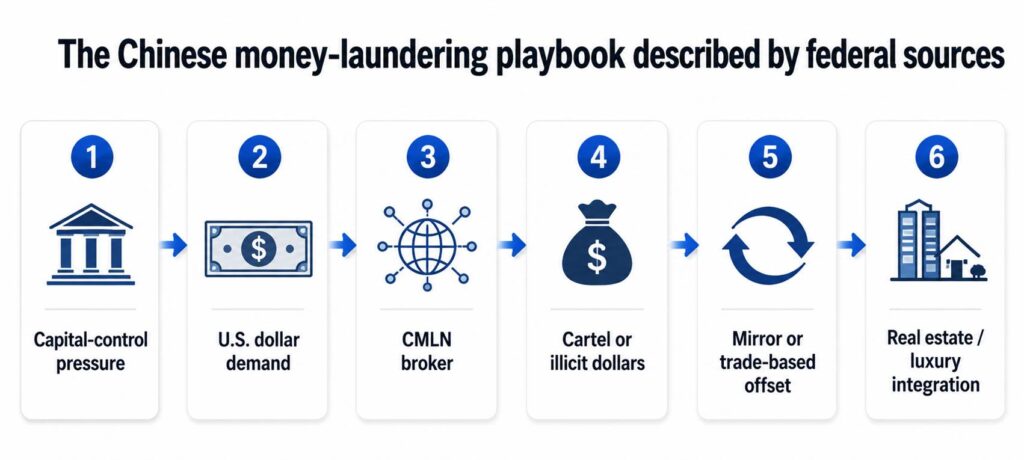
Step one: create dollar demand
The starting point is not always a criminal transaction. Some China-based customers want access to U.S. dollars because of currency controls, family relocation, education expenses, investment goals, or property purchases. That demand creates a shadow market. Criminal organizations also need to move U.S. cash, including drug proceeds, out of view. The network makes money by matching those needs.
This is why the same network can touch both ordinary-looking investment flows and criminal money. One client may want U.S. dollars abroad. Another actor may need to dispose of bulk cash. The network makes the swap possible without a clean institutional record showing the original source.
Step two: use mirror transfers
A mirror transfer is a simple concept with serious consequences. Money does not always cross the border in a straight line. A client pays local currency inside China. A separate pool of U.S. dollars is released in the United States, often by a different person or entity. To the parties, the economic exchange is complete. To investigators, the paper trail is fragmented.
Chart 1: The playbook mechanics
| Tool | How it works | Why it frustrates tracing |
| Mirror transfer | Value is exchanged through separate pools of money in different countries. | The money received in the U.S. may not be the same money paid abroad. |
| Money mule | A person opens or uses accounts for someone else. | The legal account holder may not control the funds. |
| Shell company | An entity holds money or title with limited visible operations. | The true beneficial owner may be concealed. |
| Trade-based laundering | Goods, invoices, or exports move value. | Pricing and shipment data obscure the financial transfer. |
| Real estate purchase | Funds become a deeded asset. | Property can later be sold or refinanced as legitimate wealth. |
Step three: use mules and entities
FinCEN has warned that money mules may include people whose stated occupation does not match the volume of money moving through their accounts. That does not prove guilt. It does mean the account deserves scrutiny. A student, retiree, laborer, or homemaker receiving or sending large unexplained wires is not automatically a criminal, but the mismatch between profile and transaction volume is precisely the kind of warning sign compliance teams are trained to examine.
Entities create a second layer. An LLC may be legitimate, but it can also hide who controls a purchase. A trust may be ordinary estate planning, but it can also obscure control. A nominee may be a family arrangement, but it can also be a laundering tool. In real estate, the danger is the combination: unusual source of funds, entity buyer, third-party remitter, and pressure to close without source-of-funds clarity.
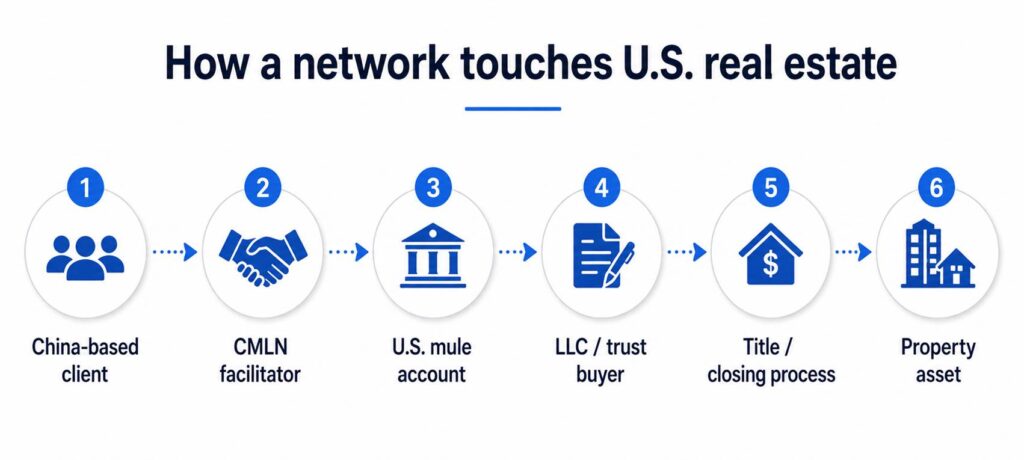
Step four: move into real estate
Real estate completes the playbook because it turns a messy transaction history into a visible asset. The deed can sit quietly for years. The property can generate rent, be pledged as collateral, be refinanced, or be sold. Each later transaction creates a new explanation for the money. That is integration.
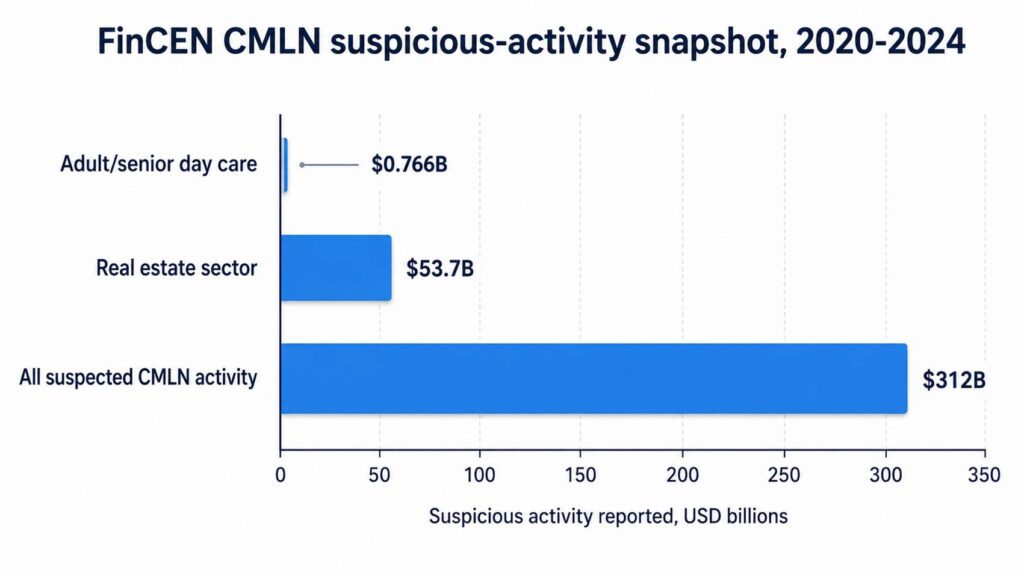
FinCEN’s 2025 analysis identified 17,389 BSA reports involving more than $53.7 billion in suspicious activity tied to the real estate sector. See FinCEN CMLN analysis.
How the Barton allegations fit the playbook
The Barton case does not become a CMLN case simply because investors were Chinese nationals. That would be an unfair and unsupported shortcut. The relevant issue is the alleged structure: Fu’s intermediary role, investor communications, claimed proxy remitters, KYC resistance, and Barton’s 2019 reports of suspected money laundering. Those are the facts that make the case worth examining through the lens of the playbook.
The Walji letter analysis argues that Fu controlled the Chinese funding apparatus and that the Commission was warned before proceeding against Barton. The timeline places Barton’s reports to DHS and FBI in 2019.
Chart 2: Barton comparison to federal CMLN red flags
| Federal red flag | Barton-related question | Why it matters |
| Money mules or proxy remitters | Were funds sent by people different from the named co-lenders? | Mismatch can obscure true source and control. |
| Shell or intermediary structure | Who controlled the co-lender relationship and transfer instructions? | Control identifies the real financial actor. |
| KYC resistance | Were tax IDs, wire records, and origin documents refused? | Refusal to comply is a major warning sign. |
| Whistleblower report | Did Barton report the concerns before enforcement? | Timing affects the public narrative and motive question. |
Conclusion
The Chinese money-laundering playbook is not a slogan. It is a set of recurring methods federal agencies have identified: mirror transfers, mules, shell buyers, trade-based value movement, and real estate integration. The Barton case deserves scrutiny because the defense says those warning signs were present before the government chose its target.
Frequently Asked Questions
What is a Chinese money-laundering network?
A Chinese money-laundering network, or CMLN, can connect people seeking U.S. dollars with actors trying to move or disguise illicit proceeds. Common methods include mirror transfers, proxy remitters, money mules, shell companies, and real estate.
What is a mirror transfer?
A mirror transfer moves value without the same funds necessarily crossing the border. A client may pay local currency in China while a separate pool of U.S. dollars is released in the United States, making the financial trail harder to follow.
Why is real estate used in money laundering?
Real estate can convert complicated financial flows into a tangible asset that can later be rented, refinanced, pledged, or sold. For more warning signs, see our guide to real estate money-laundering red flags.
Why is the Barton case compared with the CMLN framework?
The comparison is not based on investor nationality. It focuses on the alleged structure: Fu’s intermediary role, claimed proxy remitters, KYC resistance, investor communications, and Barton’s 2019 reports of suspected money laundering.
Read More
Chinese Money Laundering and U.S. Real Estate
A broader look at how Chinese money-laundering networks may intersect with U.S. property transactions.
Real Estate Money Laundering Red Flags
Key warning signs involving source of funds, third-party remitters, shell entities, and beneficial ownership.
Walji Letter Analysis
A closer look at the defense-side argument concerning Fu’s alleged control of the Chinese funding structure and what regulators were reportedly told before the SEC case.
This is the version I’d use. It gives you the SEO benefit of an FAQ section without making readers feel like they are reading the same article twice.