

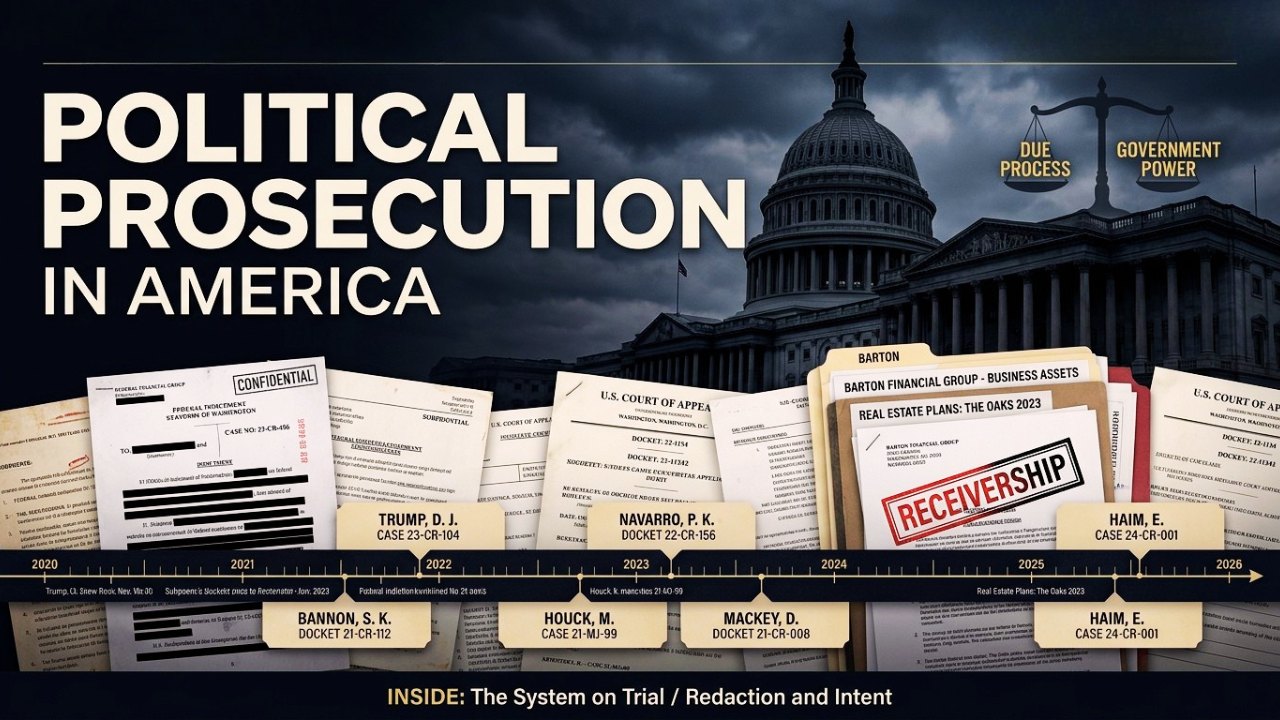
Political prosecution is one of the most serious accusations that can be made against a legal system. It does not mean a defendant is innocent. It does not mean a government can never charge powerful people. It means something narrower and more dangerous: that the machinery of law may have been used to weaken a political opponent, punish a viewpoint, or make the process itself the penalty.
That debate exploded after the disputed 2020 election, the January 6, 2021 protest and Capitol breach, and the Biden-era investigations that followed. Donald Trump, Steve Bannon, Peter Navarro, pro-life activist Mark Houck, online political figure Douglass Mackey, and whistleblower-physician Eithan Haim all became part of a national argument over whether prosecution was being used neutrally – or politically.
The Tim Barton SEC case belongs in that same conversation for a different reason. Barton was not only charged, but his business network was placed under a sweeping receivership before any conviction, and this receivership tactically impaired his ability to fight back. Barton’s case fits a broader pattern of lawfare against Trump associates and supporters.
The question is not whether every controversial case is automatically unlawful. The question is whether the pattern shows selective pressure, unusual procedure, and pre-trial punishment. That is where the political-prosecution issue begins.
What Political Prosecution Means
In plain English, political prosecution means using civil or criminal enforcement power for a political purpose rather than neutral law enforcement. In court, however, the accusation has to fit a recognized doctrine. The label “political prosecution” is not a magic phrase that ends a case.
The main legal doctrines are selective prosecution, as in United States v. Armstrong; vindictive prosecution, as in BLACKLEDGE, WARDEN, ET AL. V. PERRY, and retaliatory prosecution as in HARTMAN et al. v. MOORE. Each is difficult to prove because courts give prosecutors broad discretion. That is why public concern can be strong even when formal legal relief is hard to win.
| Doctrine | What must usually be shown | Why it is difficult |
| Selective prosecution | Discriminatory effect and discriminatory purpose; usually proof that similarly situated people were not prosecuted. | Courts defer heavily to charging decisions and require strong comparator evidence. |
| Vindictive prosecution | Government action that appears to punish a defendant for exercising a legal right. | Courts rarely presume retaliation during ordinary pretrial charging decisions. |
| Retaliatory prosecution | Evidence of retaliatory motive plus, in many First Amendment contexts, lack of probable cause. | Even hostile motive may not be enough if probable cause existed. |
Why the Modern Debate Accelerated After 2020 and 2021
The phrase “political prosecution” did not begin with Donald Trump. But the modern American debate took on new force after the 2020 election and January 6. Once the federal government began charging Trump allies, pursuing contempt-of-Congress cases, and later indicting Trump himself while he was again the leading opposition-party figure, the legal system moved directly into the center of electoral politics.
That does not prove unlawful motive. It does explain why timing matters. The public saw criminal cases, congressional investigations, campaign calendars, and media narratives converging. In that environment, even legitimate prosecutions require more transparency, not less.
Biden-Era Cases Critics Describe as Political Prosecution
The following table does not claim that every case below was legally defective. It identifies high-profile matters from the Biden years that critics described as political prosecution or lawfare, then separates the public accusation from the legal status.
| Case | Action | Status | Why critics call it political |
| Donald J. Trump – 2020 election case | Federal indictment filed August 2023 over alleged efforts to overturn the 2020 election. | Dismissed without prejudice after Trump won the 2024 election, under DOJ policy against prosecuting a sitting president. | Critics argued the leading opposition candidate was indicted over election-related political conduct during another campaign cycle. |
| Donald J. Trump – classified documents case | Federal indictment filed June 2023 over classified documents and obstruction allegations. | Dismissed by the district court in 2024 on Appointments Clause grounds; critics also compared it to the Biden classified-documents inquiry. | Critics argued the charging theory and differential treatment concerns made it appear politically selective. |
| Steve Bannon | Contempt of Congress case for refusing a January 6 Committee subpoena. | Convicted, served sentence; later proceedings continued to be reported in 2026. | Critics argued a Trump ally was selectively punished in a highly political congressional investigation. |
| Peter Navarro | Contempt of Congress case for refusing a January 6 Committee subpoena. | Convicted and sentenced to four months. | Critics pointed to executive-privilege arguments and different treatment of other subpoena disputes. |
| Mark Houck | FACE Act prosecution after an alleged clinic-escort altercation. | Acquitted by a jury in 2023. | Critics argued DOJ federalized a local dispute and used a dramatic enforcement posture against a pro-life activist. |
| Douglass Mackey | Conspiracy-against-rights case over “vote by text” memes during the 2016 election. | Convicted in 2023; conviction later vacated by the Second Circuit in 2025. | Critics argued the government criminalized ugly political speech years after the election using an unusual theory. |
| Eithan Haim | Case over alleged wrongful disclosure of protected patient information. | DOJ page later noted dismissal with prejudice in January 2025. | Critics argued the case targeted a whistleblower in a politically charged medical-policy fight. |
| Tim Barton | SEC civil action plus parallel criminal case and broad receivership. | Receivership remained a central dispute; BartonReceivership.net says the core Supreme Court equity question remains unanswered. | Critics argue the civil receivership became a pretrial incapacitation tool against a Trump supporter and businessman. |
Why Barton v. SEC Fits the Political-Prosecution Pattern
Barton’s case is not identical to the Trump, Bannon, or Navarro cases. The strongest political-prosecution argument in Barton v. SEC is not only partisan identity. It is structure. Barton’s Case shows that the government paired criminal exposure with civil enforcement and then used a receivership to take control of assets, records, companies, and revenue streams before a merits decision.
The complete Barton timeline says the key events moved fast: a criminal indictment in September 2022, the SEC complaint days later, and a receiver appointment that quickly changed control of the business network. The pre-judgment receivership due process Strategy in Barton v. SEC explains why that matters: when a receiver controls the estate, the defendant loses practical control over the very resources needed to defend himself.
Barton also argues that the case raised an unresolved constitutional question: can the SEC, under a broad theory of equitable relief, support a receivership so sweeping that it reaches companies and assets before trial and allegedly leaves a defendant unable to fund his chosen defense? This Question is briefly framed here: SCOTUS has still not answered the real question.
That is why Barton case is important to understand the Political prosecution. The allegation is not simply “the government charged a Trump supporter.” The allegation is more concrete: a politically sensitive defendant was economically and procedurally weakened before guilt was decided.
| Lawfare indicator | Barton-specific basis | Editorial takeaway |
| Political association | Barton’s public defense narrative connects him to President Trump and the Trump supporter lawfare debate. | Political identity alone does not prove illegality, but it explains why the case draws political-prosecution scrutiny. |
| Same-week escalation | The criminal case, SEC civil action, and receiver request moved in rapid sequence in September 2022. | Speed and coordination can become evidence of pressure, especially where civil tools affect criminal defense capacity. |
| Receivership before conviction | Barton-side materials say the receiver took control of a broad business network before trial, order in written to Punish the defendant by the District Judge. | This is the core “process as punishment” concern. |
| Defense impairment | Barton argues that asset control affected his ability to fund counsel and contest the case. | A right to defend yourself means less if the government controls the money needed to defend yourself. |
| Overbreadth concern | BartonReceivership.net argues the receivership reached entities and property beyond the actual alleged proceeds. | If the remedy outruns the proof, the receivership begins to look punitive rather than preservative. |
The Standard Should Be Narrowness, Proof, and Defense Access
Government enforcement is necessary. Fraud should be investigated. Victims should be protected. Assets should not be dissipated. But a constitutional system cannot survive on the idea that allegations justify everything.
The Supreme Court’s decision in SEC v. Jarkesy reinforced a basic principle: when the government seeks punitive legal relief, constitutional process matters. Jarkesy does not decide Barton’s receivership issue by itself. But it belongs in the same constitutional atmosphere: agencies cannot use procedure to bypass rights.
The test for political prosecution should not be whether the target is famous. It should be whether the process is narrow, transparent, and contestable. If the government wants to freeze assets, it should trace assets. If it wants a receiver, it should preserve rather than destroy. If it wants punishment, it should prove guilt first.
That is the Barton warning. Political prosecution is not only about who gets charged. It is also about whether the government can use the legal process to make a defendant too damaged to fight back.
Frequently Asked Questions
What is political prosecution?
Political prosecution is the alleged use of criminal or civil enforcement power to target someone because of politics, viewpoint, protected activity, or public opposition rather than neutral law enforcement.
Is political prosecution illegal?
The phrase itself is not a standalone crime or claim. It becomes legally actionable only if the facts satisfy doctrines such as selective, vindictive, or retaliatory prosecution, due process violations, or other constitutional rules.
Were Trump and his allies politically prosecuted during the Biden administration?
Critics say yes, especially regarding the federal indictments against Trump and the January 6-related contempt cases. Courts did not uniformly accept those arguments, so a careful article should describe the claim as an allegation and examine the evidence.
Why is Barton v. SEC included in this discussion?
Because Barton’s supporters argue that his case combined political targeting with a sweeping pretrial receivership that disabled his businesses and impaired his defense before any criminal conviction.