

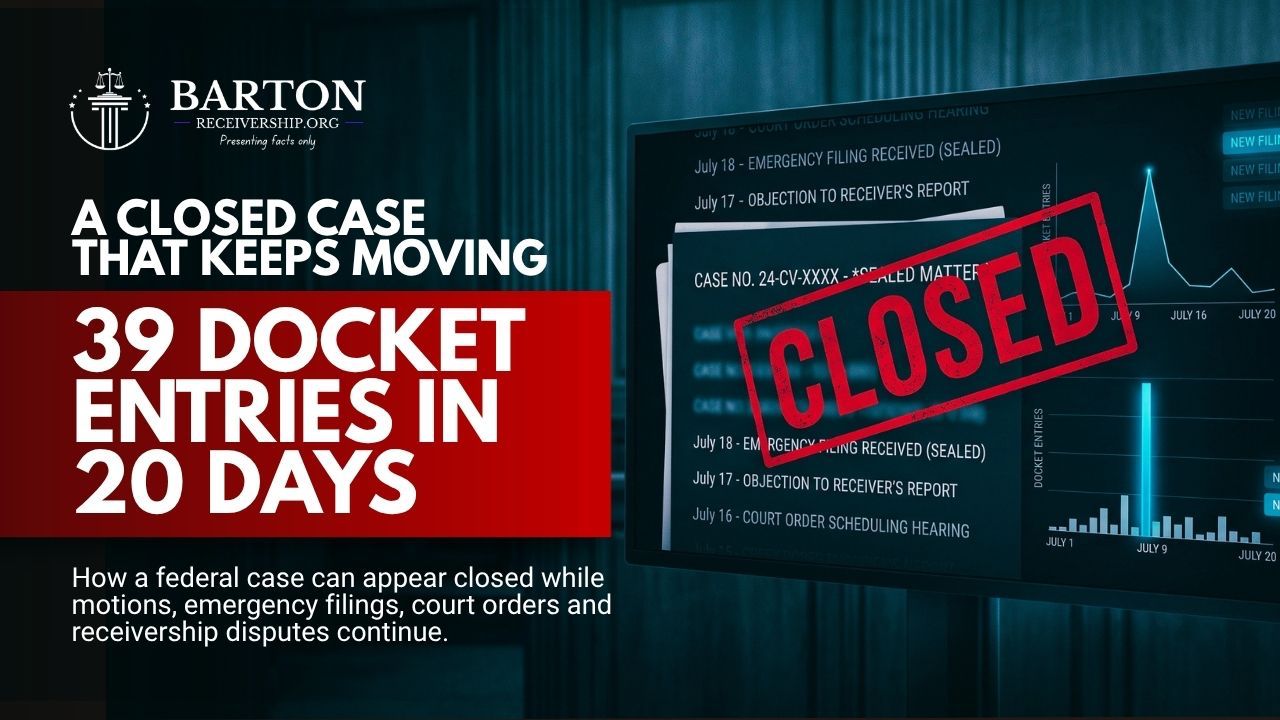
How a July 9 order sharpened the public question in SEC v. Barton: if the case remains actively managed, why should the public face still read closed?
The closed label and the active record
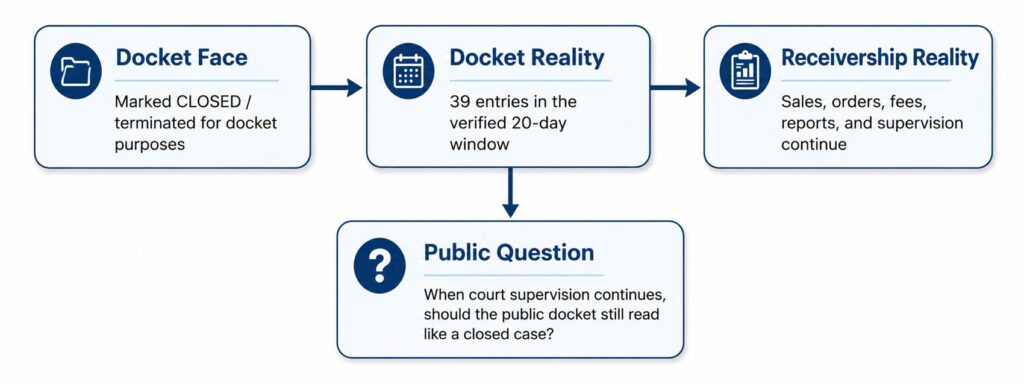
The public face of SEC v. Barton now presents a contradiction that is hard to ignore. The docket header says the civil case is closed for administrative purposes. The recent record says something else: motions, emergency requests, objections, receiver-related disputes, and court orders continue to move through the case in real time.
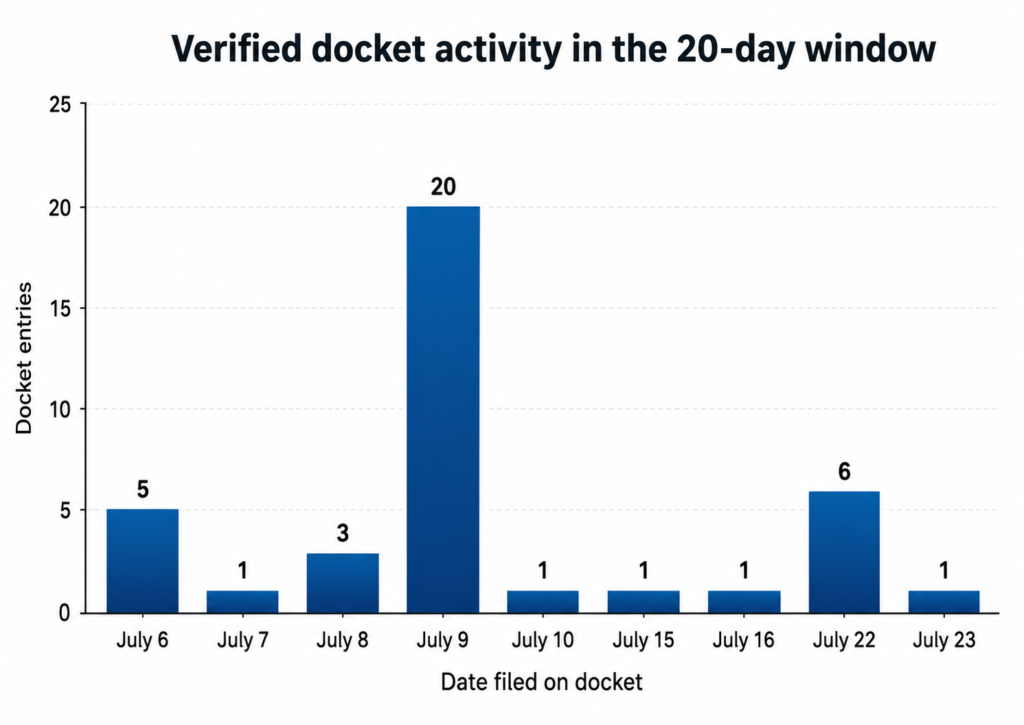
Based on the uploaded docket summary dated July 23, 2026, the verified 20-day window from July 4 through July 23 shows 39 docket entries. That includes 20 entries dated July 9 alone. The number matters because it is not evidence of dormancy. It is evidence of active judicial and receivership activity continuing under a closed-label docket.
That is the practical issue behind Barton’s reopening request. The motion did not ask the court to relitigate the SEC’s underlying claims or dissolve the receivership. It asked for a narrower, more transparent posture: restore the action to the active docket for limited receivership supervision, because the receivership continues to affect assets, records, title issues, fee matters, and case management.
The July 9 order: a statistical explanation, not the end of the story
On July 9, the court denied Barton’s request for leave to reopen the administrative closure. The order framed the issue as a misunderstanding, explaining that administrative closure does not mean the case is unmanaged and that the case is not considered open for statistical purposes because of its extended duration. In other words, the order said the case can be closed for counting purposes while still being actively managed.
Barton rejects the idea that this was a misunderstanding. His position is more direct: he understands the administrative label. He is challenging the label’s effect. From his view, the word “closed” gives priority to the court system’s statistical characterization while the factual record shows a case still moving through consequential disputes. The disagreement is therefore not about vocabulary. It is about whether the public docket should mirror the practical reality of an active receivership.
| Key public issue If the case remains actively managed, Barton’s position is that the public record should not continue to present the action as closed in a way that understates ongoing court supervision. |
Why the word “closed” matters
Court labels shape public understanding. A closed docket can signal finality to investors, creditors, journalists, property owners, title professionals, and the broader public. But ongoing receivership administration signals the opposite. When both appear at the same time, the court may understand the technical distinction, but the public may not.
That is especially important in a federal receivership. Receivership is not a minor administrative add-on. It can involve asset sales, title disputes, records custody, forensic accounting, fee applications, claims planning, investor identification, and eventual distributions. These are not housekeeping details. They affect real property, real money, and real legal rights.
In Barton’s view, the denial order treats institutional framing as more important than the factual evidence of an open, moving case. A journalist looking at the record would ask a simple question: if supervision continues, why should the docket’s public face suggest closure?
Administrative closure is not a final judgment
Administrative closure is often described as a docket-management tool, not a final merits ruling. The Fifth Circuit’s decision in Mire v. Full Spectrum Lending explains that administrative closure functions like a stay and affects how active cases are counted on the court’s docket. That distinction matters here because the Barton case is not quiet in practice.
Receivership law also reinforces the need for continued supervision. Federal Rule of Civil Procedure 66 recognizes the court’s continuing role in receivership administration, and BartonReceivership.net’s Federal Court Receiverships Explained explains how federal receiverships operate through court authority and equitable oversight.
The receivership reality
The Barton receivership has already been the subject of major appellate scrutiny. In 2023, the Fifth Circuit vacated the original receivership order in SEC v. Barton, No. 22-11132. Later appellate proceedings addressed the narrowed receivership and related sale and settlement orders, including SEC v. Barton, No. 24-10788. That history makes the public-facing status of the case more important, not less.
The broader due-process concern has been covered in Barton v. SEC: Can the Government Seize Everything Without Due Process? and Receivership in Texas Explained. The reopening dispute adds a new layer: it is not only about what a receiver may do, but also about how the court system describes what is being done.
The public-facing contradiction
A docket can be technically closed for statistical purposes and still functionally active for supervision. But that distinction should be unmistakable. If the public-facing record says closed while filings and orders continue, the label risks understating the level of ongoing judicial activity.
That is the heart of Barton’s objection. He is not saying the court lacks power to manage its docket. He is saying the court should not use the word “closed” in a way that benefits internal case-counting while the case continues to produce substantive orders, receivership decisions, and emergency disputes.
Put plainly, there is no misconception in Barton’s position. The factual record shows continuing activity. The remedy he seeks is equally direct: reopen the matter for the limited purpose of receivership supervision so the docket reflects the reality of the case.
The bottom line
The verified record does not show a dormant case. It shows a closed-label docket with ongoing motion practice, continued receivership supervision, and a one-day burst of July 9 activity that would not look closed to any ordinary reader.
If administrative closure is only a statistical device, then the public record should not obscure the fact that the litigation remains alive in substance. In a receivership case, that distinction matters because the receiver’s authority comes from the court, and the court’s supervision is the safeguard.
A case can be closed for counting purposes. But when 39 docket entries appear in a 20-day window, and the court itself says the case remains actively managed, the public question is fair: why should the docket still tell the world this case is closed?
Verified 20-Day Docket Activity Table
| Date filed | Number of docket entries |
| July 6, 2026 | 5 |
| July 7, 2026 | 1 |
| July 8, 2026 | 3 |
| July 9, 2026 | 20 |
| July 10, 2026 | 1 |
| July 15, 2026 | 1 |
| July 16, 2026 | 1 |
| July 22, 2026 | 6 |
| July 23, 2026 | 1 |
| Total verified entries | 39 |
Further Reading and Legal Sources
For readers who want more background, see the SEC v. Barton case timeline, Federal Court Receiverships Explained, Barton v. SEC: Can the Government Seize Everything Without Due Process?, and Receivership in Texas Explained.
For legal reference, see Federal Rule of Civil Procedure 66, Mire v. Full Spectrum Lending, SEC v. Barton, No. 22-11132, and SEC v. Barton, No. 24-10788.