

A recent record-retrieval fight in SEC v. Barton raises a simple but serious question: what does the right to defend yourself mean when a court-appointed receiver controls the records needed for that defense?
In theory, a defendant walks into court with rights: the right to counsel, the right to confront the government’s case, the right to compulsory process, and the right to present a defense. In practice, those rights depend on access to records. Bank statements, tax files, entity documents, correspondence, loan materials, accounting records, and internal business files are not side issues. They are the raw material of a defense.
That is why the latest record-retrieval dispute in SEC v. Barton is more than another procedural skirmish. Timothy Barton has asked to place before the court an opposed motion seeking turnover and production of records he says are necessary to prepare for the parallel criminal case. The court granted leave for that motion to be filed, which means the fight over access can now be briefed on the merits. The order did not decide the underlying request; it opened the door for the dispute to be heard.
| Key issue: When a civil receivership controls business and personal records, the practical right to prepare a criminal defense may depend on whether the defendant can obtain usable access before trial deadlines arrive. |
The problem behind the paperwork
Receivership is often described as an asset-preservation tool. But in a case like Barton’s, where civil enforcement and criminal prosecution move on parallel tracks, records can become as important as money. BartonReceivership.net has covered the broader debate over whether a pre-judgment receivership can shift from preservation into pressure before a jury has heard the case. Its coverage of pre-judgment receiverships and due process frames the problem plainly: once a receiver controls assets and documents, the battlefield changes.
Federal receiverships operate through a mix of equitable court power, local practice, and Federal Rule of Civil Procedure 66. That rule governs actions involving receivers, but it is not a full code of criminal-defense protections. It does not answer the everyday trial-preparation question: how does a defendant review the same records that a receiver has gathered, stored, filtered, or controlled?
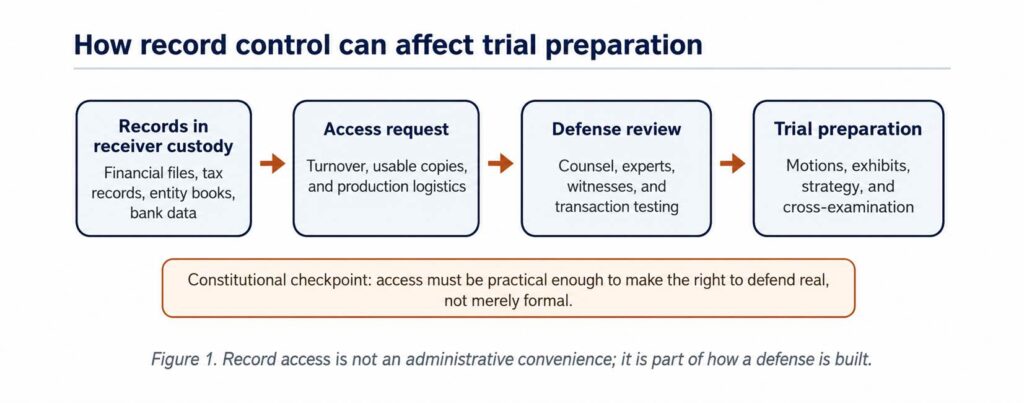
That gap matters. A defendant cannot meaningfully test a financial case without the financial file. He cannot prepare experts without source data. He cannot prepare witnesses without the documents those witnesses may be asked about. And he cannot challenge the government’s timeline if the underlying records are delayed, incomplete, unusable, or placed behind a cost barrier created by the receivership itself.
Why records are constitutional, not clerical
The Constitution does not promise a decorative defense. It promises a real one. The Supreme Court has recognized, in Crane v. Kentucky, that a criminal defendant must have a meaningful opportunity to present a complete defense. The Compulsory Process Clause is part of the same architecture: the defense must be able to present its version of the facts, not merely react to the prosecution’s version.
This is related to, but broader than, the familiar Brady disclosure framework. Brady focuses on favorable evidence in the government’s possession. The Barton record-retrieval issue is different in form: it asks whether a defendant can obtain and use records held through a court-supervised civil receivership when those records are needed for criminal-defense preparation. The practical concern is the same: a fair trial requires usable access to the material facts.
That is why this dispute should not be treated as a housekeeping issue. The question is not whether the defense wants more documents for convenience. The question is whether a defendant can be forced to prepare for trial while the records needed to test the allegations sit inside a process he does not control.
The receivership context makes the issue sharper
The Barton receivership has already produced major appellate rulings. The Fifth Circuit’s 2025 decision summarized the earlier history: the initial receivership was vacated in 2023, the district court later imposed a narrowed receivership on remand, and the new receivership was later upheld. The appellate history matters because it shows that scope has been a live issue from the beginning. See the Fifth Circuit’s discussion in SEC v. Barton and the later appeal summarized by Justia.
On BartonReceivership.net’s federal receivership explainer, the core due-process concern is the absence of a detailed statutory framework comparable to bankruptcy. Bankruptcy has schedules, creditor processes, reporting rules, and established procedures. Receivership is more fluid. That flexibility can preserve assets in proper cases, but it can also create uncertainty over records, access, costs, timing, and accountability.
The public timeline at The Complete Tim Barton Case Timeline places the record dispute inside a longer arc: SEC enforcement, receivership control, parallel criminal exposure, appellate review, and years of litigation before a final criminal trial. The more time passes, the more urgent record access becomes. Memories fade. Deadlines approach. Experts need data. Trial teams need to know what the documents actually show.
Cost can become control
There is another part of the problem that rarely gets enough attention: cost. If assets and revenue streams are frozen or controlled by a receiver, then requiring a defendant to personally finance record retrieval, copying, sorting, and expert-ready production may convert access into a privilege. A right that depends on paying for records after the system has restrained the resources needed to pay is not meaningful.
This is where civil and criminal procedure collide. A civil receiver may be focused on estate administration. Prosecutors may be focused on trial. The court may be focused on docket control. But the defendant experiences all of it at once. The same legal architecture that controls assets can also control the materials needed to defend liberty.
Why readers should care
The Barton dispute is not only about one defendant’s file access. It is about the constitutional consequences of letting civil enforcement machinery shape the conditions of a criminal defense. When Constitutional Rights Become Conditional in Court makes that broader point: rights are weakened when they exist formally but become difficult to exercise in practice. What Happens When You Fight the SEC describes the cumulative pressure that can build when civil receivership, defense costs, family pressure, lawyer pressure, and trial preparation collide.
The public question is simple. Can a defendant fairly defend himself when the records needed to prepare that defense are controlled by the very receivership structure he is challenging? If the answer is yes, the system must prove it through timely, usable, affordable access. If the answer is no, then the constitutional problem is no longer abstract.
Courtrooms often speak in technical language: custody, turnover, production, leave, receivership estate, equitable authority. But behind those words is a basic principle. The right to defend yourself is not just the right to stand in a courtroom and deny allegations. It is the right to investigate, test, document, explain, and answer the government’s case with the records that matter.
That is why the record-retrieval fight belongs in the center of the Barton receivership story. If the records are the roadmap, then access to the records is access to the defense itself.
| Bottom line The record-retrieval dispute asks whether constitutional defense rights remain real when the documents needed to prepare for trial are controlled through a civil receivership. That question reaches beyond one filing and goes to the integrity of the adversarial system itself. |