

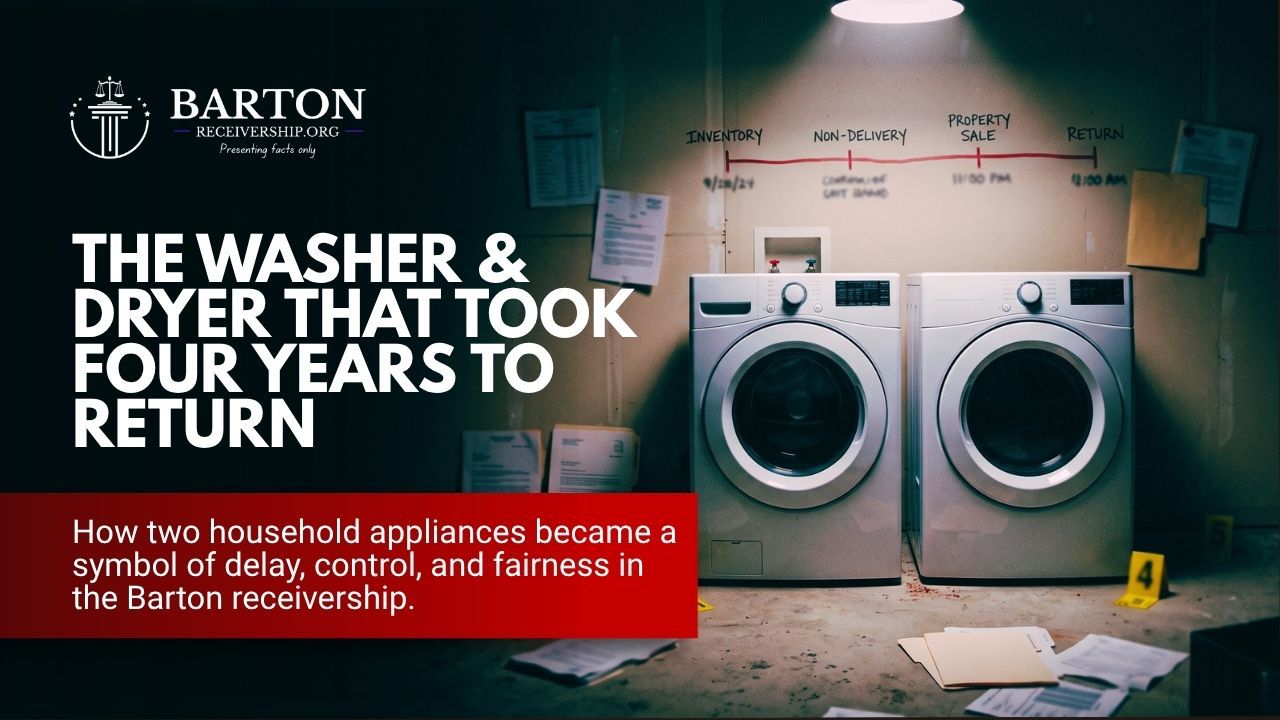
In the Barton receivership, two household appliances became a window into a much larger fight over property control, delay, and basic fairness.
| At a glance: The court record identifies the washer and dryer as discrete household items from the Rock Creek property. Barton says their eventual return shows the appliances could be separated from the receivership dispute, but only after years of resistance and formal motion practice. |
In most federal cases, a washing machine and dryer would never become news. They would not be the subject of a motion, a receiver response, or a court order. They would simply be recognized as household property and returned. The washer and dryer dispute in the Barton receivership shows how even identifiable household property can become tied up in years of litigation, receiver control, and formal motion practice.
But in the long-running Barton receivership, even ordinary household property has taken on larger meaning. The return of a washer and dryer from the Rock Creek property is not just about two appliances. It is about what happens when a receivership reaches so broadly that a defendant has to fight over items that should have been simple to identify, account for, and deliver.
The recent filings put the issue in plain view. The washer and dryer were identified in the Rock Creek personal-property inventory. They were not delivered to Timothy Barton when the property contents were addressed. The receiver’s side pointed to a tenant-related explanation and allowed the appliances to remain at the property. Later, after the Rock Creek sale closed, the receiver said he was not opposed to returning them. The court then denied Barton’s request for leave to file a return-of-property motion, treating the motion as unnecessary because the receiver was not opposing delivery.
That sequence is what makes the story worth telling. Barton described the return as the end of a fight that took years. In his view, the appliances came back only after the house itself was gone. The practical question remains: if the washer and dryer could be returned after the sale closed, why could they not be returned before?
A Small Item, a Larger Pattern
The Barton receivership has always been about more than property management. The broader case has raised recurring questions about due process, asset control, defense access, and whether a pre-judgment receivership can function as punishment before any final civil judgment. For background, see Barton v. SEC: How a Dallas Developer Lost Everything and Federal Court Receiverships Explained.
The washer and dryer dispute gives that debate a concrete image. It is easy to talk about receivership control in abstract terms. It is different when the fight concerns household appliances sitting inside a home, inventoried and traceable, yet still not returned until years later.
A court-appointed receiver is not an ordinary property manager. A receiver acts under court authority and is supposed to preserve property subject to litigation. Federal Rule of Civil Procedure 66 governs federal receivership practice, and Cornell’s legal overview describes receivership as a court-ordered remedy where a receiver takes possession of, manages, or preserves property during litigation. That structure is designed to protect property, not make basic personal-property return more difficult than necessary.
The Tenant Explanation
The most important question is not whether a washer and dryer are valuable enough to dominate federal court attention. The question is whether the explanation for keeping them changed once the sale closed.
Barton framed the dispute as a chain-of-custody problem. The appliances were identified. They were not delivered. He wanted an accounting and a return. The receiver’s response took a different route: it maintained that Barton had not proven entitlement to possession, while also saying that tracing the purchase history would not be worth more receivership expense and that the appliances could now be tendered to him.
That is the contradiction at the center of the issue. Before closing, the appliances remained tied to the property and the tenant’s claimed use. After closing, the appliances could be returned. Either the tenant-related issue created a real basis to withhold them, or it did not. If it did, why did it disappear after the sale? If it did not, why did Barton have to keep pressing for their return?
The public does not need to resolve every legal detail to understand the concern. In a receivership, control itself can become leverage. The longer property remains under someone else’s authority, the more the process becomes part of the pressure.
The Washer and Dryer Dispute Timeline
| Stage | What the record shows |
| Inventory | The washer and dryer were identified as separate personal-property items at the Rock Creek property. |
| Non-delivery | They were not delivered to Barton when the property contents were addressed. |
| Tenant use | The receiver-side explanation referenced continued use by the tenant and an alleged repair-cost issue. |
| After closing | Once the Rock Creek sale closed, the receiver said the items could be tendered to Barton. |
| Public question | If return was possible then, what justified the prior delay? |
Why It Matters
Some readers may ask why anyone should care about a washer and dryer in a federal securities case. The answer is simple: small property disputes often reveal how power operates.
A receivership that controls businesses, real estate, bank records, books, personal files, and household property can create enormous pressure. When even ordinary items require motions, responses, and court attention, the process itself becomes the burden.
The Fifth Circuit has recognized broad discretion in federal equity receiverships, including in SEC v. Forex Asset Management LLC. But broad discretion does not erase the need for practical fairness. The concern is sharper when receiver control reaches personal items and daily life, not just complex business assets.
That is why the washer and dryer matter. Their return appears to confirm that the appliances could be separated from the broader receivership estate and delivered. If so, the delay becomes the story. A fight over ordinary household property becomes a measure of how difficult it can be for a person to regain control once a receivership takes over.
The Court’s Order Does Not End the Public Question
The court denied Barton’s leave motion after noting that the receiver was not opposed to returning the appliances. Procedurally, the ruling treated the motion as unnecessary. But the public-interest question is broader than the procedural outcome.
Why did the issue take this long? Why did Barton have to press for a formal return? Why did the receiver resist the need for court action while also acknowledging that delivery could occur? And why did the practical ability to return the appliances appear only after the sale had closed?
These questions fit within the wider concerns covered by Controversial Mismanagement of Personal Property in the SEC vs. Barton Case and Government Overreach: 7 Real Examples: whether a sweeping receivership can cross the line from asset preservation into deprivation.
The washer and dryer dispute may appear small, but it points to a larger constitutional concern in the Barton receivership: whether temporary judicial custody is being used to preserve property, or whether it has become a mechanism that delays, controls, and effectively decides ownership before legal rights are finally resolved.
The Bottom Line
The washer and dryer story may sound small. It is not.
It shows how receivership control can reach into the ordinary details of a person’s life. It shows how a defendant can spend years trying to retrieve items that, in normal circumstances, would not require federal motion practice. And it raises a sharp question about consistency: if the appliances could be returned after the sale, what justified keeping them from Barton before?
A washer and dryer will not decide the Barton case. But their return may help explain it. In a system where property is taken first, and questions are answered later, even two household appliances can become evidence of a much larger problem.
Frequently Asked Questions
Why did the washer and dryer become an issue in the Barton receivership?
The washer and dryer were identified as separate household items in the Rock Creek personal-property inventory but were not delivered to Timothy Barton when the property contents were addressed. Their eventual return required continued requests and formal motion practice.
Where were the washer and dryer located?
The appliances were located at the Rock Creek property and were identified in the personal-property inventory associated with that property.
What explanation was given for not returning the appliances earlier?
The receiver’s side referred to the tenant’s continued use of the appliances and an alleged repair-cost issue. It also maintained that Barton had not established his entitlement to possession.
What happened after the Rock Creek property was sold?
After the Rock Creek sale closed, the receiver indicated that he was not opposed to tendering the washer and dryer to Barton. The court then denied Barton’s request for leave to file a return-of-property motion because the receiver was no longer opposing their delivery.
Why does the washer and dryer dispute matter?
The dispute provides a concrete example of how receivership control can extend beyond businesses and real estate to ordinary household property. It raises questions about delay, consistency, accountability, and the burden placed on a person seeking the return of identifiable personal items.
Did the court decide who originally owned the appliances?
The article does not describe the court as issuing a final ownership determination. Instead, it explains that the court treated the requested motion as unnecessary after the receiver stated that the appliances could be returned.