

A whistleblower story rarely begins with a microphone. It begins with a warning. A document is handed over. A suspicious pattern is reported. A person with something to lose tells someone in authority that the official story may be wrong. The public likes to believe that government rewards that warning. The record of American whistleblower law says something more complicated: the law praises whistleblowers in theory, but institutions often punish them in practice.
Punishment does not always look like a termination letter. Sometimes it looks like a new investigation. Sometimes it looks like a reputation campaign. Sometimes it looks like being isolated from the decision-makers who once needed your information. And sometimes, in the most severe cases, it looks like the machinery of legal process turning against the very person who first raised the alarm.
That is why this article begins with a harder question than “what is whistleblower retaliation?” The question is this: when someone reports suspected misconduct and later becomes the target of a civil enforcement action, criminal exposure, and a sweeping receivership, how should the public evaluate the sequence? The Barton timeline presents that question directly.
Key finding
From FY2015 to FY2025, complaints received increased by approximately 87.9%, while complaints docketed for investigation increased by approximately 1.9%. The apparent docketing rate declined from 43.7% to 23.7%.
Annual comparison
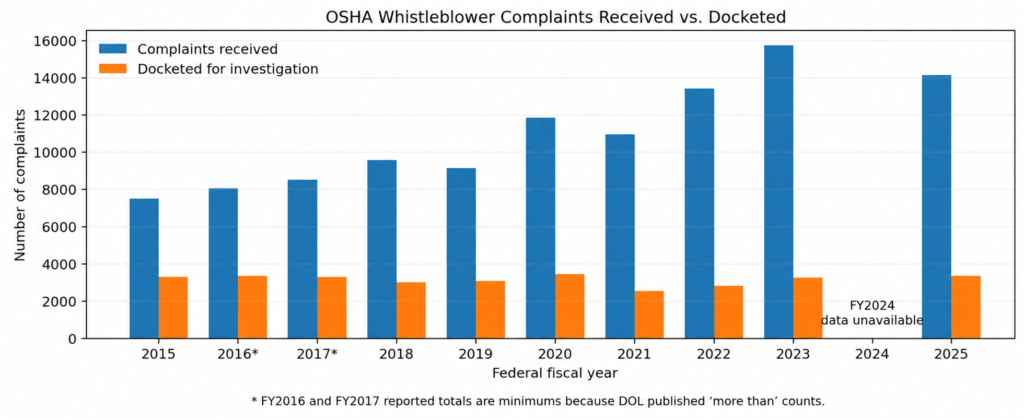
Figure 1. OSHA whistleblower complaints received and complaints docketed for investigation.
Annual data
| Fiscal year | Complaints reported | Docketed for investigation | Docketing rate |
| 2015 | 7,517 | 3,288 | 43.7% |
| 2016 | >8,055 | 3,355 | <41.7% |
| 2017 | >8,503 | 3,303 | <38.9% |
| 2018 | 9,566 | 3,007 | 31.4% |
| 2019 | 9,146 | 3,091 | 33.8% |
| 2020 | 11,865 | 3,448 | 29.1% |
| 2021 | 10,964 | 2,556 | 23.3% |
| 2022 | 13,432 | 2,815 | 21.0% |
| 2023 | 15,758 | 3,243 | 20.6% |
| 2024 | Not located | Not located | — |
| 2025 | 14,125 | 3,352 | 23.7% |
FY2016 and FY2017 reported totals are lower bounds because DOL published “more than” counts. Their docketing rates are therefore upper-bound percentages.
Official sources
- OSHA Whistleblower Protection Program — Data and Statistics
- OSHA — Data and Statistics for FY2016 to FY2021
- U.S. Department of Labor — FY2017 Congressional Budget Justification, OSHA
- U.S. Department of Labor — FY2018 Congressional Budget Justification, OSHA
- U.S. Department of Labor — FY2025 Congressional Budget Justification
- U.S. Department of Labor — FY2027 Congressional Budget Justification, OSHA
The Legal Baseline: Retaliation Is a Real Doctrine, Not a Slogan
The U.S. Department of Labor explains retaliation in practical terms: an employer may not punish a worker for exercising rights under whistleblower-protection laws. The adverse action can be obvious, such as firing or demotion, but it can also be an action that would dissuade a reasonable person from raising a concern.
In the federal workforce, the Office of Special Counsel describes prohibited personnel practices as banned employment-related activities, including retaliation, that violate the merit system. 5 U.S.C. § 2302 protects certain disclosures about illegality, gross mismanagement, gross waste, abuse of authority, and substantial dangers to public health or safety.
Private-sector protection is more fragmented. Sarbanes-Oxley § 806 protects certain fraud-related reporting. Dodd-Frank created the SEC whistleblower program and anti-retaliation remedies for qualifying SEC whistleblowers. The False Claims Act protects employees, contractors, and agents from retaliation for lawful acts connected to stopping fraud on the government.
Chart 1: The Whistleblower Protection Framework
| Framework | Who It Generally Protects | Retaliation Focus |
| 5 U.S.C. § 2302 | Covered federal employees and applicants | Personnel actions after protected disclosures about illegality, waste, abuse, or danger. |
| Sarbanes-Oxley § 806 | Employees of covered public companies and certain contractors | Fraud-related reporting, testimony, or participation in proceedings. |
| Dodd-Frank § 78u-6 | Individuals who qualify as SEC whistleblowers | Retaliation because of SEC-related whistleblower activity. |
| False Claims Act § 3730(h) | Employees, contractors, and agents | Retaliation for lawful acts to stop false claims against the government. |
Retaliation Is Broader Than a Firing
The common mistake is to shrink whistleblower retaliation into one narrow image: an employee reports misconduct, the employer fires him, and the case becomes a standard employment dispute. That happens. But it is not the whole category. Retaliation law has always cared about deterrence. Would the action discourage a reasonable person from speaking up? Would it teach others to stay silent? Would it convert lawful disclosure into personal ruin?
The Supreme Court’s anti-retaliation decision in Burlington Northern v. White is useful because it looks at practical deterrence. The point is not merely whether the target still technically has a job or a right to file a complaint. The question is whether the institution’s response would make a reasonable person think twice before reporting misconduct.
Chart 2: Retaliation Forms Beyond a Termination Letter
| Retaliation Form | What It Looks Like | Why It Chills Reporting |
| Direct retaliation | Firing, demotion, suspension, reduced pay, reduced hours | It sends a clear message that reporting costs the reporter personally. |
| Reputational retaliation | Smear campaigns, selective leaks, accusations framed as settled facts | It makes the reporter look unreliable before the evidence is tested. |
| Procedural retaliation | New investigations, burdensome demands, escalating legal pressure | It turns participation in the system into a financial and psychological penalty. |
| Economic retaliation | Asset restraint, loss of business control, pressure on lenders or partners | It makes defense or continued resistance practically impossible. |
| Isolation retaliation | Loss of access, refusal to engage, exclusion from decision-making | It strips the reporter of the ability to correct the record. |
The Barton Connection: The Reporter Becomes the Target
The Tim Barton timeline provides the central sequence examined here. The timeline records that Barton retained Guidepost Solutions in 2019 after identifying suspicious funding patterns, and that reports were made to DHS and the FBI about suspected money-laundering concerns tied to Michael Fu and related funding activity. It also records that Barton’s attorney briefed an SEC investigator before the government filed its later enforcement action.
The public-facing record described on BartonReceivership.net shows a dramatic role reversal: the SEC filed its civil case, a parallel criminal case followed, and the district court appointed a receiver over Barton-linked entities. Barton’s defense argues that he reported misconduct first and then became the person stripped of assets, operational control, and practical defense resources.
The 2019 Whistleblower Year
The public record identifies 2019 as the year the warning signs were formally documented. According to Barton’s account, suspicious funding patterns had emerged, including instances in which the names listed in agreements did not match the apparent sources of the funds. Barton subsequently retained Guidepost Solutions to investigate those discrepancies.
Barton describes a significant turning point as Michael Fu’s alleged default on a mediation settlement agreement within one week of its execution. He states that Fu declined to provide identifying and banking information that Barton believed was necessary to return the funds to the accounts and individuals from which they had originated, consistent with applicable U.S. tax and anti-money-laundering requirements. Barton further characterizes the legal action later initiated by Fu as retaliation arising from that dispute. According to the BartonReceivership.net record, the concerns were serious enough to be reported to the Department of Homeland Security and the FBI, and an SEC investigator was later briefed.
That chronology matters because retaliation analysis depends heavily on sequence. The public does not need to resolve every disputed fact to recognize the basic pattern under examination: a disclosure was made, government officials allegedly became aware of it, and adverse action followed. The more severe the later action, the more important it becomes to ask whether the original disclosure was fully investigated or whether the person who raised it ultimately came to be treated as the problem.
Chart 3: The Barton Timeline Through a Retaliation Lens
| Timeline Stage | Barton Site Narrative | Retaliation Question |
| Warning signs identified | Funding patterns allegedly raised money-laundering concerns. | Did the system treat the evidence as a warning or as a complication? |
| Outside investigation retained | Guidepost Solutions was reportedly hired to examine funding sources. | Were the findings preserved and considered? |
| Reports made | The timeline says DHS and the FBI were alerted. | Which officials received the information and what did they do with it? |
| SEC knowledge alleged | The record says an SEC investigator was briefed. | Did the SEC later evaluate Barton as a reporter or as a target? |
| SEC and DOJ action followed | Civil and criminal proceedings arrived in 2022. | Was the later escalation proportionate to the full record? |
When Process Becomes Punishment
The receivership is central to understanding Barton’s retaliation claim. The federal receiverships explainer describes receivership as a court-supervised takeover of assets by a court-appointed receiver. The due-process article argues that a pre-judgment receivership can become a battlefield because the target loses possession and control before any final verdict.
That is why whistleblower retaliation in this series is not treated only as an employment issue. It is also treated as a power issue. If the reported person or reported conduct becomes inconvenient to the government’s preferred case theory, retaliation can operate through procedure: investigations, parallel tracks, asset control, fee drain, reputational damage, and delays that make defense increasingly difficult.
Chart 4: Why the Barton Theory Is Different
| Traditional Retaliation | Retaliation-by-Process Theory | Barton Relevance |
| Firing, demotion, pay cut | Asset freeze, receivership, litigation drain, public allegations | Barton did not present a classic workplace dispute; he presents a process-driven retaliation pattern. |
| Employer punishes worker | State power or legal machinery disables a critic or reporter | The Barton record involves SEC action, a receiver, and a parallel criminal case. |
| Relief focuses on reinstatement and back pay | Relief may require due-process review, asset-control limits, and forensic accountability | Barton’s site emphasizes defense resources, asset control, and pre-judgment punishment. |
The Role Reversal Problem
The most striking part of the timeline is the reversal in Barton’s role. Barton’s defense says he reported suspected misconduct tied to the Fu funding structure. Later, Barton became the defendant fighting the SEC, the DOJ, and a receiver. A neutral reader does not have to accept every Barton-side allegation to see why that reversal requires scrutiny.
The same concern appears in the broader debate over government overreach and lawfare. If legal tools can be used to punish dissent, then whistleblower retaliation and lawfare are not separate concerns. They are overlapping mechanisms: one punishes the person for speaking up; the other uses legal process as the instrument of pressure.
What the Government Would Likely Say
The government would likely say that enforcement decisions are based on evidence, not retaliation; that receiverships preserve assets for alleged victims; that criminal charges follow probable cause; and that whistleblower labels cannot immunize anyone from prosecution. Those are real arguments. They should not be ignored.
But the public is allowed to ask whether those explanations fit the whole record. Was the alleged whistleblower evidence fully evaluated? Were less destructive measures available? Did the receivership preserve value or destroy it? Did legal process become a financial weapon before trial? Did the reported conduct receive the same scrutiny as the reporter?
Chart 5: Government Justifications vs. Investigative Questions
| Government Position | Public Accountability Question |
| The SEC case was an ordinary enforcement matter. | Why did the case require sweeping pre-judgment control of assets before final liability? |
| The receiver was needed to protect investors. | What evidence shows that the receivership preserved more value than it consumed or liquidated? |
| Barton’s reporting does not make him immune. | Correct, but did his reporting change how officials viewed him? |
| The criminal case is separate from the civil case. | If the civil receivership stripped defense resources, how separate was the practical effect? |
Why This Matters Beyond Tim Barton
A system that punishes whistleblowers does not merely hurt one person. It teaches everyone else to remain silent. If the public sees that reporting suspected misconduct can lead to years of legal exposure, loss of assets, reputational damage, and financial disarmament, the lesson is obvious: do not report unless you are prepared to be destroyed.
That is the institutional danger. Whistleblower protection is supposed to make government more accurate. Retaliation makes government more insulated. It pushes inconvenient facts out of the record and makes future witnesses calculate the price of honesty.
Why Whistleblower Retaliation Often Looks Like Normal Procedure
The Barton timeline makes this question unusually sharp because the claimed warning came before the government’s enforcement posture hardened. Barton’s side says he retained investigators, flagged suspicious funding activity, and brought concerns about Fu-linked activity to federal attention. Later, he became the person fighting the SEC, DOJ, a receiver, and a depleted estate. That does not prove retaliation. It does make the sequence important.
The retaliation question is not answered by one event. It is answered by sequence. A person reports suspected wrongdoing. Decision-makers learn about the report. The person then becomes the subject of unusual pressure, legal exposure, public accusation, or economic harm. A neutral reader should not stop at the first government press release. The better question is whether the later process would make the next person think twice before reporting similar misconduct.
Bottom Line
Whistleblower retaliation is not always a pink slip. Sometimes it is a slow-motion punishment campaign. Sometimes the process itself becomes the penalty. The Barton record, as presented by BartonReceivership.net, raises the question that every oversight-minded reader should ask: when a man reports suspected misconduct, and later becomes the target of the full enforcement machine, did the system protect truth-telling or punish it?
The pattern can be examined through the same questions used in retaliation analysis: What was reported? Who knew? What changed afterward? Was the response ordinary or unusually severe? Were less destructive options available? Did the process protect alleged victims, or did it consume the very estate supposedly preserved for them?