

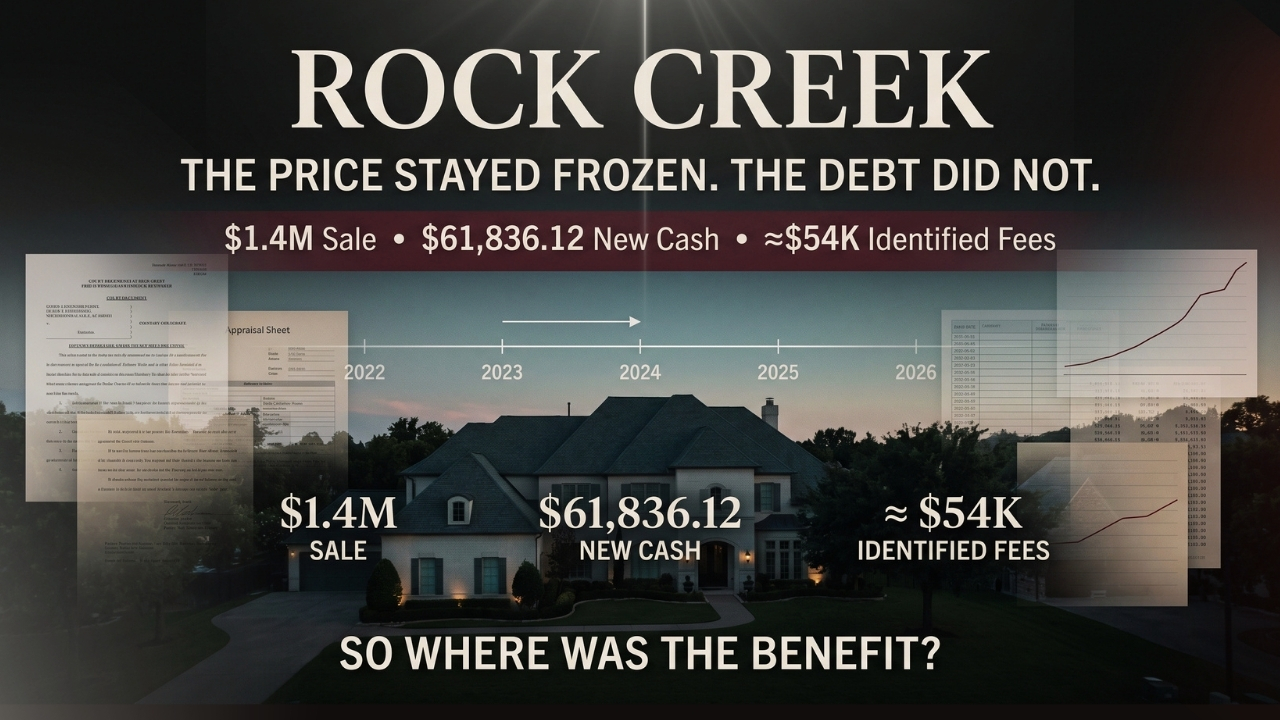
A document-driven look at why Barton challenged Rock Creek’s inclusion, what the appellate rulings actually decided, the cost of pursuing the sale, and the June 2026 closing.
Rock Creek was disputed before it was sold. Barton’s objection was not limited to the timing of a $1.4 million transaction; he challenged the premise that the whole property could be treated as Receivership Property on an example-based tracing record. The Receiver’s own September 2023 declaration said its entity-by-entity examples were a “small cross-section”. It did not provide a complete picture of every instance of investor funds benefiting an entity. The courts later upheld SF Rock Creek’s inclusion under the received-or-benefited-from standard. Still, no appellate ruling calculated what percentage of the property itself was traceable to Wall investor funds.
The sale eventually closed on June 25, 2026 for the same $1.4 million price approved in 2022. By then, the Receiver reported $401,785.10 in non-default interest and negotiated a $1,215,198 lender payout, leaving $61,836.12 in new closing cash. Barton’s review of the filed fee applications identifies approximately $54,000 in Rock Creek-specific professional fees through March 31, 2024 alone — before the later lis-pendens litigation, final title work, and closing. The complete post-March 2024 fee figure was still unavailable in the record reviewed for this article.
The numbers that define the Rock Creek record
| $1.4M Approved sale price | $1.053M Loan principal | 9.99% Fixed note rate | 18% Default rate |
| $401,785.10 Standard interest by closing | ≈$54K Rock Creek-specific fees identified through Q1 2024 | $61,836.12 Cash received at closing | $93,364.12 Reported total estate benefit |
The threshold issue: why Rock Creek was in receivership at all
4107 Rock Creek Drive is held by SF Rock Creek, LLC. The dispute over the property therefore began with a scope question: what tracing was enough to place the LLC — and with it the entire property — inside the receivership? The 2023 Fifth Circuit had already ruled that a receivership could reach only entities that “received or benefited from” assets traceable to the alleged fraud. For broader context, see the site’s Tim Barton SEC case overview and its guide to real-estate receiverships.
On remand, the district court included SF Rock Creek in the renewed receivership. Barton continued to argue that the evidence did not establish a complete dollar-for-dollar path from a specific Wall investor account into the whole Rock Creek property. That distinction became more important once the case moved from preserving assets to selling them: inclusion of an entity is a threshold receivership question; disposition of an entire asset makes the consequences irreversible.
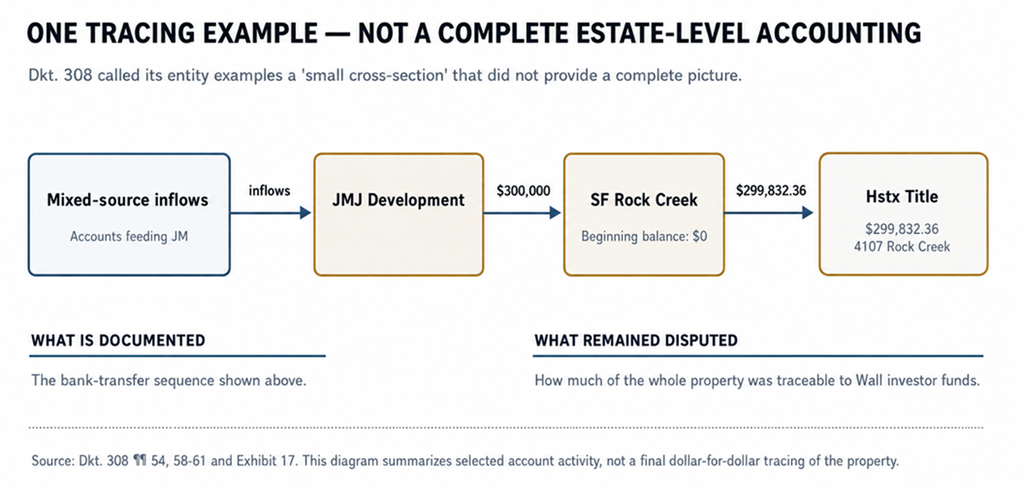
The tracing record: a documented transfer, but not a complete property-level tracing
Dkt. 308 does document a Rock Creek transfer sequence. On August 17, 2020, $300,000 moved from JMJ Development, LLC into SF Rock Creek’s Chase account, which had a stated beginning balance of zero. The same schedule shows $299,832.36 leaving SF Rock Creek that day for Hstx Title, with 4107 Rock Creek identified on the exhibit. The Receiver also cited other benefit theories, including proceeds from a property previously purchased with Wall investor funds and commingled transfers from related entities.
But the same declaration placed an express limit on what those schedules represented. Paragraph 54 said the entity examples did “not provide a complete picture” and were a “small cross-section” of the tracing analysis; paragraph 58 likewise described the transactional exhibits as representative rather than exhaustive. Barton’s position is that the Rock Creek examples may support investigation or preservation, but they do not quantify the tainted and untainted portions of the entire property before disposition.
What the 2025 affirmance did — and did not decide
In April 2025, the Fifth Circuit affirmed the renewed receivership and rejected Barton’s argument that receipt of only a small amount of traceable funds could not support inclusion of an entire entity. The panel stated that the received-or-benefited-from rule carried no proportionality limitation and held that the SEC’s specific tracing examples were sufficient for the preliminary receivership scope decision. The opinion discussed, among Barton’s examples, “the Defendant’s only home, which was held by an LLC,” and found no abuse of discretion. SEC v. Barton, 135 F.4th 206 (5th Cir. 2025)
That affirmance settled the threshold inclusion question under the preliminary record then before the court. It did not produce a complete Rock Creek accounting or identify what percentage of SF Rock Creek’s equity was traceable. The distinction remains central to Barton’s later objection: Dkt. 308 itself described the tracing as illustrative, and the Receiver’s 2026 status report continued to describe the forensic accounting as ongoing. Barton therefore argues that affirming inclusion did not answer the separate question of whether the whole property should be irreversibly disposed of before a completed estate-specific tracing was produced.
The loan was expensive even before the litigation began
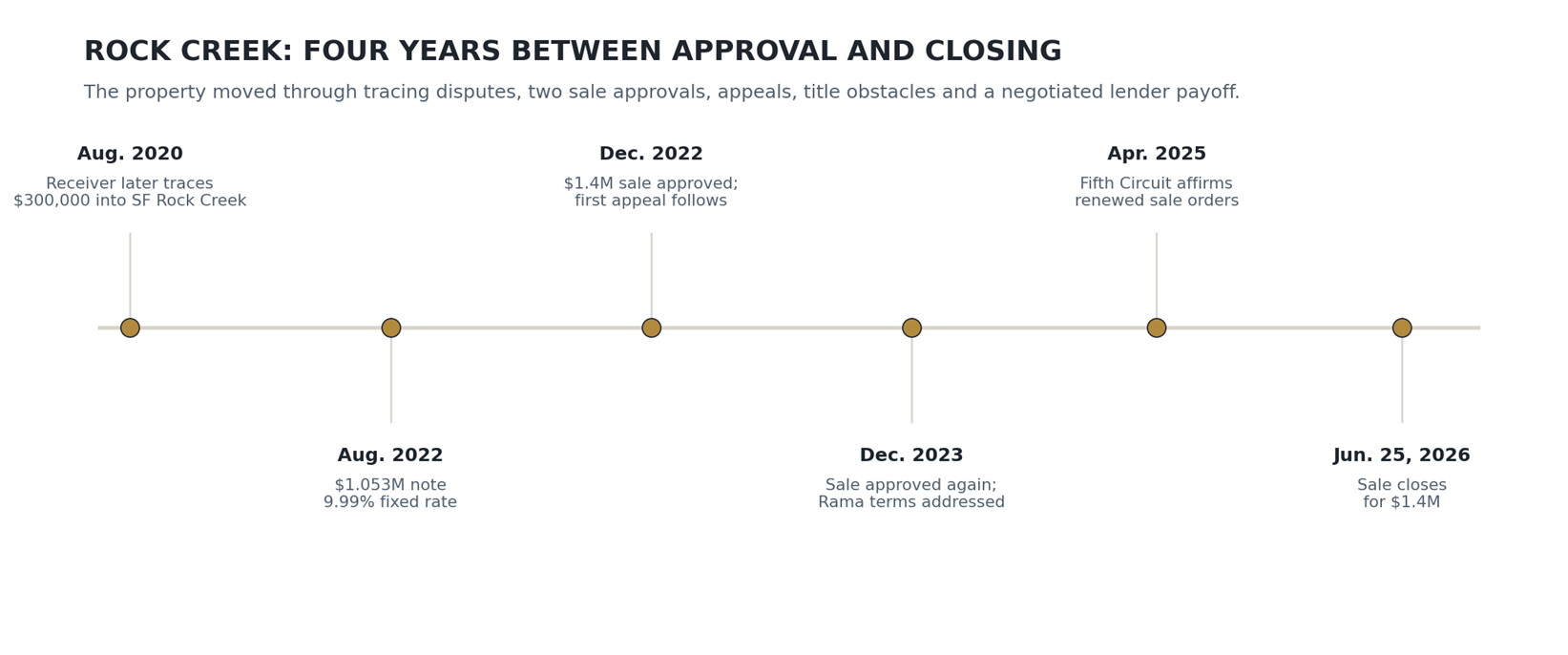
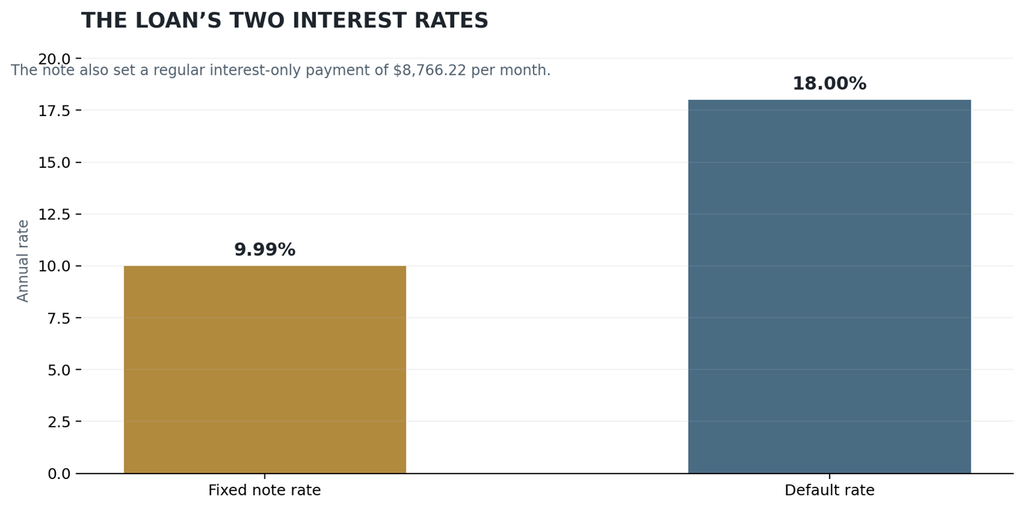
The Rock Creek financing is unusually important because the sale price barely exceeded the original principal and because interest continued to accrue while the sale remained open. The August 24, 2022 promissory note identifies SF Rock Creek, LLC as borrower and Athas Capital Group, Inc. as lender. The principal amount was $1,053,000.
The note set a 9.99% fixed annual interest rate and an 18% default rate, subject to the maximum lawful rate. It required monthly interest-only payments of $8,766.22 beginning October 1, 2022 and set September 1, 2024 as the maturity date. The scheduled balloon amount shown in the note was $1,061,766.22, consisting of the $1.053 million principal plus the final interest-only payment. (Dkt. 375.)
The first sale: $1.4 million against a $1.393 million appraisal average
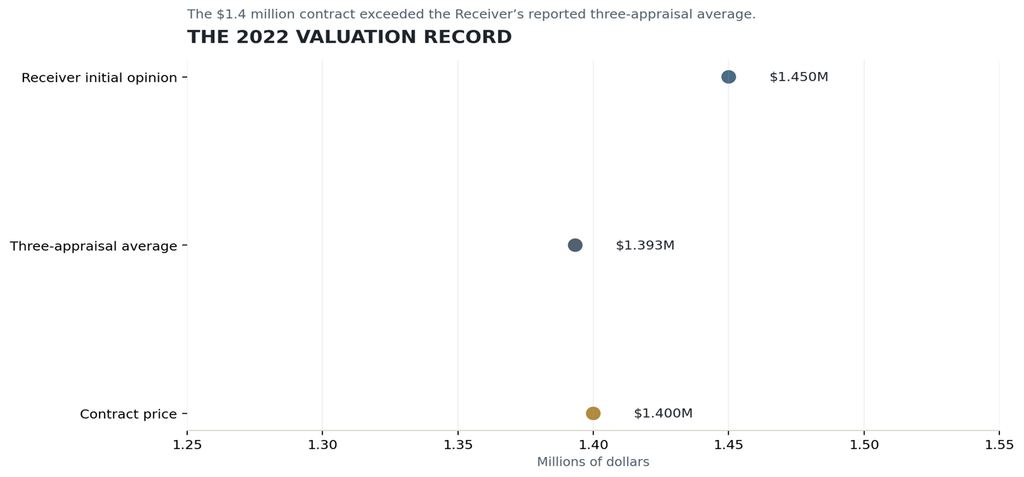
The Receiver says he obtained an initial opinion of value of approximately $1.45 million and listed the property for sale shortly after the receivership began. After receiving several offers, he agreed — subject to court approval — to sell the property “AS IS” for $1.4 million to the highest bidder. (Dkt. 308)
For the federal private-sale process, the Receiver obtained three appraisals. Dkt. 308 reports their average at $1,393,333. The $1.4 million contract therefore exceeded the reported average and, by the Receiver’s calculation, the two-thirds threshold referenced in 28 U.S.C. § 2001(b). The statute governing these private sales is available at 28 U.S.C. § 2001
A lis pendens, a sale order, and an appeal
The sale process became contested almost immediately. According to Dkt. 308, Barton recorded a lis pendens on December 1, 2022. The Receiver moved on December 16 to have it declared void, and the court held the sale hearing on December 19. The Receiver reported that the court found the sale to be in the best interest of the Receivership and authorized a December 28 closing. The court also awarded $1,200 in Receiver fees associated with the lis-pendens dispute.
Barton filed a notice of appeal on December 21, 2022. The Receiver’s later reports state that the title company would not issue title insurance while the appeal remained pending. The Fifth Circuit ultimately dismissed that first sale-order appeal after the original receivership order was vacated. The published 2023 appellate decision, which vacated the broader receivership, is available here: SEC v. Barton, No. 22-11132 (5th Cir. 2023)
Dkt. 308 also says the prospective purchaser continued to rent the property under a long-term lease while the sale remained unresolved. The Receiver described the arrangement as an effort to preserve the transaction while interest continued to accrue.
The second sale approval and the Rama agreement
After the district court entered a renewed receivership order, the Receiver returned to the Rock Creek sale. On November 1, 2023, he filed Dkt. 374, asking the court to ratify the earlier sale orders, authorize a sale free and clear of liens, and address default-rate interest. The court treated the request as a new sale motion and, after a December 14 hearing, approved the sale again on December 15, 2023. (Dkt. 838’s procedural history identifies Dkt. 437 as the Second Rock Creek Sale Order.)
At the same time, the Receiver and The Rama Fund, LLC — identified in Dkt. 392 as the holder of the Rock Creek note — filed a joint stipulation. It proposed that a receivership closing would pay Rama the $1,053,000 principal plus interest accrued at the standard rate. Claims for default interest, fees, penalties, and other amounts would be reserved for the claims process. The stipulation also contained an important condition: if delay caused principal plus standard-rate interest to exceed net sale proceeds after closing costs, the arrangement would no longer be effective. The uploaded copy is filed as a joint stipulation and proposed agreed order; its signature line for the judge is blank.
Barton appealed the second Rock Creek sale order on December 29, 2023. The Receiver says the title company again declined to insure the transaction while that appeal remained unresolved. In April 2025, the Fifth Circuit affirmed the renewed receivership and held that the district court acted within its discretion in approving the challenged property sales. The opinion is linked here: SEC v. Barton, No. 24-10004 (5th Cir. 2025)
By 2026, the debt had overtaken the sale price
The sale still had not closed when 2026 began. Dkt. 838 states that the Receiver encountered difficulty finding a title company willing to close between October 2022 and March 2026. During the second quarter of 2026, the Receiver reported that he located a title company willing to proceed after the appellate rulings.
On June 25, 2026, the reported principal remained $1,053,000 and accrued note-rate interest at the non-default rate had reached $401,785.10. Together, that was $1,454,785.10 — $54,785.10 more than the $1.4 million sale price before broker commissions, taxes and title charges were considered.
| A negotiated closing: The Receiver reported that the lender accepted $1,053,000 in principal plus $162,198 in interest, for a total payout of $1,215,198. The lender retained the ability to assert remaining claimed losses through the claims process. (Dkt. 838.) |
The June 25, 2026 closing: where the money went
Dkt. 838 reports that JNJ Group, LLC purchased the property for the same $1.4 million price approved years earlier. The closing allocation was $1,215,198 to the lender; $13,595.88 in prorated county taxes; $35,000 to the Receiver’s broker; $35,000 to the buyer’s broker; and $7,842 to the title company.
Those items leave $93,364.12. But the report makes an important distinction: $31,528 of that amount was prepaid rent already held by the Receiver. The actual new cash received at closing was therefore $61,836.12. The Receiver described the combined $61,836.12 cash plus $31,528 prepaid rent as a $93,364.12 net benefit to the Receivership Estate.
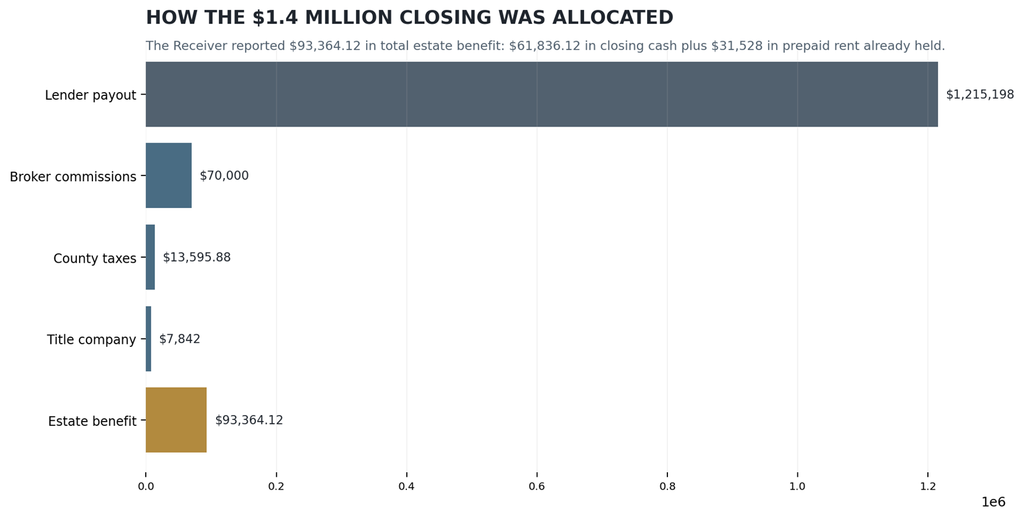
Figure 5. Closing figures from Dkt. 838, pages 33–34. The $93,364.12 estate benefit includes prepaid rent that was already in the Receiver’s possession.
| Gross sale price | $1,400,000.00 |
| Lender payout | $1,215,198.00 |
| Prorated county taxes | $13,595.88 |
| Broker commissions | $70,000.00 |
| Title company | $7,842.00 |
| Cash received at closing | $61,836.12 |
| Total reported estate benefit | $93,364.12 |
The sale also carried a professional-fee bill
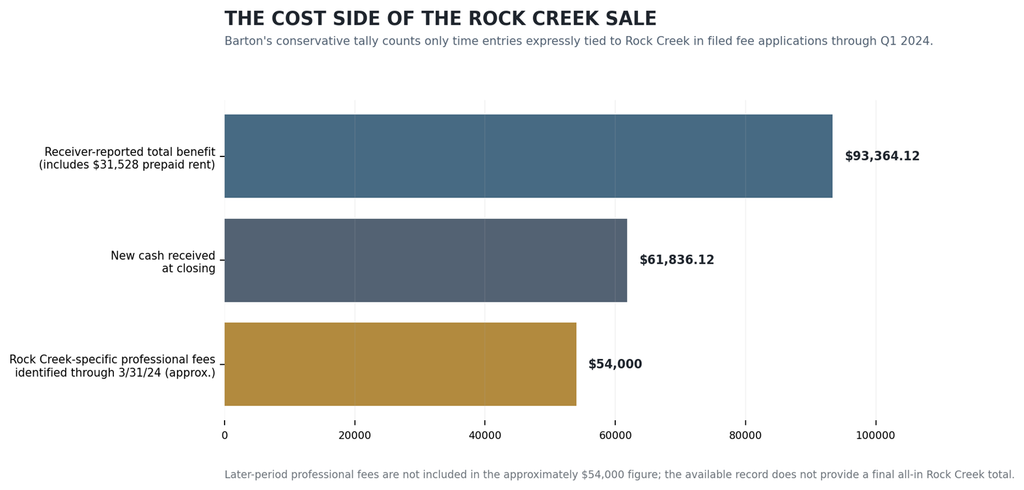
The Receiver’s quarterly status report gives the closing proceeds, but it does not provide a Rock Creek-specific total for Receiver time, counsel fees, appraisal work, publication costs, and related sale litigation. Barton’s review of the filed quarterly fee applications—Dkts. 157, 238, 540, 655 and 657—identified approximately $54,000 in time entries expressly attributable to Rock Creek through March 31, 2024. That figure is not presented as a final all-in cost; it excludes later-period work because fee applications after March 31, 2024, had not yet supplied a complete property-specific total in the record reviewed here.
The comparison is nevertheless concrete. Approximately $54,000 equals about 87% of the $61,836.12 in new cash received at closing, and about 58% of the Receiver’s $93,364.12 total-benefit figure that includes prepaid rent already held. Later Rock Creek work included renewed lis-pendens litigation, title and closing issues, and post-closing disputes. Because the later fee applications do not provide a complete Rock Creek allocation in the record reviewed here, the final property-specific professional-cost total cannot be calculated from the available filings.
The disclosure dispute came after the sale was already done
The closing did not end the Rock Creek dispute. On July 30, 2026, the Receiver filed an omnibus response to Barton’s motions seeking pre-closing disclosure for Rock Creek and Frisco Gate. As to Rock Creek, the Receiver argued that the requested pre-closing relief was moot because the sale had already closed and that the existing quarterly-reporting process was sufficient. (Dkt. 832.)
Barton’s August 4 reply took a different position. He argued that the operative contract, extensions, amendments, settlement statement, and transaction-specific accounting remained relevant after closing, particularly because the lender payout and broker commissions had been negotiated and because the final economics differed from those contemplated years earlier. Those assertions are Barton’s litigation position, not a separate court finding. (Dkt. 844.)
On August 12, 2026, the district court denied the relevant motions. The court held that the request to preserve the status quo was moot as to Rock Creek because the Receiver had already closed the sale, and it denied the additional reporting and clarification requests. (Dkt. 858)
The closing math is clear; the full tracing and cost accounting are not
The documentary record establishes the closing transaction with precision. Rock Creek sold for $1.4 million on June 25, 2026. The loan principal was $1.053 million; the note carried a 9.99% fixed rate and an 18% default rate; the Receiver reported $401,785.10 in accrued non-default interest; and the negotiated lender payout was $1,215,198. The Receivership received $61,836.12 in new cash at closing and counted $31,528 in prepaid rent toward a $93,364.12 total reported benefit.
Two questions remain less complete. First, the 2025 affirmance upheld SF Rock Creek’s inclusion without imposing a proportionality requirement, but the cited tracing examples did not quantify what portion of the entire property was traceable, and the Receiver later reported that forensic accounting remained ongoing. Second, the fee record now supplies an identifiable floor — approximately $54,000 in Rock Creek-specific professional fees through March 31, 2024, on Barton’s review — but not a final all-in total for the additional two years of sale, title and litigation work that followed.
The broader receivership context can be explored through BartonReceivership.net’s earlier Rock Creek coverage, its explainer on court-appointed receivers, and its overview of commercial property in receivership. Those pages provide context and commentary; the figures in this article are anchored to the court record described above.
Rock Creek in the larger appellate record: inclusion was affirmed; proportional tracing was not required.
The appellate sequence is important because it defines exactly what was decided. The Fifth Circuit’s 2023 opinion vacated the original receivership and held that the receivership could reach only entities that received or benefited from assets traceable to the alleged fraud. The 2025 opinion affirmed the renewed receivership and expressly rejected a proportionality limitation: the court did not require the SEC to show that a particular percentage of an entity’s value was traceable before the entity could be included. That was an affirmation of receivership scope, not a completed estate-by-estate accounting of every dollar or every asset. Barton’s later filings rely on that distinction in arguing that preservation based on examples should not automatically become full disposition without completed tracing.
For readers who want to inspect the public case chronology directly, the federal district docket is available through Justia’s docket page for SEC v. Barton. The SEC’s own litigation release and complaint are available from SEC.gov.
The bottom line
Rock Creek’s paper trail is notable because the property was ultimately sold on a record in which the threshold inclusion question had been affirmed, but the forensic accounting itself was still described as ongoing. The sale price remained $1.4 million from the first approval in December 2022 through the June 2026 closing. In between came two sale approvals, two appellate rounds, repeated title obstacles, and numerous closing extensions.
The final economics bring the defense-side concerns into focus. The lender accepted substantially less interest than the Receiver said had accrued at the standard note rate; the Receivership received $61,836.12 in new closing cash; and Barton’s review identifies approximately $54,000 in Rock Creek-specific professional fees through March 31, 2024 alone, before later sale-related work. The court rulings establish that SF Rock Creek could remain in receivership and that the sale orders were within the district court’s discretion. They do not supply the completed proportional tracing or final property-specific cost ledger that Barton says should have preceded disposition of the whole asset.
Further Reading
For broader context on Rock Creek, the Barton Receivership, and court-appointed receiverships, see:
- The Complex Case Surrounding 4107 Rock Creek Drive — Earlier coverage of the Rock Creek property and the underlying legal dispute.
- Barton v. SEC: How a Dallas Developer Lost Everything — Background on Timothy Barton’s SEC case and the broader receivership.
- What Is a Court-Appointed Receiver? — A plain-language guide to a receiver’s role, authority, and responsibilities.
- Federal Court Receiverships — An overview of how federal receiverships operate and affect property and assets.