


Inside Barton’s fight over four properties, the Receiver’s bills, and permission to be heard.
October 15, 2026 | SEC v. Barton | Northern District of Texas No. 3 22 cv 02118 X
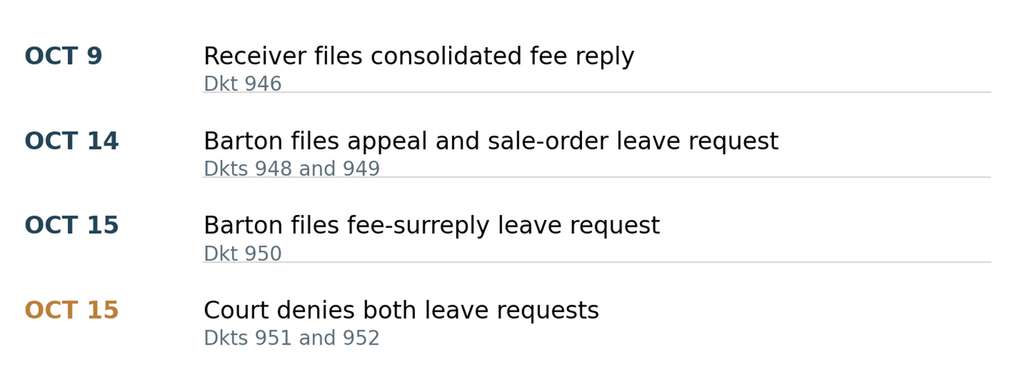
On October 15, Judge Brantley Starr denied two requests from Timothy Barton for permission to file. One is concerned with protections around the court-approved transfers of four apartment properties already headed toward appeal. The other sought to answer the Receiver’s latest explanation of billing errors and proposed payment corrections. Both were stopped at the leave stage.
The fee request, Dkt. 950, was filed on October 15 and denied that same day, within a few hours, according to Barton’s team. The sale-order request, Dkt. 949, had been filed the day before. Both requests were denied on October 15. The speed of those decisions is a central part of the defense’s concern about whether its proposed submissions received meaningful consideration.
Behind those short orders were two substantial packages. Barton wanted to narrow provisions he says could impair appellate relief before closing. He also wanted to explain why billing time that had already been written off should not excuse specific overcharges that remained in the requested fees. His requests identify what he wanted decided, provide proposed language, and record opposition from the affected parties.
The additional motion before the motion
Barton is representing himself. Under Starr’s June 5 order at Dkt. 747, he must seek leave before filing any motion. That order expressly exempts responses and replies filed under Local Rule 7.1(e) and (f). A June 8 follow-up, Dkt. 749, tells him to explain why a proposed motion must be filed, attach it and comply with the local rules, including the conference certificate requirement.
The result is an additional decision before a proposed motion can proceed as an operative filing. Barton’s amendment and stay requests had to pass that stage. A surreply, an additional response after the moving party’s reply, also requires permission; Barton acknowledged that he had no automatic right to one. His argument was that the Receiver’s reply introduced a new rationale he had not been able to answer.
This is the practical setting for the defense’s concern about an opportunity to be heard in a prejudgment receivership. In these filings, the issue was access to a defined next step: an amendment and stay application in one dispute, and a limited answer to new reply material in the other.
| Request | What Barton sought permission to file | Result on October 15 |
| Dkt. 949 Filed October 14 | Motion to alter or amend Dkt. 944, proposed amended order, and limited stay pending appeal. | Dkt. 951 denies leave without an additional substantive explanation in the entry. |
| Dkt. 950 Filed October 15 | Limited surreply concerning the Receiver’s consolidated fee reply at Dkt. 946. | Dkt. 952 denies leave, finding no exceptional circumstances warranting a surreply. |
Both conference certificates identify October 14 conferrals. The sale-order certificate reports opposition from the Receiver, SPC and SEC. The fee certificate reports opposition from the Receiver and SEC. Neither denial cites a missing conference certificate or failure to confer. The requests, therefore, raised a different question: whether the court would allow the proposed materials to proceed.
The attachments remain visible within the leave packages. Denying leave did not erase them from those PDFs. It prevented their acceptance in the manner Barton requested as the operative motions or surreply. That distinction matters when assessing what the two orders actually decided.
The four properties and the unpaid bills
The property order concerns Bellwether Ridge in DeSoto, Parc at Windmill Farms in Forney, Parc at Ingleside near Corpus Christi, and Parc at Opelika in Alabama. The three Texas transactions transfer membership interests in the property-owning companies; Opelika involves a sale of the real property. These are the four developments covered in the earlier reporting. Barton’s latest request concerns the wording governing their transfer and the protection available while he seeks appellate review.
Together, the transactions carry $132,154,408.58 in stated consideration. That figure includes substantial debt components. The settlement’s cash component is $12 million, so the headline transaction value should not be read as the amount of new cash arriving for creditors. What the estate receives, and what is paid from it, are central to understanding the two disputes.
The connection to professional fees appears in the Receiver’s own applications. Filed together on September 18, the nine applications cover April 1, 2024, through June 30, 2026. The Receiver said that, as of filing, his team had not been compensated for work or reimbursed for expenses incurred on or after April 1, 2024. He attributed the delay to insufficient cash and said the outstanding bills could not be deferred indefinitely.
Both the Seventh and Fifteenth applications expressly link payment to the SPC settlement. The Receiver said the anticipated $12 million, once received and past the escrow period, would remove the cash constraints that had prevented professional payments. He also warned that the receivership could not function properly if unpaid lawyers or accountants stopped working. The expected settlement cash therefore mattered directly to the professionals requesting compensation, as well as to the estate and its creditors. His October 9 reply renewed that request, arguing that improved estate finances meant it was time for his team to be paid.
That connection gives Barton’s two requests a shared financial context. One sought to protect appellate review before property or membership interests changed hands. The other sought to correct the directions for payments that could be made from recovered funds. His billing objections arose as the Receiver anticipated having money available to pay more than two years of professional bills.
Barton sought corrections while leaving transaction approval in place.
Dkt. 949 did not ask Starr to withdraw the approval announced at the September 29 hearing or reconsider settlement ratification at Dkt. 926. The proposed amendment left the transactions approved, subject to their contractual and regulatory conditions. Barton challenged specified findings and operative language in the written approval order, Dkt. 944.
His first concern was the difference between judicial approval and other closing conditions. He identified language declaring the conditions in settlement Sections 6(b) and 6(d) satisfied upon entry. Barton asked the order to say explicitly that court approval did not itself establish HUD approval, loan payoff or performance of any other condition. His challenge was to the reach of the sentence, rather than an assertion that HUD requirements had already been bypassed.
The interests being transferred presented a second concern. The settlement describes Receiver-held interests of 99.5 percent in D4DS, 99.5 percent in D4FR and 99.75 percent in D4IN. Barton contrasted those figures with the order’s approval of “all membership interests”. He requested an express limit to what the receivership actually held and protection for interests outside it.
He also challenged language protecting SPC’s purchase against later appellate reversal unless a stay was obtained before closing. His proposed amendment would delete or narrow that provision so the availability of appellate relief remained for the appellate court to determine under applicable law. The distinction between receivership and bankruptcy is relevant to the argument: Barton specifically disputed importing bankruptcy-style purchaser protection into this transaction without an identified basis in the record.
Other requested protections concerned independent personal and nonparty claims, transaction-level accounting and preservation of closing records. The proposed savings clause would not establish that any personal right existed or was enforceable. It would preserve the distinction between estate claims and genuinely independent rights before an expansive claims provision was applied.
Barton also recognized that a written order can elaborate on an oral ruling and that party authorship alone does not invalidate an order. He asked for record support, notice and an opportunity to address the particular additions he disputed. That was the focused amendment; he sought leave to present.
The stay request targeted closing rather than ordinary operations.
Barton had already filed his Notice of Appeal at Dkt. 948 on October 14. The limited stay tendered as Exhibit C sought to prevent closing and delivery of conveyance instruments while appellate review proceeded. It expressly allowed escrow funding, HUD application processing, reasonable cooperation, and ordinary property operations to continue. He sought relief first in the district court under Federal Rule of Appellate Procedure 8.
He explained the urgency through Dkt. 944’s purchaser-protection clause: if closing occurred without a stay, SPC and the Receiver could invoke the order’s language against the effect of a later reversal. Barton did not concede that the clause was enforceable or that closing necessarily defeated every available remedy. He sought to preserve the pre-closing position so that question would not overtake review.
| Activity | Treatment in Barton’s proposed stay |
| Closing and delivery of conveyance instruments | Pause pending appeal or a further order. |
| Escrow funding | Continue under the agreements. |
| HUD application and review | Continue, with reasonable cooperation. |
| Ordinary property operations | Continue. |
The request acknowledged costs. Barton did not claim that a stay could never delay performance or increase carrying expenses. He asked for actual transaction deadlines, anticipated closing dates, and demonstrated costs to be identified and for security tailored to supported exposure. As an alternative, he requested a short administrative pause while the Court considered the application and, if denied, seven days to seek relief from the Fifth Circuit.
These are practical questions in real estate receivership transactions: title and control can change before an appeal is decided. The new motion sought protection against that sequence without suspending the entire settlement or daily operations.
Dkt. 951 recites the name of the leave motion and its three exhibits, then states: “The Court DENIES Barton leave to file this motion.” The entry gives no further reason for refusing leave. It does not separately work through the proposed closing restraint, the requested administrative alternative, or the disputed language in Dkt. 944. It granted no interim protection.
The Receiver acknowledged errors but argued against deductions
Dkt. 950 addressed a separate part of the receivership: nine quarterly fee applications, the Seventh through Fifteenth. Barton had filed objections at Dkts. 927–935. The Receiver’s October 9 consolidated reply, Dkt. 946, answered them. Barton then sought a limited surreply to address what he identified as new concessions, corrections, and an offset theory.
The Receiver’s own reply confirms three corrections Barton sought to address: a $200 charge caused by billing one hour at $475 instead of $275; $500.50 in two entries intended to be written off; and $2,640.39 already paid but included in the Eighth application’s proposed order. The Seventh application also records a $1,786.13 Veracity invoice already paid by mistake. Barton asked for that payment to be credited against any new disbursement.
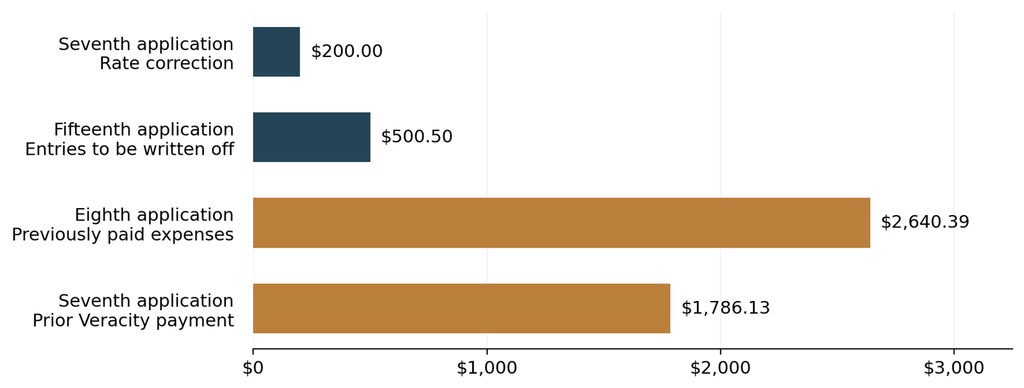
The dispute concerns what the Receiver asked the Court to do about those errors. He offered a revised Seventh request of $171,385.97 after the $200 correction, but also argued that earlier write-downs could make that reduction unnecessary. He made the same argument for the $500.50. The reply invoked nearly 100 hours, or $38,500, already written off across nine applications. Barton wanted to answer that rationale: time omitted from a bill should not become a credit against errors in the charges that remain.
The site’s earlier fee-application coverage gives the background to the recurring billing dispute. The reply describes Barton’s review as nitpicking while conceding specific errors. His proposed surreply challenged using earlier write-offs to avoid deducting charges the Receiver acknowledged should have been reduced or excluded.
Corrections in a brief and dollars in a payment order
The Receiver argued that corrections supplied through his reply could repair clerical errors without forfeiting the underlying fee requests. Barton asked for verified reconciliations and corrected proposed orders before payment. His concern was practical: the directions authorizing disbursement needed to match the amounts the Receiver said he was requesting.
The Ninth application provides a checkable example. The reply lists $13,855.41 for the Receiver and a $101,844.56 total, then says the proposed order also states the correct amount. The proposed order actually directs $13,885.41 to the Receiver. With the other two payments, its directions total $101,874.56, a $30 difference. That confirms the mismatch Barton asked to have reconciled. The reply also acknowledges that the Seventh application’s stated total omitted $10,772.46 for Veracity, although its proposed order included that amount. The Veracity issue concerns disclosure and reconciliation; the entire $10,772.46 is not automatically an overcharge.
| Issue identified in Dkt. 950 | Amount | What Barton requested |
| Ninth application reply total versus proposed payment directives | $30.00 difference | Reconcile the two totals before entering a payment order. |
| Seventh application Veracity amount omitted from stated total | $10,772.46 | Reconcile the request and payment directions; account for prior payment. |
| Fourth application amount reportedly omitted from an earlier order | $2,256.01 | Address the earlier order directly rather than carry the amount into a later quarter. |
The proposed surreply also corrects Barton’s own position. It withdraws one arithmetic objection to the Fourteenth application after accepting that $4,386.00 in fees plus $330.37 in expenses equals $4,716.37. His remaining objections stand. That withdrawal narrows the dispute rather than maintaining a claim the reply had answered.
Barton asked for corrected payment directions before disbursement. Dkt. 952 decided whether he could file his additional response; it did not determine how much should be paid, credited, or reduced.
The underlying accountability question is familiar to readers of the site’s explanation of a court-appointed receiver’s duties. For this article, the relevant requirement comes directly from Dkt. 650: compensation must be reasonable and requires prior court approval. That is why the accuracy of a proposed payment order matters before funds are disbursed.
The twenty percent safeguard Barton asked to retain
The reply’s treatment of the SEC’s position also matters. In one section, it stresses that the Commission is unopposed to the fee applications. Later, it acknowledges that the SEC recommends a twenty percent holdback on every application, then asks the Court to impose none. The Receiver invokes the $38,500 in write-offs and notes that the Court previously declined holdbacks. Barton sought to retain that safeguard while the payment figures were reconciled. The SEC recommendation was already disclosed; Barton identified the reply’s aggregated offset rationale as the new matter he wanted to answer.
Dkt. 650 already permits a twenty percent holdback of fees and expenses. It makes quarterly awards interim and subject to cost-benefit and final review, with held-back amounts payable at the Court’s discretion at the close of the receivership. Barton asked to use that existing safeguard and to obtain the SEC’s direct confirmation of its reported position.

He attached the SEC’s published Billing Instructions as guidance for assessing reasonable descriptions, combined tasks, and travel charges. His motion acknowledged that the receivership order does not expressly incorporate that document. The request therefore asked the Court to consider its relevance to reasonableness rather than assume every instruction had already been made binding in this case.
The Receiver offered to provide unredacted invoices if the Court considered that necessary, while arguing that a review was unnecessary. Barton asked Starr to use that option. A private judicial inspection would allow review of contested entries while protecting privileged content.
Dkt. 952 acknowledges that surreplies are not available as of right and concludes that the circumstances are not exceptional enough to warrant one. The entry does not explain why the alleged new offset rationale or proposed corrections failed that test. It does not approve the fees, reject the original nine objections, or decide against a holdback. Those questions cannot be treated as resolved by this leave denial.
What the two denials leave unanswered
The sale-order request and fee request concerned different decisions, but encountered the same permission stage on October 15. One sought to clarify the scope of an order and preserve review before closing. The other sought to answer a financial justification offered after the initial objections. The Court denied both requests for leave.
The same-day denials leave the defense with a direct concern about meaningful consideration. Both packages identified specific corrections and protective steps. Dkt. 951 gives no additional substantive explanation. Dkt. 952 invokes exceptional circumstances without addressing the alleged new matters individually. Neither proposed submission obtained permission to proceed.
The denial entries do not set out answers to the amendment’s specific protections or the surreply’s offset argument. They record the refusal of leave. They do not establish a separate merits determination on every issue raised in the attached materials.
The current docket also records that Barton has appealed. Dkt. 948 identifies Dkts. 944 and 926; the proposed stay recognizes that an appeal does not itself halt closing. Neither the October 15 denial grants a stay, nor does this docket establish that a transaction has already closed. The immediate result is that Barton’s appeal has been filed while these two requested district-court submissions have been denied leave.
The latest entries extend the documented Barton case timeline. They record an appeal, a request to protect its practical value, and a separate effort to contest the Receiver’s billing explanation. On October 15, the Court answered both leave requests with denials. The concerns set out in their attachments remain available for readers to examine against those brief orders.
Frequently Asked Questions (FAQs)
1. Why did Judge Brantley Starr deny Timothy Barton’s two filing requests?
On October 15, 2026, Judge Starr denied two requests for leave to file in SEC v. Barton. Dkt. 951 denied permission to pursue proposed amendments and a limited stay concerning four apartment properties without providing additional substantive reasoning. Dkt. 952 denied permission to file a surreply concerning Receiver fees, finding insufficient exceptional circumstances.
2. Which four apartment properties are involved in the SEC v. Barton dispute?
The properties are Bellwether Ridge in DeSoto, Texas; Parc at Windmill Farms in Forney, Texas; Parc at Ingleside near Corpus Christi, Texas; and Parc at Opelika in Alabama. The transactions involve approximately $132.15 million in stated consideration, including substantial debt components, with a $12 million settlement cash component.
3. What billing discrepancies did Barton identify in the Receiver’s fee applications?
Barton identified a $200 billing-rate error, $500.50 in entries intended to be written off, and previously paid amounts requiring reconciliation. His proposed surreply also challenged whether approximately $38,500 in earlier billing write-offs could justify leaving acknowledged errors uncorrected.
4. Did the court’s October 15 denials resolve the disputed Receiver fees?
No. Dkt. 952 denied permission to file an additional response. It did not approve the nine pending fee applications, decide Barton’s original objections, or determine the appropriate payment amounts and holdbacks.
5. Has Timothy Barton appealed the four-property settlement order?
Yes. Barton filed a Notice of Appeal on October 14, 2026, at Dkt. 948, identifying Dkts. 944 and 926. His proposed stay sought to prevent property closings while appellate review proceeded. However, the October 15 denial did not grant a stay, and filing an appeal does not automatically suspend closing.
Further Reading
For more background on the property disputes, Receiver fee applications, and ongoing court proceedings in SEC v. Barton, explore these previously published investigations.
- Unveiling the Truth Behind Parc at Windmill Farms — Examines Barton’s objections to the property’s inclusion in the receivership, financing arrangements, and proposed sale.
- Bellwether Ridge: Challenging the Receiver’s Motion for Sale — Explores disputes surrounding property valuation, sale procedures, and the Receiver’s proposed disposition of the apartment complex.
- Behind the Numbers: Unjustified Billing in the Receiver’s Fee Application — Investigates disputed professional charges, billing inconsistencies, and questions concerning receivership expenses.
- A Closed Case That Keeps Moving: The Docket Says Closed, the Record Says Active — Examines how motions, court orders, and receivership disputes continued despite the case’s administrative closure.
- Rock Creek: A $1.4 Million Sale Built on Disputed Tracing and $61,836 in Closing Cash — A document-based investigation of property-sale proceeds, financing costs, professional fees, and the tracing dispute.
- Receivership Gone Rogue: 16 Key Properties and Agreements in Timothy Barton’s Legal Battle — An overview of major properties, proposed sales, settlements, and legal challenges associated with the Barton receivership.