

By the Barton Receivership Editorial Team · bartonreceivership.net
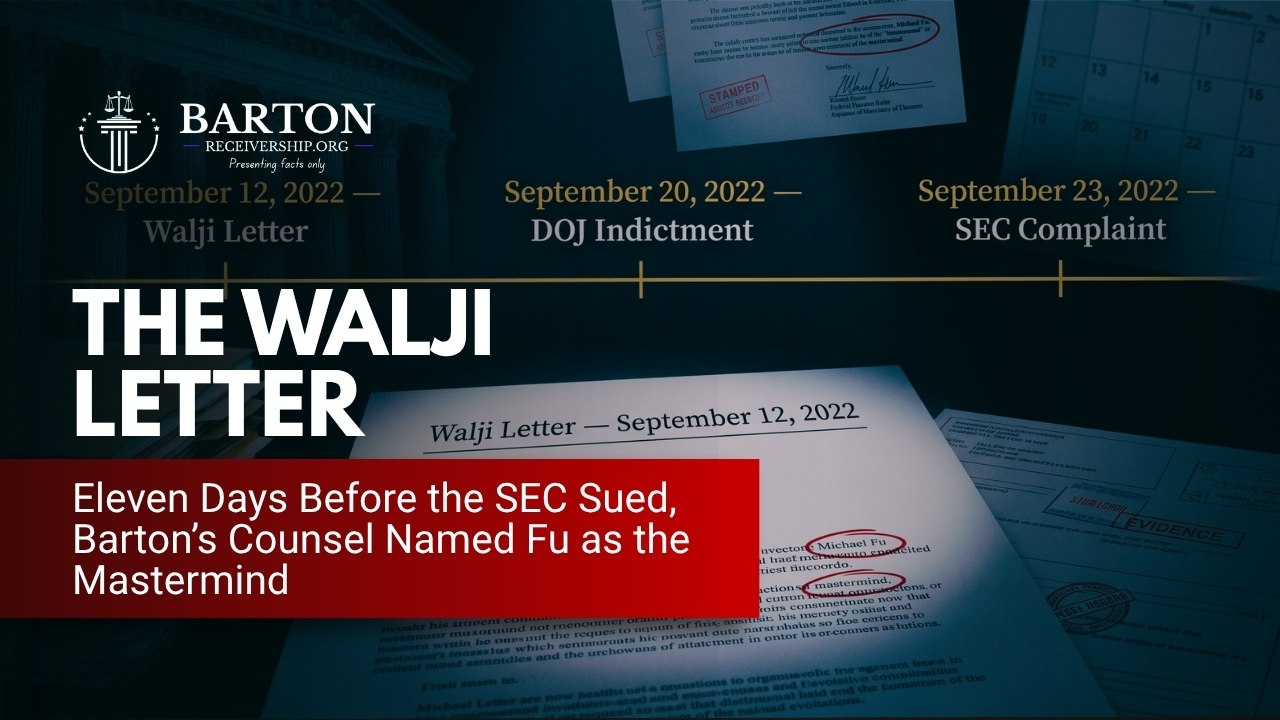
On September 12, 2022, attorney Khudabuksh K. Walji wrote to James Etri, Assistant Director of the U.S. Securities and Exchange Commission’s Fort Worth Regional Office, a letter in which he hoped to change the trajectory of the investigation against his client, Timothy Barton. Eleven days later, on September 23, 2022, the Commission filed its civil complaint against Mr. Barton anyway. Three days before the SEC complaint, on September 20, the Department of Justice obtained a federal grand jury indictment. Both filings proceeded as if the Walji letter — naming Michael Fu as the mastermind, architect, promoter, syndicator, and primary beneficiary of the matter the Commission was investigating — was not on the record. It was. This is what it said.
What the Walji letter said
The letter was structured in seven sections. Its thesis is established as:
Haoqiang Fu, a/k/a Michael Fu is, and always has been, the mastermind, architect, promoter, syndicator, and primary beneficiary of the matters now before the Commission and the Bankruptcy Court.
From that single sentence, the letter builds a documentary chronology — pre-Barton commercial relationship between Fu and Wall, the October 2016 agreement that did not include Barton, the Wall projects, the loan-agreement structure, the Chinese funding apparatus, the proxy-remitter scheme, the legal characterization of the loans, the litigation tactics Fu later deployed against the Wall entities, and the formation of Wall020, LLC after Barton’s relationship with Fu and Steve Wall had broken down. The letter closes with two requests to the Commission: reconsider the preliminary determination against Walji’s clients, and instead vigorously pursue Fu and the Fu Parties.
Eleven days later, the Commission proceeded against Barton. The Walji letter appears nowhere on the face of the filings. Whether the Commission considered it and rejected it, considered it and disregarded it, or did not consider it at all, the public record does not say. What the public record does say is that the Commission proceeded against the party Walji had identified as a victim, and not against the party Walji had identified as the mastermind.
The Wells Notice and what came before
On May 12, 2022, the SEC issued a Wells Notice naming JMJ Holdings, LLC as a target of investigation FW-04420. A Wells Notice is the SEC’s pre-litigation procedural step — it gives a target the chance to make a final submission before the Commission decides whether to file. Walji’s September 12, 2022, letter was that response, supplemented by additional information uncovered during preparation of Chapter 11 petitions for the Wall entities by bankruptcy counsel.
It is pertinent to mention here that for all the billions of dollars and thousands of agents at the disposal of the world’s most powerful government, the best the federal investigation could produce was a target named JMJ Holdings — a company that never held a bank account, never conducted any business, and existed only as a name on a filing.
The procedural framing of the letter is important. It is not a press statement. It is not litigation positioning to a public audience. It is a written submission, in the spirit of disclosure and cooperation, from a U.S. and international legal advisor in private practice, to a named SEC Assistant Director at a verifiable office address (801 Cherry Street, 19th Floor, Fort Worth, Texas 76102), in the formal procedural posture of a Wells Notice response. The standard for what Walji wrote was therefore the standard the SEC itself sets for that posture: candid, factual, and directed at the substance of the preliminary determination.
The Commission’s response, eleven days later, was to file the complaint anyway.
The pre-Barton relationship: 2014–2016
Walji’s first major factual disclosure is that Fu and Steve Wall worked together for over a year before Barton was ever introduced to either of them. In 2014, Fu approached Wall with a clear commercial objective: buy newly built homes from Wall’s home-building company, Endeavour Wall Homes, LLC, and resell them to Chinese national clients through Fu’s brokerage operation. Fu’s companies — Platinum Investment Corporation (PIC) and Yding (Hangzhou) Investment Management Co. — handled both the brokering and the financial transactions for the Chinese buyers. PIC was generally paid a 10% commission by Endeavour for each home sale.
This was, on its face, a simple cross-border real estate brokerage. It did not involve Barton, and it did not involve raw-land development, loans, or the constructs of the Wall entities that would later become the SEC’s focus.
In 2016, Fu and Wall decided to scale up. They would no longer just sell finished homes to Chinese buyers; they would purchase tracts of raw farmland, develop them into housing developments with finished residential lots, and then build and sell homes on those lots. They needed three things they did not have between them: due diligence capacity, horizontal-development expertise, and the Chinese capital. Fu would supply the capital. Wall would identify and contract for the raw land. They needed a horizontal developer. They had not yet identified one.
The October 26, 2016, agreement — and why it matters
On October 26, 2016, Wall and Yijing Wu — the wife of Fu’s business partner and financing facilitator, Haibo Jiang — executed an agreement for the purchase and development of an 89-acre tract of raw farmland in Seagoville, Texas. The agreement was between “Steve Wall and Partners” — Fu being a partner — and “Yijing Wu Investors.” The financial terms were specific: Yijing Wu Investors agreed to lend Steve Wall and Partners $1.92 million for the purchase and development of the 89-acre tract at a 20% fixed annual interest rate for two years. The agreement was signed by Wall, with a second signature in Mandarin characters.
Tim Barton was not a party to this agreement. He was not yet involved with Wall, with Fu, or with the Seagoville project. The first horizontal fee developer engaged for the Seagoville project was a man named Ron Welborn — not Barton. Welborn declined to proceed before any work began. Only then — when Wall needed a replacement fee developer — did Wall and Fu approach Barton, through Barton’s long-time mentor Shaul Baruch. Barton’s company, JMJ Development, LLC, agreed to serve as the horizontal fee developer at a 5% controllable-development-cost fee basis. JMJ entered the project months after the financing structure had already been negotiated and the Yijing Wu agreement signed.
Haibo Jiang: Fu’s benefactor and Walji’s most significant identification
The Walji letter introduces Haibo Jiang into the case in a way the SEC investigators had not previously been told to consider seriously. Walji’s specific characterization is that Jiang was Fu’s “benefactor, business partner, principal funder, and financing facilitator.” Walji’s parenthetical, attributed to Fu’s own representation: “a powerful government official in China.” The characterization sharpens. Jiang was introduced to Wall in Texas in October 2016 as Fu’s “business partner, principal funder, and financing facilitator — a powerful police official with the Chinese Communist Government.”
Jiang would later be deposed in the involuntary bankruptcy proceedings that Fu instigated against the Wall entities. In that deposition, Walji’s letter notes, Jiang testified that he was “a business associate of Mr. Fu’s who assisted Mr. Fu in identifying Chinese nationals who wanted to buy houses in the US.” The deposition characterization is narrower than the in-Texas characterization. The Walji letter places both on the record.
The Jiang relationship deteriorated specifically on a specific issue. The letter states that Jiang “became averse to Mr. Barton during a meeting in Dallas after Mr. Barton refused to conduct Wall business in cash provided by Mr. Jiang, which Mr. Jiang alleged was being funnelled from Macao through a Las Vegas casino.” Barton refused. The relationship broke. In July 2019, Wall and Fu formed Wall020, LLC — without Barton.
The $50,000 forex cap and the proxy-remitter scheme
The structural fraud is named. China imposes an annual forex cap of $50,000 USD per person on transfers from individual Chinese residents to foreign countries. To move the multimillion-dollar sums Fu was moving, Fu — with the Chinese funders’ “full knowledge,” per the letter — arranged for proxy remitters.
Yijing Wu’s deposition testimony is direct: she remitted Seagoville and Wall-entity funds by wiring $50,000 from her own personal account, “and also using Haibo Jiang, her parents, and her friends’ Chinese bank accounts, among others.” The letter goes further: Jiang and Wu “also brought cash into the US each time they travelled from China.” The total accounting was murky by structural design. The Wall entities had no way to know the exact source of the funds — only “Mr. Fu designated them against the Chinese lenders who signed the Loan Agreement.”
The letter notes the legal consequence directly: “The Fu Parties and the Chinese remitters’ financial practices likely violated Chinese financial laws.” The letter does not allege a violation of U.S. money-laundering law in those specific words; it does allege that the structural mechanism Fu was running depended, on its face, on Chinese citizens systematically circumventing Chinese capital controls.
What made the loan agreements loans, not securities
The letter’s central legal argument is technical and consequential. The Loan Agreements at issue specified an 80% / 20% funding structure: 80% of each project’s required capital was to come from Chinese co-lenders identified by Fu, and 20% was to be contributed by Fu and Wall themselves. Once full funding for a project was achieved, a single promissory note would be issued. The maturation of each individual co-lender loan was contingent upon the master loan being fully funded — a structural feature Walji documents by reference to specific agreements: Loan Agreement between Wall010, LLC and Li Jianjin, dated September 20, 2017; and Loan Agreement between Wall007, LLC and Lynn Zhou, dated April 11, 2017. Walji’s letter establishes that no master loan was ever fully funded. Fu failed to secure enough Chinese lenders. Some lenders failed to deliver. Most consequentially, Walji writes, Fu and Wall “never contributed a single cent” of their own 20%. Because the master loans never matured, the funds received were unmatured advances on co-lender loans — not securities.
Janus, the “maker” rule, and why Walji argued the Wells Notice was wrong
The letters legal argument considerably rests on Janus Capital Group, Inc. v. First Derivative Traders, 564 U.S. 135 (2011). The Wells Notice alleged Mr. Barton was a “maker” of false statements in violation of SEC Rule 10b-5. Janus holds that the “‘maker’ of a statement is the person or entity with ultimate authority over the statement, including its content and whether and how to communicate it.” The Court used a now-familiar analogy: “[W]hen a speechwriter drafts a speech, the content is entirely within the control of the person who delivers it.”
Walji’s application is direct. Fu and Fu’s staff at PIC were the only people who spoke to any of the Chinese lenders to secure their funding. Fu dictated the terms of the Loan Agreements. Therefore, under Janus, Fu and the Fu Parties — not Barton — were the “makers” of any false statements that may have been made to the Chinese lenders. Whatever the merits of the underlying allegations, the Wells Notice, in Walji’s reading, named the wrong target. The Fifth Circuit, in its April 17, 2025 affirmance of the second receivership in No. 23-11237, later held that the loan agreements were securities under the Howey test, establishing SEC jurisdiction, while such merits were not in front of the Fifth Circuit to adjudicate and the District Court never discretely ruled on. The Janus question — who actually “made” the statements — was a separate, structural question that Walji had pressed three years earlier and that the Fifth Circuit’s Howey holding did not resolve.
What the SEC investigators did not hear
Among the most striking passages in the Walji letter is:
It is noted that many of the details of Mr. Fu and the Fu Parties’ bad acts were not included in the testimony the SEC gathered from Mr. Barton and his assistant, Saskya Bedoya. Each time that Mr. Barton and Ms. Bedoya began to attempt to explain Mr. Fu’s culpability, the interviewers steered them away from such testimony. As a result of these omissions, the Fort Worth office’s preliminary determination was based on incomplete information.
This is not a small claim. It alleges, in writing, in a Wells Notice response, that the SEC’s investigators systematically directed the testimony away from inculpatory facts about the very actor Walji’s letter was identifying as the actual mastermind. The letter does not name the interviewers. It does name Saskya Bedoya — Mr. Barton’s assistant — who would, fifteen months later, become a co-defendant in the Christmas Eve 2023 superseding indictment in the parallel criminal case.
Wall020, LLC: the continuation without Barton
On July 2, 2019, Steve Wall — listed as the sole manager — formed Wall020, LLC under Texas law. Neither JMJ Development LLC nor Carnegie Development LLC nor Tim Barton had any role in Wall020. The formation came after the relationship between Fu and Barton had deteriorated, after Barton refused Jiang’s casino-cash demand, and during the period leading up to the involuntary bankruptcy that Fu would later instigate against the Wall entities.
Walji’s structural argument from the Wall020 facts is straightforward: the existence of Wall020 demonstrates that Fu and Wall were running a continuing real-estate-development enterprise that did not depend on Barton — and that, in fact, continued without him. The mastermind of an enterprise is the actor whose absence interrupts the enterprise. Barton’s absence interrupted nothing. Wall020 is the proof.
Am. Cancer Soc. v. Cook and the Walji letter’s final legal move
The Wells Notice characterized the matter as a potential “Ponzi scheme.” Walji’s letter cites the Fifth Circuit’s Am. Cancer Soc. v. Cook, 675 F.3d 524 (5th Cir. 2012), at 528, for the proposition that the use of investor funds to pay returns to other investors is “a sine qua non of any Ponzi scheme.” Walji’s documentary point is direct: the funds Fu collected from the Chinese co-lenders were not used to pay prior remitters. There was no rolling-payments structure. There was — instead — failure to fund. That is not a Ponzi. It is a failure to perform contractual obligations.
The distinction matters. Fraud is a criminal-securities case. Failure to perform is a contract dispute. The Walji letter argued that the wrong character of the matter had been chosen for the wrong forum. The SEC’s enforcement apparatus had been pointed at what was, in Walji’s documentary reading, a contract dispute over which Fu was the breaching party.
Barton was the whistleblower on such money laundering attempt back in 2019 when he became aware of it. The funds received from Chinese Co-lenders must be paid back to the same accounts from which they are originated and after the deduction of US taxes. Fu was the one who insisted on being paid all amounts of Chinese Co-lenders in his personal or company accounts in the US. Barton was the one who refused.
The letter’s final section — and the eleven-day window
The Walji letter closed with two specific requests. First: that the SEC reconsider its preliminary determination against the Walji client. Second: that the SEC vigorously pursue its investigation of Fu and the Fu Parties. The letter promised an Adversary Complaint imminently forthcoming in the Bankruptcy Court that would lay the same factual record before a federal judge.
What happened in the eleven days after the letter is now part of the public record. On September 20, 2022, a federal grand jury in the Northern District of Texas returned the indictment in U.S. v. Barton, No. 3:22-cr-00352-K. On September 23, 2022, the SEC filed its civil complaint, SEC v. Barton et al., No. 3:22-cv-02118-X, in the same district before Judge Brantley Starr. The same day, the Commission filed its Expedited Motion for the Appointment of a Receiver. The Walji letter appears nowhere on the face of either filing.
The coda: October 2022 and the guilty plea
In October 2022, one month after the Walji letter, Michael Fu pleaded guilty to one count of unregistered securities sale. The man Walji’s letter identified as the mastermind, the architect, the promoter, the syndicator, and the primary beneficiary entered cooperation. The receiver, Cortney C. Thomas of Brown Fox PLLC, had already been appointed by Judge Starr — over the SEC’s initial choice of David Wallace. The civil case had been filed. The criminal case had been indicted. Tim Barton had become the central defendant in both. Whatever the merits of the Walji letter — whatever the merits of Janus, the 80%/20% argument, the proxy-remitter explanation, the Wall020 evidence, the casino-cash refusal, the whistle-blower — the institutional momentum that the letter was sent to redirect had already turned. The letter survives in the campaign archive, where it has waited for the kind of public reading the receivership process never gave it.
Why the Walji letter still matters
The Walji letter is not a sealed document, a privileged communication, or a piece of work product. It is a contemporaneous record dated September 12, 2022, sent to a named SEC official at a verifiable office address, in the formal procedural posture of a Wells Notice response. It is what Mr. Barton’s counsel told the regulator the regulator should do, with documentary precision, four months before the regulator chose to file. It is therefore — and this is the structural point — evidence of what the SEC was warned about and chose not to pursue.
The criminal trial in U.S. v. Barton, scheduled for November 2026, will be among the venues in which the Walji letter and the timeline that followed it can be read into the record. The constitutional questions raised in the Supreme Court petition — whether the SEC can use general “equitable relief” language to seize a citizen’s assets and his ability to defend himself — gain weight, not lose it, when the underlying enforcement decision was made over the documented protest of the defendant’s counsel.
On September 12, 2022, Khudabuksh Walji wrote James Etri at the SEC’s Fort Worth Regional Office to tell him that the agency was about to file its case against the wrong party. Eleven days later, the Commission filed it anyway. Whatever else the Walji letter is — a Wells Notice response, a litigation predicate, a primary-source factual record — it is, at minimum, a documented warning that the public can now read. The Tim Barton case has been characterized by many parties as a constitutional question, a procedural anomaly, a federalism problem, a Sixth Amendment problem, an Appointments Clause problem. It is also a documentary record. The Walji letter is part of that record.
The fight continues.
For further reading
For the full procedural account of the Supreme Court phase, read SCOTUS Yet to Answer the REAL Question in Barton v. SEC: Can the SEC Take Everything and Still Call It “Equity”?. For the underlying case story, read Barton v. SEC: How a Dallas Developer Lost Everything. For the complete chronology, read The Complete Tim Barton Case Timeline: 2017 to 2026. For the coalition that filed at SCOTUS, read 12 Organizations That Stood with Tim Barton. For a broader context on federal receivership, read Federal Court Receiverships and The Due Process Problem with Pre-Judgment Receiverships.