

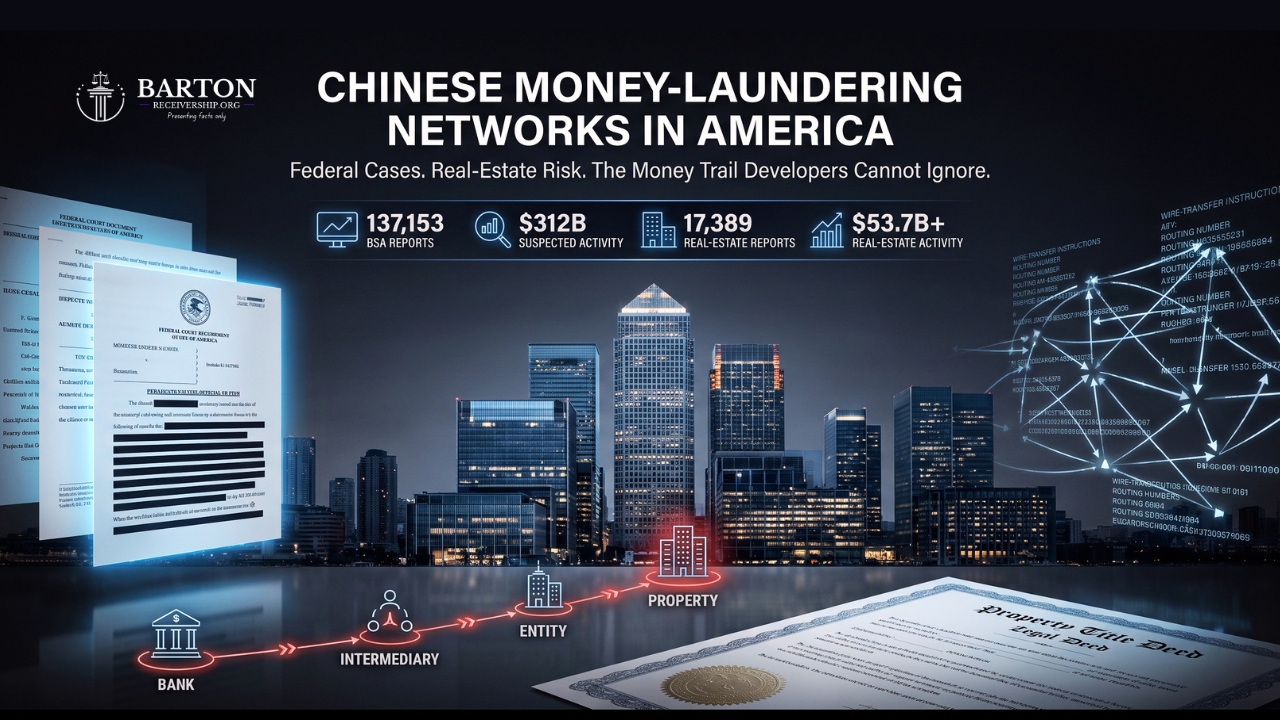
Federal cases, real-estate risk, and the warning signs developers cannot ignore.
What the Evidence Shows
Chinese money-laundering networks in America are no longer a theoretical concern. Federal prosecutors and FinCEN have described cases involving cartel proceeds, mirror transfers, trade-based laundering, fraud proceeds, money mules, and real estate. These cases do not prove that every China-linked transaction is suspicious. They prove that the typology exists, that it has reached the United States, and that real estate can be part of the integration stage.
The case record federal agencies are building
The public enforcement record shows that U.S. authorities are no longer treating Chinese money-laundering networks as isolated incidents. Prosecutors describe multi-year schemes, cross-border actors, trade-based laundering, encrypted communications, mirror transfers, and connections to Mexican cartels. Some cases are pending indictments. Some involve guilty pleas. All must be treated according to their legal posture.
Chart 1: Recognized federal cases and source links
| Case / source | What prosecutors or regulators alleged | Why it matters |
| DOJ: Sinaloa cartel and Chinese underground banking | Federal prosecutors alleged an alliance between Sinaloa cartel associates and money launderers linked to Chinese underground banking to launder more than $50 million. | https://www.justice.gov/usao-cdca/pr/federal-indictment-alleges-alliance-between-sinaloa-cartel-and-money-launderers-linked |
| DOJ: Transnational money-laundering organization | Two Chinese nationals were charged with conspiracy to launder funds for transnational criminal organizations using mirror transfers, foreign accounts, encrypted communications, and trade-based laundering. | https://www.justice.gov/opa/pr/members-transnational-money-laundering-organization-charged-laundering-cartel-funds |
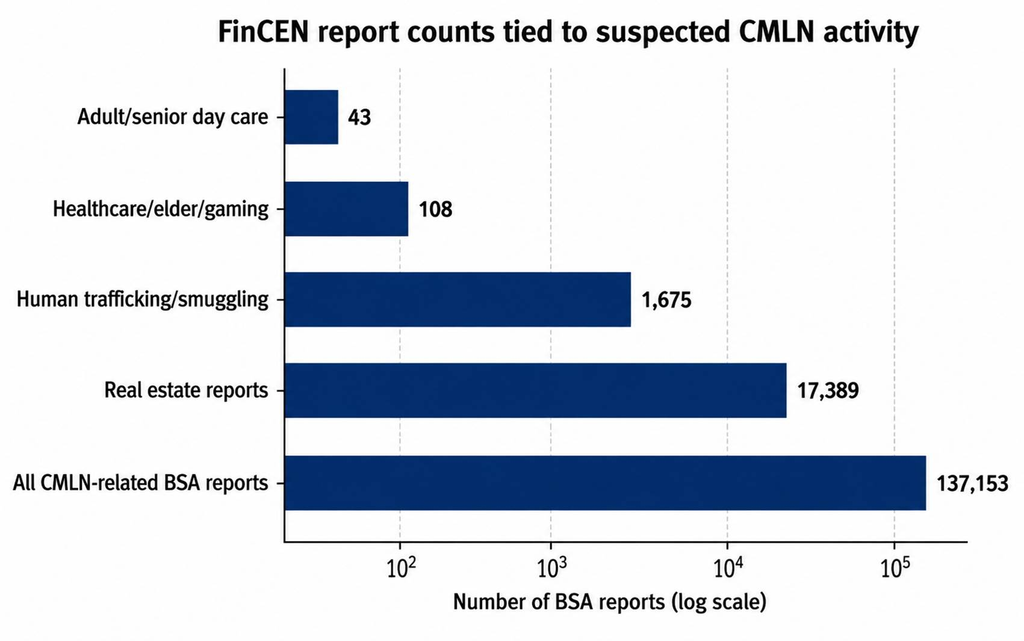
| FinCEN CMLN analysis | FinCEN identified 137,153 BSA reports and approximately $312 billion in suspected CMLN-related transactions from 2020 through 2024. | https://www.fincen.gov/news/news-releases/fincen-issues-advisory-and-financial-trend-analysis-chinese-money-laundering |
| FinCEN real estate data | FinCEN identified 17,389 BSA reports involving more than $53.7 billion in suspicious activity connected to real estate. | https://www.fincen.gov/news/news-releases/fincen-issues-advisory-and-financial-trend-analysis-chinese-money-laundering |
The network pattern
The pattern repeats because the incentives repeat. Cartels need to convert U.S. cash into usable financial value. China-based clients may seek dollars outside the PRC system. Brokers profit by matching those needs. Mules and shell entities give the transactions a legal face. Real estate gives the money a durable home.
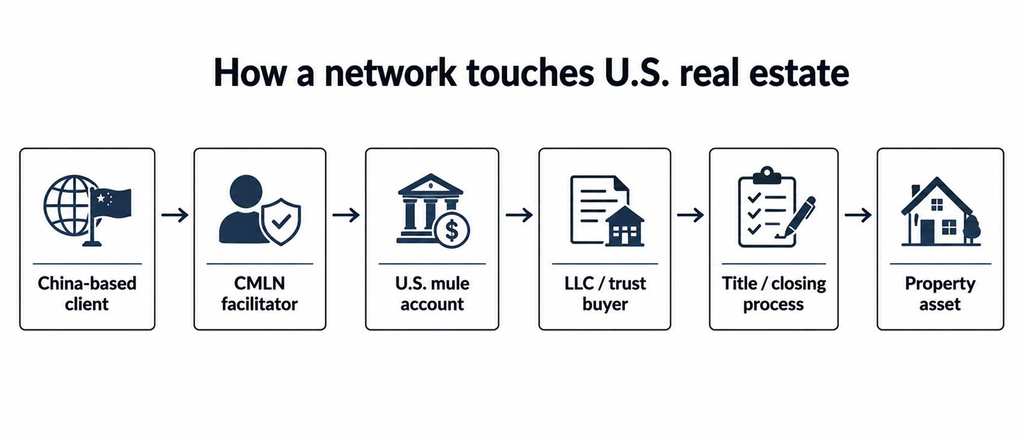
Chart 2: Network roles
| Role | Function | What investigators look for |
| China-based client | Seeks U.S. dollars or U.S. assets. | Source of wealth and reason for transfer. |
| CMLN broker | Matches dollar demand with illicit or restricted funds. | Communications, fees, transfer instructions. |
| Money mule | Moves funds through personal or business accounts. | Account activity inconsistent with profile. |
| Shell entity | Holds funds, contract rights, or title. | Beneficial ownership and business purpose. |
| Real estate professional | May facilitate closing or development. | Knowledge, due diligence, and warning signs. |
Why this matters to real estate developers
Developers can become exposed without being the original source of the problem. A developer may receive funds for a project, rely on an intermediary for foreign lenders, or assume the lender side has been vetted. That assumption becomes dangerous if the intermediary controls the investor relationship, provides incomplete documentation, or pushes funds through third parties whose names do not match the contracts.
The compliance lesson is direct: developers need source-of-funds discipline even when they are not banks. When the project depends on foreign funds, the developer should know who the lender is, who is sending the wire, why the sender matches or does not match the contract, whether the remitter has authority, and whether the transaction structure is trying to avoid scrutiny.
The Barton relevance
Barton’s defense position is that he was not the architect of the Chinese funding network; Fu was. That position matters because federal CMLN cases often turn on the person who controls access to funds, account instructions, mules, remitters, and communications. The person who receives operational blame is not always the person who designed the money trail.
The SEC overreach article describes Fu as the alleged architect and promoter of the ventures, while the Walji letter analysis details the defense-side claim that the SEC was warned about Fu before proceeding against Barton.
Chart 3: Developer exposure checklist
| Question | Clean answer | Danger answer |
| Who sourced the lender? | A documented investor with clear source of funds. | An intermediary who controls all access and documentation. |
| Who sent the wire? | Same party listed in the agreement or authorized representative. | Different sender with no clear authority. |
| Who provided KYC? | Complete tax IDs, wire records, and beneficial-owner details. | Refusal, delay, or substitution. |
| Who benefited from commissions? | Disclosed compensation tied to lawful services. | Hidden fees to the person controlling the money trail. |
| Who reported the problem? | Compliance concern escalated early. | Reporter later becomes enforcement target. |
Conclusion
Chinese money-laundering networks in America are documented enough that real estate participants can no longer treat the issue as theoretical. The Barton case belongs in that discussion because it presents a disputed money trail involving Chinese co-lenders funds, a powerful intermediary, alleged proxy remitters, and a developer who says he raised the alarm. The next question is not whether the label sounds dramatic. It is whether the evidence was followed wherever it led.
Frequently Asked Questions
What are Chinese money-laundering networks?
Federal authorities have described networks involving cross-border actors, underground banking, mirror transfers, trade-based laundering, foreign accounts, money mules, shell entities, and other mechanisms used to move or disguise funds.
What did FinCEN report about suspected CMLN activity?
FinCEN identified 137,153 BSA reports involving approximately $312 billion in suspected CMLN-related transactions from 2020 through 2024. It also identified 17,389 BSA reports involving more than $53.7 billion in suspicious activity connected to real estate.
How can these networks involve U.S. real estate?
The structure can involve a client, intermediary or broker, mule account, LLC or trust buyer, title or closing process, and ultimately a property asset. The exact structure varies from transaction to transaction.
What warning signs should real-estate developers watch for?
Warning signs discussed in this article include a wire sender who does not match the agreement, incomplete KYC or beneficial-owner information, unexplained third-party remitters, hidden compensation, and an intermediary controlling access to the lender or documentation.
Does a China-linked transaction automatically indicate money laundering?
No. The federal cases and FinCEN data do not establish that every China-linked transaction is suspicious. They show that these laundering typologies exist and that real estate can be used as part of the movement or integration of funds.
Further Reading
This article is part of our continuing examination of money-laundering risks, real-estate transactions, and the disputed funding issues surrounding the Barton case.
- CCP Connection & National Security: Chinese Money Laundering in American Real Estate
Examines the broader connection between China-linked financial activity, U.S. real estate, and the concerns raised in the Barton matter. - What Is Real Estate Money Laundering?
Explains how real estate can be used in money-laundering structures and identifies warning signs that developers and other participants should recognize. - The Chinese Money-Laundering Playbook
Looks more closely at recurring methods such as intermediaries, third-party transfers, money mules, shell entities, and movement of funds across borders.