

What landmark decisions reveal—and what they do not prove—about the Barton record
Whistleblower retaliation is not an abstract concern. It has shaped major Supreme Court decisions, federal statutes, and continuing debates over whether people can safely report suspected wrongdoing. But the phrase can also be used too broadly. Each law protects different people, different disclosures, and different reporting channels.
The cases examined here do not mirror the Barton matter. Most arose from employment disputes, federal personnel actions, or public-employee speech. Their value is narrower: they show how courts distinguish protected reporting from unprotected conduct, identify materially adverse action, and evaluate causation without relying only on an admission of retaliatory motive.
No court has ruled that Timothy Barton was legally retaliated against as a whistleblower. The question is whether the sequence described in the Barton case timeline—reporting first, enforcement later, followed by receivership and asset-control consequences—warrants examination through the same disciplined lens.
The Legal Baseline: Protection Depends on the Statute
The U.S. Department of Labor administers or enforces whistleblower provisions across numerous federal statutes. In the federal workforce, the Office of Special Counsel addresses prohibited personnel practices, including retaliation for protected disclosures.
Private-sector protections are more fragmented. Sarbanes-Oxley § 806 protects qualifying fraud-related reporting by employees of covered companies and certain contractors. Dodd-Frank § 78u-6 provides a separate SEC whistleblower framework. The False Claims Act protects employees, contractors, and agents from retaliation for lawful efforts connected to stopping false claims against the government.
These laws do not create one universal definition of a whistleblower. A serious analysis asks four separate questions: Was the activity legally protected? Did the relevant decision-maker know about it? Was there a materially adverse response? And is there sufficient evidence connecting the report to the later action?
Table 1. The Whistleblower Protection Framework
| Framework | Who It Generally Protects | Primary Retaliation Focus |
| 5 U.S.C. § 2302 | Covered federal employees and applicants | Personnel actions following protected disclosures concerning illegality, waste, abuse, or danger. |
| Sarbanes-Oxley § 806 | Employees of covered public companies and certain contractor employees | Fraud-related reporting, testimony, assistance, or participation in proceedings. |
| Dodd-Frank § 78u-6 | Individuals who satisfy the statute’s SEC-reporting definition | Retaliation connected to qualifying SEC whistleblower activity. |
| False Claims Act § 3730(h) | Employees, contractors, and agents | Retaliation for lawful efforts to stop false claims against the government. |
Case 1: Burlington Northern v. White — Practical Deterrence
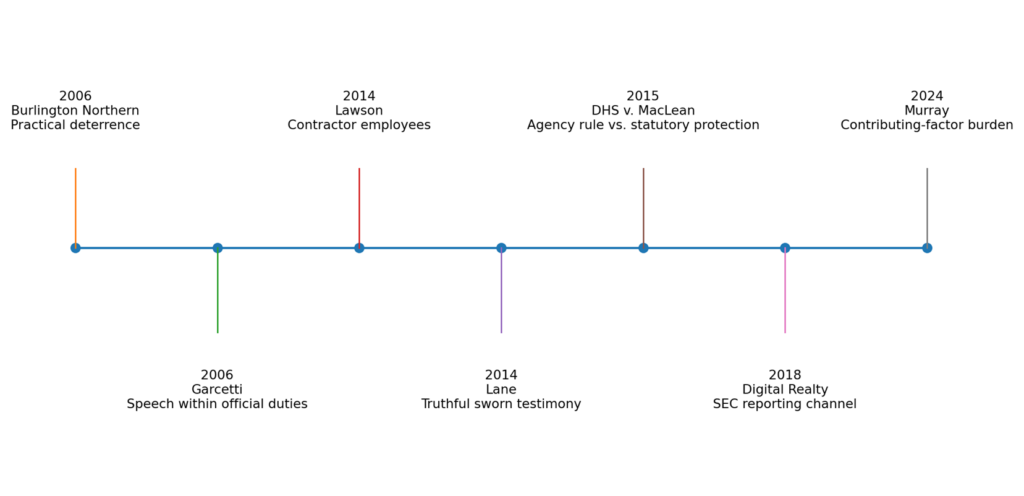
Burlington Northern & Santa Fe Railway Co. v. White was a Title VII employment-retaliation case, not a whistleblower case under securities or federal-personnel law. Its importance lies in the Court’s practical test: retaliation is not confined to ultimate employment decisions, and the challenged action must be serious enough that it could dissuade a reasonable worker from making or supporting a complaint.
The decision does not automatically extend Title VII to a business owner facing government enforcement. It does, however, explain why courts examine real-world deterrence rather than formal labels alone. For public scrutiny of the Barton record, the relevant question is whether the combined consequences described by Barton would discourage similarly situated people from reporting suspected misconduct.
Case 2: DHS v. MacLean — Agency Rules Do Not Automatically Defeat Statutory Protection
Department of Homeland Security v. MacLean involved a federal air marshal who disclosed that the Transportation Security Administration planned to remove air marshals from certain long-distance flights. The government removed him, arguing that the disclosure was prohibited. The Supreme Court held that the disclosure was not “specifically prohibited by law” for purposes of the federal whistleblower statute merely because a TSA regulation restricted it.
MacLean is a narrow statutory decision. It does not mean that employees may disclose any restricted information without consequence. Its broader lesson is that an agency cannot necessarily eliminate congressionally created whistleblower protection simply by relying on its own regulation.
Case 3: Lawson v. FMR — Protection Beyond the Public Company’s Payroll
Lawson v. FMR LLC addressed employees of privately held contractors and subcontractors that served public companies. The Supreme Court held that Sarbanes-Oxley § 806 can protect those employees, rather than limiting protection only to people directly employed by the public company.
The case demonstrates that retaliation can operate through complex organizational relationships. That insight is relevant to modern enforcement settings involving outside investigators, lawyers, contractors, and court-appointed professionals. It does not establish that every outside participant is a whistleblower or that every adverse relationship is retaliatory.
Case 4: Digital Realty Trust v. Somers — The Reporting Channel Can Control the Remedy
Digital Realty Trust, Inc. v. Somers interpreted Dodd-Frank’s definition of “whistleblower” to require providing information relating to a securities-law violation to the SEC. An individual who reported only internally could not invoke Dodd-Frank’s anti-retaliation provision on that basis.
The decision is an important warning against loose terminology. A person may report serious misconduct and still fall outside a particular statutory remedy because the report, the reporter, or the reporting channel does not satisfy that statute. Barton’s alleged reports therefore require statute-by-statute analysis rather than a generalized claim that every whistleblower law applies.
Case 5: Murray v. UBS Securities — Retaliatory Intent Is Not a Separate Element
Murray v. UBS Securities, LLC addressed the burden under Sarbanes-Oxley. The Supreme Court held that a plaintiff need not separately prove retaliatory intent. The employee must show that protected activity was a contributing factor in the unfavorable personnel action; the employer may then invoke the statute’s same-action defense.
Murray does not eliminate the need to prove causation. It clarifies how that burden operates. Timing, institutional knowledge, shifting explanations, and departures from ordinary practice may therefore matter even when there is no written admission of retaliatory motive.
Case 6: Garcetti and Lane — Public-Employee Speech Has Its Own Boundaries
Garcetti v. Ceballos held that public employees generally do not speak as private citizens for First Amendment purposes when they make statements pursuant to their official duties. Lane v. Franks later held that truthful sworn testimony outside an employee’s ordinary job duties can be citizen speech on a matter of public concern.
These decisions are not statutory whistleblower cases and are not direct analogies to Barton. They reinforce a central point: legal protection depends on context, duty, channel, and the specific source of law. The word “whistleblower” is a starting point for analysis, not the end of it.
Table 2. What the Landmark Cases Actually Establish
| Decision | Core Legal Principle | Responsible Use in Barton Coverage |
| Burlington Northern | Material adversity is assessed through practical deterrence. | Ask whether the response would discourage future reporting, while acknowledging that the case arose under Title VII. |
| DHS v. MacLean | An agency regulation was not the same as a disclosure “specifically prohibited by law.” | Examine the source and legal status of any claimed disclosure restriction. |
| Lawson v. FMR | SOX protection can reach employees of private contractors serving public companies. | Recognize indirect organizational relationships without assuming statutory coverage. |
| Digital Realty | Dodd-Frank’s anti-retaliation definition requires reporting to the SEC. | Identify precisely where, how, and to whom the information was reported. |
| Murray v. UBS | SOX does not require separate proof of retaliatory intent; contributing-factor causation still must be shown. | Evaluate chronology and causation without treating sequence alone as proof. |
| Garcetti / Lane | Public-employee speech protection turns on official duty and citizen-speech context. | Avoid blending First Amendment and statutory whistleblower doctrines. |
The Barton Connection: The Reporter Becomes the Target
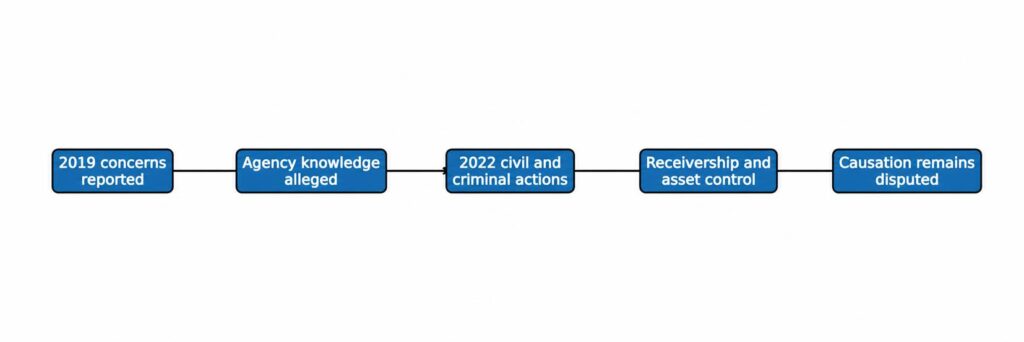
The Tim Barton case timeline states that Barton retained Guidepost Solutions in 2019 after identifying suspicious funding patterns. It further states that suspected money-laundering concerns tied to Michael Fu and related funding activity were reported to DHS and the FBI, and that Barton’s mediation attorney briefed an SEC investigator before the government filed its later enforcement action.
Three years later, the public record summarized in the Barton case overview shows a role reversal: the SEC filed a civil case, a parallel criminal case followed, and the district court placed Barton-linked entities into receivership. Barton argues that he reported suspected misconduct first and later lost operational control, access to assets, and practical defense resources.
Those facts are disputed in important respects, and no court has found a legally actionable whistleblower-retaliation claim in Barton’s favor. The chronology raises an investigative question; it is not itself a judicial conclusion.
Why Barton Is Not a Copy of These Cases
Barton was not a federal air marshal, an employee of a mutual-fund contractor, or a securities analyst pursuing a conventional Sarbanes-Oxley claim. His situation involves a businessman, alleged reports concerning outside funding, an SEC enforcement action, a parallel criminal proceeding, and a federal receivership.
That difference should make the analysis more careful, not more dramatic. The landmark cases supply questions and legal principles; they do not convert Barton’s chronology into a proven statutory claim. The appropriate public framing is that retaliation doctrine offers a disciplined way to examine the sequence, institutional knowledge, adverse consequences, and possible alternative explanations.
Table 3. A Legal Claim Compared With a Public Pattern Inquiry
| Question | Specific Legal Claim | Public Pattern Inquiry |
| Protected activity | Did a particular statute protect the person, subject matter, and reporting channel? | Was serious suspected misconduct reported through a documented channel? |
| Institutional knowledge | Did the legally relevant decision-maker know of the protected activity? | What did government personnel know, when did they know it, and how was it handled? |
| Adverse action | Was there an action covered by the applicable retaliation standard? | Did the later process impose unusual legal, economic, operational, or reputational pressure? |
| Causation | Was the protected activity a legally sufficient cause or contributing factor? | Does the sequence warrant further investigation, and what independent reasons support the later actions? |
| Conclusion | A court determines liability and available remedies. | Journalists and the public identify unanswered questions without declaring legal liability. |
When Process Becomes Punishment
The receivership is central to Barton’s public theory. BartonReceivership.net’s federal receiverships explainer describes the transfer of asset and operational control to a court-appointed receiver. Its pre-judgment due-process analysis examines the consequences of that transfer before final liability is determined.
The investigative question is not whether a receivership is inherently retaliatory. It is whether the original disclosure was independently evaluated, whether less restrictive measures were considered, whether the receivership preserved more value than it consumed, and whether civil asset control materially affected Barton’s ability to defend the criminal case.
What These Cases Teach Beyond Their Facts
Taken together, the decisions do not announce one universal whistleblower rule. They demonstrate that retaliation law is highly dependent on statutory text, reporting channel, employment status, institutional knowledge, material adversity, and causation.
They also show why formal labels are not enough. An institution may call an action routine, protective, or administrative. A court still examines what the governing law requires and how the action operated in practice. In public reporting, the same discipline means testing claims against documents, dates, decisions, costs, and plausible non-retaliatory explanations.
The Public Lesson
Case law keeps the discussion grounded. It prevents “whistleblower” from becoming a slogan applied to every person who reports a concern and prevents “ordinary procedure” from becoming a complete answer to every allegation of retaliation.
For Barton, the responsible question is not whether he can be inserted into an employment case that does not fit. It is whether the documented chronology—reporting, alleged government knowledge, later enforcement, receivership, and defense-resource pressure—has been fully and independently explained.
Bottom Line
America’s leading retaliation decisions offer no automatic verdict on the Barton matter. They do provide a method: identify the governing law, trace the reporting channel, determine who knew what and when, examine the practical consequences, and test causation against independent explanations.
No court has ruled that Barton was retaliated against as a whistleblower. But the sequence described in the public record is serious enough to warrant scrutiny. The strongest case for public examination is not that Barton is identical to Burlington Northern, MacLean, Lawson, Digital Realty, Murray, Garcetti, or Lane. It is that those decisions show why protected reporting, government knowledge, adverse process, and causation should be examined with precision rather than assumption.
Related Reading
This article is part of the Barton Receivership series examining whistleblower retaliation and the Timothy Barton case. For additional background, read: