

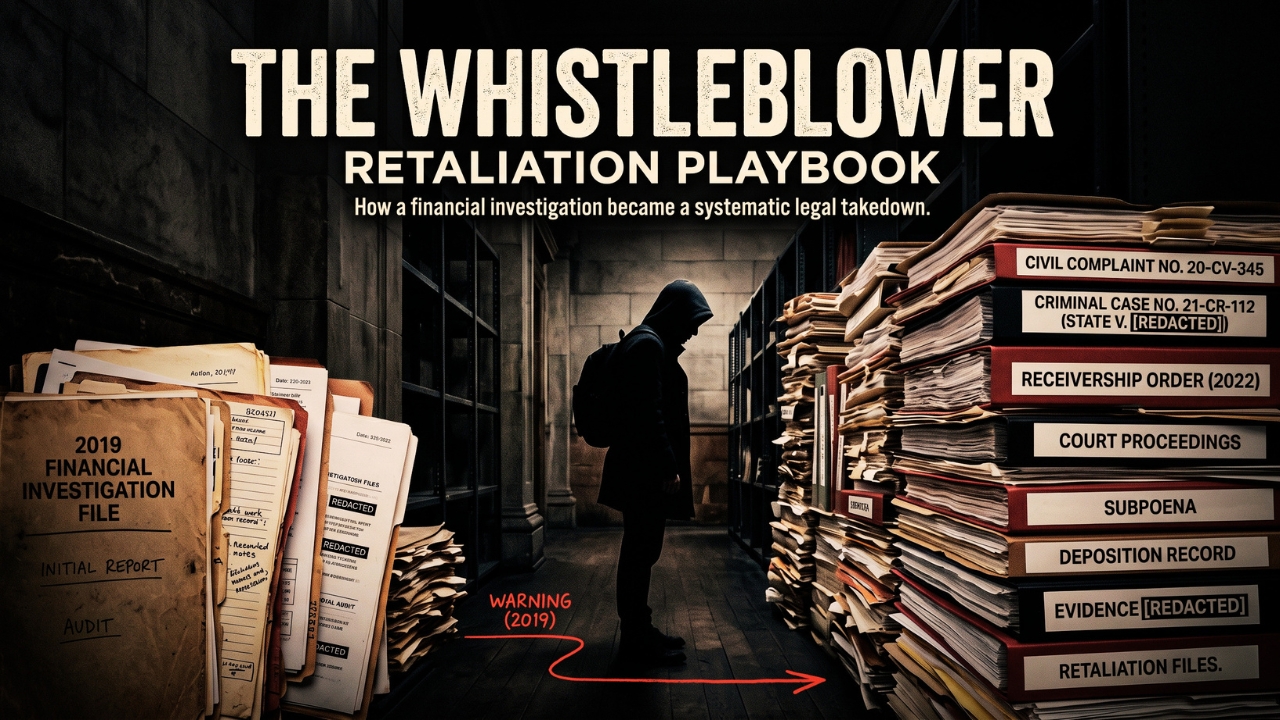
Whistleblower retaliation rarely announces itself in plain terms. It usually does not arrive with a memo saying that someone is being punished for speaking up. Instead, it may emerge through a sequence of events that appear routine when viewed separately: a warning is narrowed, the reporter is recast as a problem, new proceedings begin, costs rise, and the public narrative settles before the underlying facts are fully tested.
That sequence is often described as a whistleblower-retaliation playbook. It is not proof of retaliation by itself, and no court has ruled that Timothy Barton was legally retaliated against as a whistleblower. But examining the sequence helps explain why the Barton record raises questions that deserve careful, evidence-based scrutiny.
Whistleblower protections vary by statute and setting. The U.S. Department of Labor describes retaliation as adverse action connected to protected activity, while the U.S. Office of Special Counsel explains the federal-workforce framework. Those standards do not decide Barton’s case, but they illustrate why chronology, institutional knowledge, adverse action, and causation matter.
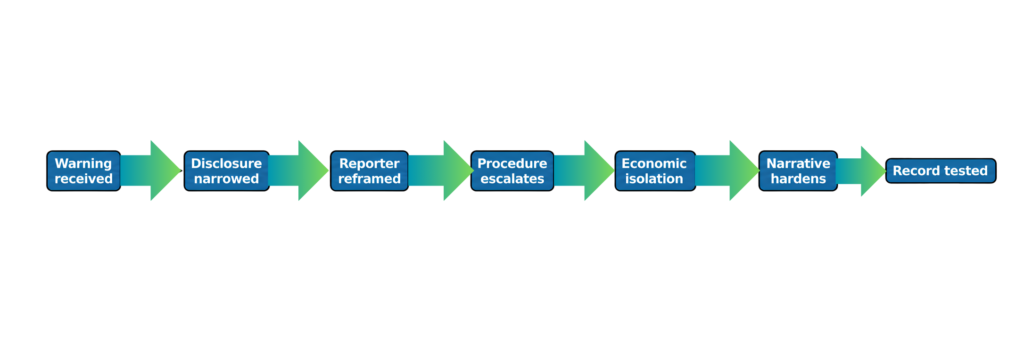
Figure 1. A retaliation-by-process sequence becomes visible when separate events are examined together.
Step 1: Receive the Warning, Then Shrink It
The first institutional response to a warning is not always open hostility. Sometimes it is polite inaction. A disclosure may be received but treated as incomplete, inconvenient, or outside the immediate scope of review. In other cases, officials may avoid follow-up questions that could challenge an existing theory of the case.
None of those responses proves retaliatory intent. The concern arises when a potentially material warning is repeatedly narrowed while attention shifts toward the person who raised it.
Table 1. How Institutions May Respond to a Warning
| Disclosure Response | What It May Signal | Potential Concern for the Reporter |
| Full, independent review | The report is treated as potentially material and tested against the available evidence. | Lower concern if the process remains neutral and documented. |
| Narrow review | Only part of the disclosure is examined, or difficult questions are left unresolved. | The report may become marginalized without being fully tested. |
| No meaningful review | The disclosure is received but produces no visible investigative follow-up. | The reporter may later be characterized as unsupported or unreliable. |
| Reverse inquiry | The institution’s attention shifts from the reported conduct to the reporter. | Raises the strongest concern about a possible role reversal. |
Step 2: Reframe the Reporter
When a warning becomes inconvenient, scrutiny can move from the substance of the report to the credibility or motives of the person who made it. The reporter may be described as disgruntled, self-interested, unreliable, politically motivated, or legally exposed. That shift can weaken the disclosure in the public mind before the underlying evidence is independently evaluated.
This is where the Barton record becomes significant. According to the Tim Barton timeline, Barton reported suspected money-laundering concerns in 2019. The SEC and DOJ later focused enforcement proceedings on Barton. His position is that the person who first raised the warning ultimately became the target.
Step 3: Turn Procedure Into Leverage
Retaliation-by-process is difficult to assess because each event may have an ordinary legal purpose. A subpoena can seek evidence. A hearing can resolve a dispute. A receiver can preserve assets. A fee application can document estate administration. The investigative question is whether the cumulative use of those tools remained proportionate, independently justified, and subject to meaningful oversight.
Table 2. Procedure as Leverage
| Procedural Tool | Ordinary Purpose | Concern When Misused or Disproportionate |
| Investigation | Gather facts and test competing explanations. | May become narrowly focused on the reporter while the original disclosure receives limited review. |
| Public complaint | State the government’s allegations and requested relief. | Can create reputational consequences before evidence is tested at trial. |
| Parallel criminal proceeding | Pursue alleged criminal conduct. | Can increase plea and defense pressure when combined with civil asset restrictions. |
| Receivership | Preserve and administer assets under court supervision. | Can transfer control and restrict access to defense resources before final liability. |
| Fee and reporting cycle | Document estate administration and professional compensation. | Can reduce estate value if costs grow without clear, transparent benefit. |
| Delay | Allow motions, discovery, appeals, and administration to proceed. | Can exhaust resources and harden public perceptions before final resolution. |
When Process Becomes Punishment
The receivership is central to understanding Barton’s retaliation theory. BartonReceivership.net’s federal receiverships explainer describes a receivership as a court-supervised process in which a receiver takes control of assets. The site’s due-process article examines how a pre-judgment receivership can place a defendant at a serious practical disadvantage by transferring possession and control before a final verdict.
The Barton record also raises a broader question about the exercise of institutional power outside the traditional employment setting. When reported conduct is not independently evaluated—particularly where it conflicts with the government’s developing enforcement theory—procedural tools can impose substantial pressure through investigations, parallel proceedings, asset control, legal and professional fees, reputational damage, and prolonged delay.
Table 3. Why the Barton Theory Is Different
| Traditional Retaliation | Retaliation by Process Theory | Barton Relevance |
| Firing, demotion, or loss of pay | Asset restraint, receivership, litigation costs, and public allegations | Barton’s case does not present a classic workplace dispute; his theory concerns an alleged pattern operating through legal process. |
| Employer acts against worker | Government power or legal machinery places pressure on a reporter or critic | The record involves SEC action, a receiver, and a parallel criminal case. |
| Relief often focuses on reinstatement or back pay | Relief may involve due-process review, limits on asset control, and financial accountability | Barton’s public position emphasizes defense resources, asset control, and pre-judgment consequences. |
Step 4: Drain the Economics of Resistance
A legal process can have serious practical consequences even before the underlying claims are decided on the merits. Litigation, experts, appeals, and public communications all require resources. When a defendant loses access to assets or control of operating businesses, the ability to test the government’s allegations may narrow regardless of the eventual outcome.
That concern appears throughout BartonReceivership.net’s due-process coverage. The pre-judgment receivership article examines the loss of possession and control before trial. The SCOTUS article frames the unresolved question as whether equitable relief can be applied so broadly that a defendant is left unable to fund a defense in a parallel criminal case.
Step 5: Let the Narrative Harden Before Trial
Public allegations can harden into perceived truth long before a factfinder reaches a final decision. A civil complaint may be read as proof. The appointment of a receiver may be treated as a finding that assets are tainted. An indictment may be mistaken for a conviction. These assumptions can impose reputational consequences even when the underlying allegations remain disputed.
Table 4. Narrative Hardening Before Trial
| Public Signal | Common Assumption | Investigative Correction |
| Civil complaint filed | The allegations have already been proven. | A complaint states allegations; it is not a verdict. |
| Receiver appointed | The assets must be tainted. | The appointment of a receiver is not itself a final finding of liability. |
| Criminal indictment | The defendant is guilty. | An indictment is a charge, not a conviction. |
| Repeated reports and fees | The administration must be ordinary and effective. | The public can still ask what value is being preserved, at what cost, and for whom. |
The Barton Connection: The Reporter Becomes the Target
The Tim Barton case timeline provides the central sequence examined here. It states that Barton retained Guidepost Solutions in 2019 after identifying suspicious funding patterns, and that reports concerning suspected money laundering tied to Michael Fu and related funding activity were made to DHS and the FBI. It also states that Barton’s mediation attorney briefed an SEC investigator before the government filed its later enforcement action.
Three years later, the public-facing record described on BartonReceivership.net shows a significant role reversal: the SEC filed a civil case, a parallel criminal case followed, and the district court appointed a receiver over Barton-linked entities. Barton argues that he reported misconduct first and later lost access to assets, operational control, and practical defense resources.
No court has ruled that Barton was legally retaliated against as a whistleblower. The relevant question for this article is narrower: whether the chronology resembles a retaliation pattern strongly enough to warrant independent examination.
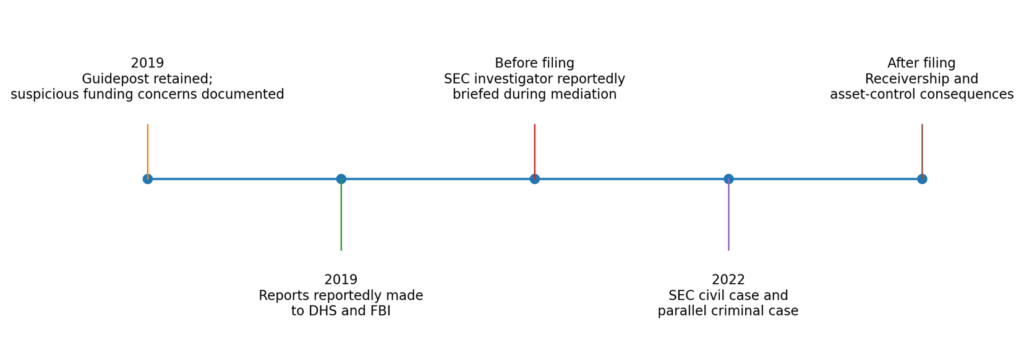
Figure 2. The Barton chronology through a retaliation-pattern lens. The sequence reflects the public record and Barton’s stated position; it is not a judicial finding of retaliation.
Table 5. Barton Through the Retaliation Playbook
| Playbook Stage | Publicly Described Barton Record | Why the Stage Matters |
| Warning | Barton reportedly retained investigators and reported suspected money laundering in 2019. | Establishes the claimed whistleblower-type starting point. |
| Institutional knowledge | The record says an SEC investigator was briefed before the later enforcement filing. | Raises questions about what the agency knew and how the information was evaluated. |
| Role reversal | Barton later became the central target of SEC and DOJ proceedings. | The reporter-to-target sequence is the central public concern. |
| Asset control | A receiver took control of Barton-linked entities. | Escalated the dispute from litigation to direct economic and operational control. |
| Defense pressure | Barton says the receivership impaired his ability to fund a defense. | Raises questions about the practical interaction between the civil and criminal proceedings. |
| Long duration | The case and receivership continued through years of motions, reports, and appeals. | Prolonged proceedings can impose substantial burdens before final resolution. |
Step 6: Isolate the Reporter Economically
Economic isolation can take different forms. In an employment case, it may involve the loss of wages or professional opportunities. In an enforcement case, it may involve loss of asset control, limited access to counsel and experts, or dependence on court-supervised processes for basic defense expenses.
Barton argues that the receivership created that form of pressure. The estate was intended to preserve value, but the practical effect was to move control away from him while the receiver, lawyers, and related litigation continued. That does not establish retaliation, but it makes the receivership’s costs, results, and effect on the defense relevant to any neutral review.
Step 7: Make the Public Narrative Move Faster Than the Court
Public enforcement narratives often move faster than judicial findings. Allegations appear immediately, while motions, evidentiary disputes, appeals, and final merits decisions can take years. Headlines become shorthand, and the person accused may become publicly identified with allegations that have not yet been adjudicated.
The Barton record illustrates that timing problem. The government’s allegations and the receivership became public early, while disputes over the merits, receivership administration, appellate jurisdiction, and Supreme Court questions developed much more slowly. That imbalance can affect reputation, resources, and litigation decisions long before the legal process reaches a final answer.
How the Playbook Hides in Plain Sight
A possible retaliation pattern can remain difficult to see because each action has a separate procedural explanation. An investigation may be described as routine. A public complaint may be defended as transparency. Delay may be attributed to docket pressure. A lawsuit may be characterized as asset recovery. A receiver may be presented as neutral. The broader pattern becomes visible only when the events are arranged in sequence and tested against the full record.
What Breaks the Playbook
The most effective response is a documented chronology. Dates matter. Letters matter. Investigative reports matter. Docket entries matter. Fee applications matter. Sale orders matter. When the sequence is visible, isolated procedural explanations can be tested against the broader record.
A clear timeline is therefore more than a communications tool. It allows the public, courts, journalists, and oversight bodies to compare what was reported, who knew about it, what happened next, and whether later actions were independently justified.
What a Neutral Investigator Would Ask
- Who received Barton’s 2019 reports, and what did they do with them?
- Were Barton’s documents, sworn statements, and investigative materials evaluated before the SEC complaint was filed?
- Did any official treat Barton’s reports as inconsistent with the government’s developing enforcement theory?
- What role did Michael Fu’s cooperation play in the government’s theory?
- Why were less drastic measures considered insufficient before the receivership took operational control?
- How much estate value was preserved, compared with the amounts consumed, sold, or delayed during the receivership?
- Did the civil receivership materially impair Barton’s ability to defend the criminal case?
Bottom Line
The whistleblower-retaliation playbook is rarely defined by one dramatic event. The concern arises from accumulation: a warning is narrowed, the reporter is reframed, legal pressure increases, resources decline, and public assumptions harden before trial.
The Barton chronology does not prove retaliation, and no court has made that finding. It does, however, present a report-first, target-later sequence that merits close examination. The fairest way to evaluate it is not through slogans, but through records, dates, costs, decision-making, and a clear account of what officials knew at each stage.
Further Reading
This article is part of BartonReceivership.net’s Whistleblower Retaliation Series. Begin with the pillar report, “Whistleblower Retaliation: How Government Punishes”, then continue with “What Is Whistleblower Retaliation?”, “Famous Whistleblower Retaliation Cases in America“, and “Did the Barton Case Follow the Whistleblower Retaliation Pattern?” for the legal framework, historical cases, and Barton-specific analysis.