


Years before Judge Starr approved $132.15 million in apartment transactions, disputes over Chinese creditors’ loan claims had reached his docket. Timothy Barton says the connection deserves a closer look.
NOVEMBER 24, 2026 • SEC v. Barton, Northern District of Texas
On September 29, 2026, four Texas and Alabama apartment developments came before Judge Brantley Starr in a hearing that lasted about forty minutes. By early October, the court had approved transactions valued at $132.15 million. Yet Timothy Barton argues that the more important question had been raised years before anyone discussed these sale prices: why were the apartment companies under federal receivership control in the first place?
The SEC case arose from approximately $26.3 million raised through offerings linked to land-development loans involving investors, many based in China. Barton says the receivership ultimately reached a far larger collection of American business assets, a portfolio he estimates at about $200 million in gross value. That $200 million is his estimate, not a court appraisal or a measure of available equity. The four properties at issue in the September hearing had their own court-accepted appraisals totaling $138.44 million.
For Barton, the story has two chapters that cannot be separated: the older disputes over the lenders and the reach of the receivership, followed by the sale process that moved valuable real estate toward new ownership. Both chapters involve the same federal district judge. The court records establish that connection, but they do not establish every conclusion Barton draws from it.
Before the apartment sales, there was a dispute over the lenders.
The story begins with lending agreements used to finance specific Wall land-development projects. In 2020, petitioning creditors living in China brought involuntary bankruptcy cases against several Wall entities. Those filings produced an unusual fight over basic questions: Who authorized the petitions? Could the signatures be verified? Would the creditors appear to answer questions under oath?
Barton also points to an earlier civil lawsuit brought by lenders that he says was dismissed before the involuntary bankruptcies. That separate civil docket and the precise basis for its dismissal have not been independently verified here. The later bankruptcy court’s published account, however, puts the creditor-identity and deposition disputes on the record in unmistakable terms.
Judge Harlin DeWayne Hale, the bankruptcy judge overseeing those cases, required the creditors to commit to appearing for depositions in person in the United States. A court-published account of his November 23, 2020 ruling records discrepancies among signatures and unsuccessful efforts to verify some creditors’ identities and participation. The court warned that the cases could not be left indefinitely on hold and provided for dismissal without prejudice if the required deposition agreement or an appellate stay was not obtained.
That history gives Barton an understandable question: before courts used extraordinary remedies affecting American companies, how thoroughly were the original claimants and their claims tested? The bankruptcy record documents serious identity and discovery disputes. It does not, on its own, establish that the creditors were fictitious, that they were CCP operatives, or that fraud on the court was adjudicated.
Barton has said the petitioning creditors never came to the United States to testify. The material reviewed here confirms the order requiring in-person depositions; it does not establish the later travel or testimony history of every petitioner. The distinction matters because a court order requiring testimony and proof that every individual failed to comply are different things.
The same judge appears in the earlier appeals.
The connection Mr. Barton has emphasized is specific. Docket indexes show that two bankruptcy appeals brought by the Chinese petitioning creditors, Li v. WALL007 LLC, Nos. 3:21-cv-00033-X and 3:21-cv-00781-X, were assigned to Judge Brantley Starr in 2021. The same judge later oversaw the SEC enforcement action, appointed the replacement receiver after an appellate remand, and approved the four apartment transactions in 2026.
Assignment of those appeals is documented. What the available records do not show is that Starr personally found fraud on the court in those earlier cases. The identity concerns and deposition requirement came from Judge Hale’s bankruptcy record. A stronger claim about what Starr knew or decided would require the signed orders and complete dockets from the two 2021 appeals.
Still, the overlap makes the timeline worth examining. The same Wall lending arrangements moved from an earlier creditor dispute into an SEC action in which the government pursued securities-law remedies. The question is not whether foreign lenders may use American courts; they may. It is whether the evidentiary questions from the earlier proceedings were sufficiently addressed when federal control expanded to other companies and assets.
How loans became securities and why the receivership survived appeal
The SEC filed its civil case in September 2022, alleging that Barton, Stephen Wall, and Haoqiang Fu misled investors about how money raised through the Wall entities would be used. Barton rejects that characterization and maintains that the transactions were fixed-term, collateralized loans. The SEC’s allegations were not a final fraud verdict when the receiver was first appointed.
Barton sees the move from private loan disputes to a federal enforcement action as a fundamental change in who carried the burden of pursuing payment. He has described the SEC process as functioning like a collection mechanism for disputed lending claims. The SEC, for its part, brought a distinct public securities case; the reviewed record does not prove that the agency acted at the direction of the earlier creditors.
The legal history has several distinct stages. In August 2023, the Fifth Circuit vacated the original receivership order, citing errors in the standard applied and the breadth of its scope. On November 29, 2023, Judge Starr issued the second Order Appointing Receiver (Dkt. 417), continuing Cortney C. Thomas as receiver over 54 named entities. On April 17, 2025, the Fifth Circuit affirmed that second order and held that the Wall loan arrangements qualified as investment contracts under federal securities law. A later district-court receivership order (Dkt. 650) governed the receivership’s continued administration; it was not the order affirmed in April 2025.
The appellate court accepted a scope that included entities receiving or benefiting from assets traceable to the alleged conduct. It expressly rejected a rule requiring a proportional amount of lender money before an entity could be included. Barton disagrees with that approach. But the April 2025 ruling means the article cannot accurately say that a court had already found the November 2023 second receivership order unlawful.
That appellate decision did not end the property-accounting controversy. Barton continues to ask what specific value the apartment-owning entities received, what rights were held by others, and whether the transactions approved years later fairly reflected the estate’s economic interest after secured debt and other claims.
For general background on the difference between court supervision and an ordinary property sale, see our guide to real estate receivership.
The apartments were not the original Wall Land projects.
Bellwether Ridge, Parc at Ingleside, Parc at Windmill Farms, and Parc at Opelika were developed through separate property-owning entities, with substantial HUD-backed financing. Barton says those apartment ventures were not parties to the original Wall loan agreements and should not have been treated as recoverable property simply because they shared office resources or benefited from employees working across related businesses.
Receiver Cortney Thomas offered a broader explanation in his September 2023 declaration and testimony. He pointed to salary payments, office expenses, alleged benefits from JMJ personnel, SBA loans, and other assets connected with HUD loan applications. He also identified examples of transfers that he said could be traced to investor funds. His theory was not limited to one employee or free office space, although those examples have become central to Barton’s criticism.
At an October 2023 hearing, Thomas acknowledged that his side had found examples rather than completed a full analysis of certain office payments. Barton returns to that admission because, in his view, the size of any indirect benefit should be measured against the much greater value of whole apartment businesses placed under receivership control.
The Fifth Circuit upheld the district court’s broader legal approach to receivership scope. Barton’s continuing challenge focuses on the factual and economic consequences of applying that approach to these four properties, especially where the assets to be sold were financed largely with debt that would remain central to the transaction price.
What the four transactions were actually worth
The Receiver stated the four deals were worth $132,154,408.58. That was not a $132 million cash payment to the receivership. About $96.10 million consisted of HUD loan balances, approximately $24.05 million reflected SPC debt components, and $12 million was allocated from the settlement’s cash payment. Cash eventually available for distribution may be lower after expenses, adjustments, taxes, and claims.
A similar distinction between stated sale price and cash recovery emerged in the Rock Creek receivership sale, where a $1.4 million transaction ultimately produced $61,836.12 in new closing cash.
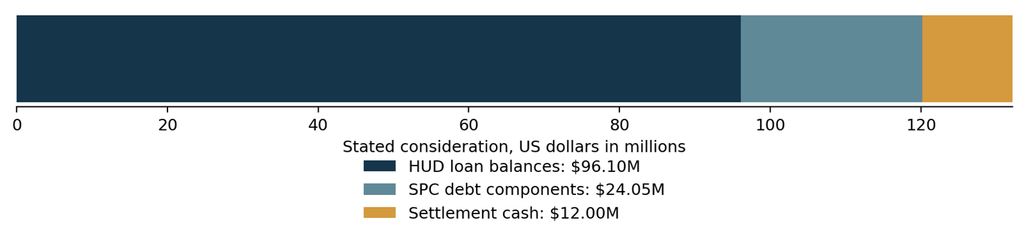
The accepted average real estate appraisals totaled $138,436,666.66. That is $6,282,258.08 above the four stated transaction values combined. The difference is worth understanding, but it is not automatically a dollar-for-dollar loss: the deal also addressed disputed SPC rights, debt, and the risks of continued litigation.
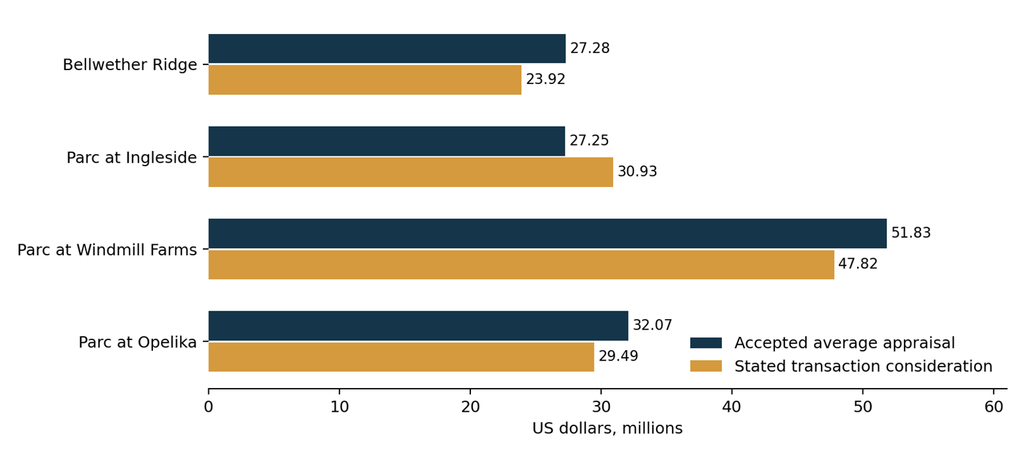
| Property | Accepted appraisal | Stated consideration |
| Bellwether Ridge | $27,283,333.33 | $23,919,918.38 |
| Parc at Ingleside | $27,250,000.00 | $30,931,755.78 |
| Parc at Windmill Farms | $51,833,333.33 | $47,815,802.19 |
| Parc at Opelika | $32,070,000.00 | $29,486,932.23 |
| Total | $138,436,666.66 | $132,154,408.58 |
Could an outside buyer realistically compete?
The Receiver published notice in the Dallas Morning News on September 16, 2026. There were no competing offers. But Barton’s criticism was about the conditions under which an outside buyer was expected to compete. The notice did not reproduce every proposed bid term, and an overbidder faced a ten-percent premium, a substantial deposit on a short timetable, and a tight closing window.
Under the filed procedures, a bidder would have to exceed the settlement price by at least ten percent. That pushed the qualifying floor above the accepted average appraisal for three of the four properties. For Ingleside, for example, the implied threshold was about $34.02 million, almost $6.77 million, or approximately 24.9 percent, over the accepted $27.25 million appraisal.
Federal law addresses judicial sales of real property in 28 U.S.C. § 2001 and personal property in 28 U.S.C. § 2004. Which provisions govern a particular transaction depends on the interests being conveyed and the applicable court orders.
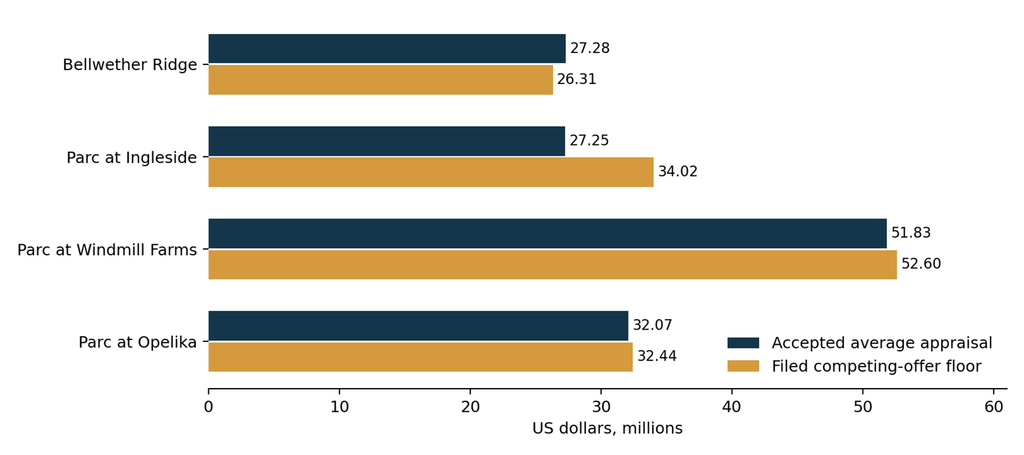
Barton also objected to the lack of a diligence period, a ten-percent deposit due within twenty-four hours, and payment of the balance within seven days after approval. He wanted published prices, a refundable deposit, thirty days for due diligence, and more time for necessary HUD approvals. SPC acknowledged that language about debt might be read as double counting and said it would not oppose certain bidding clarifications if the court chose to adopt them.
At the hearing, Receiver’s counsel Charlene Koonce said the public notice had identified the properties, the hearing and the basic requirement for a ten-percent-higher offer. Judge Starr concluded that the publication was adequate and said the omission of lengthy detailed terms had not, in his view, discouraged buyers. He approved the transactions. Barton remains unconvinced that a process with no bids proves a process was genuinely competitive.
The debt, the cash and the question of what the estate received
Barton’s concern was not limited to the published prices. For Opelika, the $29.49 million stated consideration included approximately $21.88 million in HUD debt, $4.78 million in SPC debt and $2.82 million in cash. Barton argued that the SPC obligation rested with parent companies rather than the selling entity itself, and asked why that obligation should count as value received by the property seller.
He also questioned a $5,420,149.48 increase in stated SPC balances, from $18,632,065.62 in the Receiver’s January 2023 figures to $24,052,215.10 credited as of June 2026. He sought a reconciliation showing principal, interest, fees, and credits instead of treating the larger figure as settled.
Another disputed pool involved $6,940,710.13 held in property-management accounts, including a separately reported $5,336,184 in excess cash at the end of 2025. Barton wanted the ownership and treatment of those funds explained. Koonce responded at the hearing that the accounts had not been hidden, that SPC claimed rights to them, and that tenant obligations also mattered. The judge treated the account dispute as part of the broader settlement.
The Receiver valued the compromise against litigation risk and carrying costs, presenting $12 million in settlement cash as more certain than years of costly disputes over SPC’s claims. Barton argued that before liquidation the court should have required clearer proof of how the claimed debt and available cash translated into genuine recovery for the estate.
Forty minutes in court, then an order entered on Sunday
The September 29 hearing was expressly limited to the appraisals and the settlement-related property sales. Barton received roughly twenty minutes to address his objections. The hearing summary lists no admitted exhibits, though the official transcript shows he circulated a written proffer and tried to place additional material before the court. Koonce objected to his attempted offer of proof, and the transcript does not show the judge formally admitting the proffer as an exhibit.
One point from the hearing has special importance to Barton: Koonce corrected an earlier statement suggesting that SPC’s assumption of HUD loans would release Barton from obligations under the Section 50 addenda. She explained that a sale would not itself release such liability, while stressing that the underlying loans were nonrecourse and the potential obligations were narrow. The correction underscored how much could depend on the precise wording of the sale order.
The dispute over the sale order continued in October, when Barton sought permission to make additional filings. The subsequent denials are examined in Two Filing Requests Denied in One Day.
After the hearing, the Receiver and SPC sent proposed orders to chambers, copying Barton. He meanwhile sought positions from the parties so he could request leave to file detailed objections to the proposed wording. On Sunday, October 4, the approval order reached the docket at 10:58 a.m. Central. It bore an October 2 date. The Receiver’s opposition to Barton’s requested filing arrived after entry, followed by further responses.
The property transactions also unfolded while the SEC civil case remained administratively closed despite continuing receivership oversight. That procedural issue is examined in Administrative Closure, Active Docket.
The sequence led Barton to question whether the full substance of his transcript-based objections had reached the judge before the order was entered. He has raised the possibility of private coordination, but the copied email submissions and timing alone do not establish undisclosed ex parte contact. The dates do show that the order was entered before Barton received the conference positions he had requested.
Judge Starr’s written order approved the Opelika real-estate sale and transfers of membership interests in the other three property-owning entities. The court found the transactions in the estate’s best interests and above the relevant statutory appraisal threshold. The order did not adopt Barton’s proposed changes to the bidding window, debt accounting or the short period he sought to pursue appellate protection.
The unresolved questions behind the sale order
The larger dispute is not simply that four property transactions were discussed in forty minutes. Years before that hearing, a bankruptcy judge had insisted on better verification of creditors’ participation and signatures in cases connected with the original Wall lending dispute. Related appeals were assigned to Judge Starr in 2021. Later, as the SEC case unfolded, federal courts first vacated and then upheld a receivership covering businesses that the Receiver said had received or benefited from investor-related assets.
Barton maintains that the eventual reach of that process was disproportionate, affecting a portfolio he estimates at about $200 million in gross property value, including developments he says were financed separately from the original Wall loans. The appellate rulings favor the SEC and Receiver on major legal questions. Barton’s remaining public challenge is more concrete: what did each apartment entity actually receive, what property interests could the estate convey, and how much value remained after debts and disputed claims?
No final jury verdict on the SEC’s underlying fraud claims had been entered when the four sales were approved. Federal law permits some forms of preliminary receivership relief before final judgment; that is part of the reason the appellate courts upheld the replacement order. Barton argues that preservation must still be distinguished from liquidation, particularly where the properties involve outside lenders and ownership rights that have not been tested in a final merits trial.
For readers outside the courtroom, the question is straightforward: when a dispute starts with loans for specific land projects, what must be shown before other, highly leveraged American real estate developments are placed under a receiver’s control and sold? The records answer parts of that question. Barton insists the remaining accounting deserves just as much attention as the $132.15 million headline.
Frequently Asked Questions
Which four apartment properties were involved in the September 2026 transactions?
The properties were Bellwether Ridge in DeSoto, Texas; Parc at Ingleside near Corpus Christi, Texas; Parc at Windmill Farms in Forney, Texas; and Parc at Opelika in Alabama. The three Texas transactions involved membership-interest transfers, while Opelika involved a real-estate sale.
Did the receivership receive $132.15 million in cash?
No. The $132.15 million was stated transaction consideration, not cash paid into the receivership. It included approximately $96.10 million in HUD loan balances, $24.05 million in SPC debt components, and $12 million in settlement cash. The cash available for distribution may be lower after expenses and claims.
What did the court record say about the earlier WALL007 creditors?
In 2020, Bankruptcy Judge Harlin DeWayne Hale addressed disputes over petitioning creditors’ identities, signatures, and depositions and required commitments to in-person depositions in the United States. Those concerns did not, by themselves, establish that the creditors were fictitious or that fraud on the court had been adjudicated.
What happened to the first, second and later receivership orders?
The Fifth Circuit vacated the first receivership order in August 2023. Judge Starr issued a second Order Appointing Receiver (Dkt. 417) on November 29, 2023, and the Fifth Circuit affirmed that second order on April 17, 2025. Dkt. 650 was a separate, later district-court receivership order, not the appellate decision itself.
Why did Timothy Barton object to the four-property sales?
Barton challenged the competing-offer requirements, short diligence period, disputed SPC debt amounts, and treatment of property-management funds. He asked how the stated transaction value translated into an actual recovery for the estate. The district court approved the transactions.
Further Reading: Related Barton Receivership Reports
Bellwether Ridge: Challenging the Receiver’s Motion for Sale — Earlier coverage of the Bellwether Ridge property dispute.
Parc at Windmill Farms: Questions About Receivership Inclusion and Sale — Background on the Windmill Farms dispute and the proposed settlement.
Two Requests. Two Denials. One Day. — October 2026 filings concerning the property transfers and Receiver fees.
Rock Creek: A $1.4 Million Sale and $61,836 in Closing Cash — A related analysis of gross sale value, net closing cash, and disputed tracing.
A Closed Case That Keeps Moving — Earlier investigation of administrative closure and ongoing court activity.
Real Estate Receivership: What Owners Need to Know — A general guide to the powers and financial consequences of real estate receivership.