


After repeated extensions, the Receiver filed twenty-seven months of bills together, and Barton challenged what the estate was being asked to pay.
October 19, 2026 | SEC v. Barton | Seventh through Fifteenth Quarterly Fee Applications
For more than two years, the deadline for the Receiver’s seventh quarterly fee application kept moving. Then, on September 18, 2026, it arrived with eight more applications. Together, their proposed orders directed just over $1 million in payments from the receivership estate. The latest court-approved filing deadline was still fifty-nine days away.
To Timothy Barton, the sudden batch turned a long-delayed disclosure into an immediate burden. Twenty-seven months of professional work now required examination together. His concern is that the volume could overwhelm meaningful review just as the Receiver sought access to substantial settlement proceeds.
The bills include an hour at $300 to post signs deterring stray animals, work defending a grievance against the Receiver’s lawyer, and a paycheck-delivery entry marked “No charge,” with a $269.50 client total. Barton filed nine objections. The Receiver defends the work and also acknowledges billing errors. The dispute asks what the estate must check before paying.
How quarterly disclosure became a backlog
The Fifth and Sixth applications, covering late 2023 and early 2024, were filed on July 8, 2025. The next nine applications did not arrive until September 2026.
The Receiver’s August 2026 extension motion recites eleven earlier extension requests dating to November 2023. Including that latest motion, the history comprises twelve requests. Nine included the Seventh application, beginning in August 2024. Each of those nine was granted.
| Extension request | Motion docket | Order granting request |
| August 13, 2024 | 547 | August 20, 2024 | Dkt. 552 |
| November 15, 2024 | 586 | December 2, 2024 | Dkt. 590 |
| February 14, 2025 | 600 | February 18, 2025 | Dkt. 603 |
| May 13, 2025 | 637 | May 14, 2025 | Dkt. 638 |
| August 5, 2025 | 668 | August 7, 2025 | Dkt. 672 |
| November 11, 2025 | 692 | November 12, 2025 | Dkt. 693 |
| February 10, 2026 | 708 | February 13, 2026 | Dkt. 711 |
| May 11, 2026 | 730 | May 12, 2026 | Dkt. 731 |
| August 11, 2026 | 850 | August 20, 2026 | Dkt. 870 |
Table 1. Extension requests that included the Seventh application. Later requests also included additional quarters as they accumulated. Dates and docket numbers are drawn from the October 15 docket report.
The last motion was sought on November 16, 2026, for all nine outstanding applications. Starr granted it on August 20. The Receiver filed them on September 18, fifty-nine calendar days before that date. A deadline permits earlier filing. Barton’s concern is the accumulated volume and abrupt change in pace after repeated postponements.
The nine applications, attached proposed orders, and supporting appendices total 562 PDF pages, using the corrected Eleventh appendix filed September 21. Barton filed nine ten-page objections on September 25, seven days after the applications and four days after that correction. The work involved checking invoices, earlier awards, and payment directions across nine quarters while preparing for the September 29 property hearing.
Why Barton challenged the extensions before the bills arrived
Barton had already opposed the latest extension on August 14. His objection separated the Receiver’s ability to pay a bill from the obligation to disclose it. A cash shortage might justify postponing payment, he argued, but it did not explain withholding applications that would show the accumulated liability.
That distinction mattered as property transactions advanced. In Barton’s account, the Court was being asked to evaluate liquidation without a current, reviewable account of the professional costs that future proceeds might fund. He asked for immediate disclosure of accrued fees, allocation among the receivership entities, and enough billing detail to evaluate the benefit of the work. His alternative request would condition any extension on those disclosures.
The Receiver gave a different explanation. His extension motion described scarce cash, property taxes, and secured debt. The September applications also blamed Barton’s appeals of sale orders for delaying recoveries. The Receiver said his team had gone unpaid for work after March 31, 2024, and connected filing the applications to the prospect of cash from the SPC settlement.
Those explanations address the Receiver’s financial position. Barton’s criticism concerns the way delayed applications concentrate the review task. The ordinary quarterly schedule would put each period’s charges before the court while the work was comparatively recent. Instead, the Seventh application arrived alongside bills for the next eight quarters. A disputed entry in an early period now had to be assessed in the same window as charges recorded more than two years later.
Barton sees that sequence as burying him in filings and leaving too little practical time to examine them. That is his assessment of the burden and the Receiver’s approach. The documented sequence establishes repeated extensions followed by a simultaneous filing; it does not by itself establish an intention to obstruct his review.
His nine filed objections show why the volume matters. They identify specific entries, question the benefit of legal work, challenge proposed payment figures, and seek safeguards before disbursement. Several points later drew concessions from the Receiver. The request for scrutiny therefore produced issues that required a substantive answer.
The seven days describe his actual turnaround. The court’s general civil motion rule provides twenty-one days for a response unless another rule or the judge directs otherwise. The reviewed docket and fee orders identify no shorter fee-objection deadline. The burden argument rests on nine applications arriving together, rather than an established seven-day limit.
Barton Receiver Fee Applications: Two Different Sets of Totals
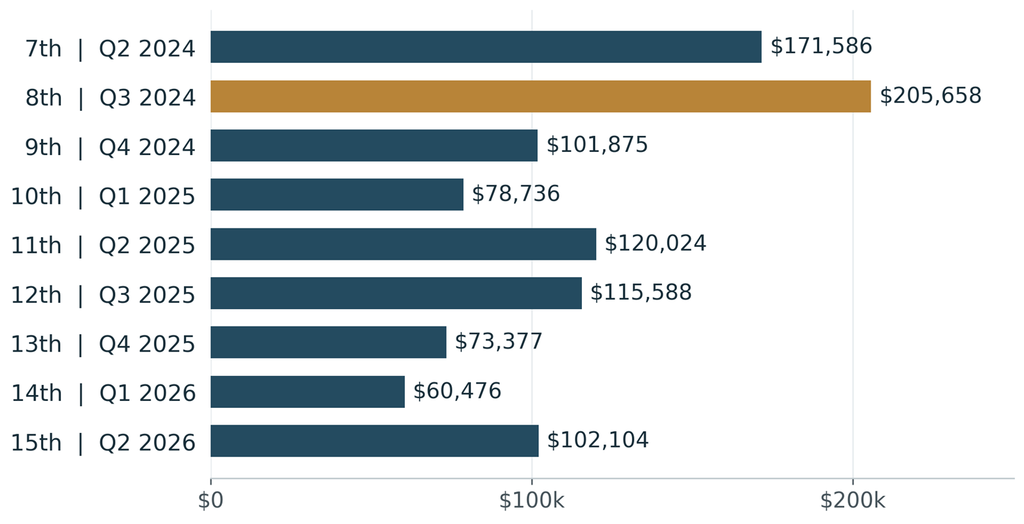
The opening totals in the nine applications add to $1,014,593.01. The payment directions in their attached proposed orders add to $1,029,422.08. The $14,829.07 difference is concentrated in the Seventh, Eighth and Ninth applications. For Barton, that is a reason to reconcile the papers before an order authorizes money to leave the estate.
| Application and quarter | Opening request | Proposed payment directions |
| 7th | Q2 2024 | $160,813.51 | $171,585.97 |
| 8th | Q3 2024 | $204,821.87 | $205,657.57 |
| 9th | Q4 2024 | $98,653.65 | $101,874.56 |
| 10th | Q1 2025 | $78,735.58 | $78,735.58 |
| 11th | Q2 2025 | $120,024.20 | $120,024.20 |
| 12th | Q3 2025 | $115,588.19 | $115,588.19 |
| 13th | Q4 2025 | $73,376.60 | $73,376.60 |
| 14th | Q1 2026 | $60,475.52 | $60,475.52 |
| 15th | Q2 2026 | $102,103.89 | $102,103.89 |
| TOTAL | $1,014,593.01 | $1,029,422.08 |
Table 2. Opening amounts are the totals stated on page 3 of each application. Payment directions are summed from the attached proposed order. Quarter labels identify the main application period; the Veracity request bundled into the Seventh application covers later quarters.
The difference is not a combined overcharge. The Seventh application’s stated total omits $10,772.46 for veracity, although the body discusses that request, and the proposed order includes it. The Receiver acknowledges that omission. A separate issue is the $1,786.13. Veracity invoice, he says, was already paid by mistake: Barton wants that earlier payment expressly credited against any new disbursement.
The Eighth application presents three figures: a $204,821.87 opening request, $205,657.57 in proposed payment directions, and $203,017.18 identified in the Receiver’s reply as the amount actually sought. The reply admits that the proposed order includes $2,640.39 already paid. The Ninth raises a different expense-period dispute and a further $30 mismatch between the reply and the proposed order. Each issue calls for its own explanation.
Who is asking to be paid?
These latest requests extend the dispute covered in the site’s earlier reporting on the Receiver’s fee applications. The new filings make the immediate question concrete: which amount would the court be authorizing?
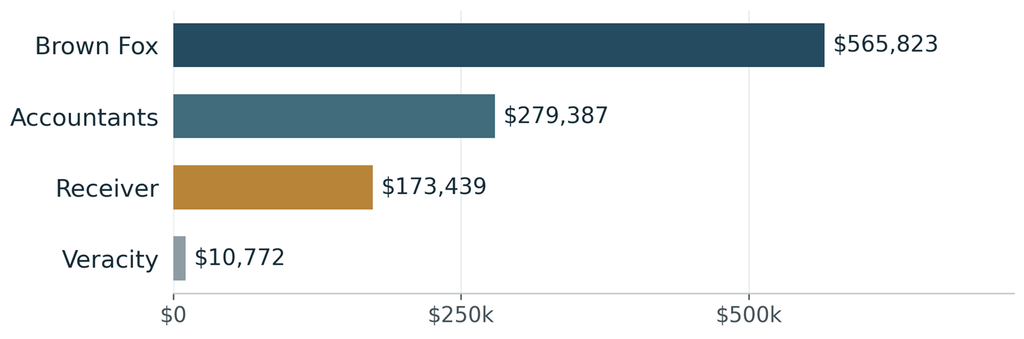
Brown Fox, the law firm representing the Receiver, accounts for the largest share of the proposed payment directions: $565,823.00. The accounting firms named in the orders account for $279,387.31, Thomas for $173,439.31, and Veracity Forensics for $10,772.46. Those figures include expenses where the orders include them; they are not all attorney fees.
In his October 9 reply, the Receiver argues that the estate’s improved financial position means the professionals should now be paid. He warns that the estate could not function properly if unpaid lawyers and accountants stopped working. Barton’s demand is that the Court examine the disputed amounts and work before granting the requested payment authority.
The applications themselves connect that anticipated improvement to the SPC settlement. They say its expected $12 million cash payment, once received and past the escrow period, would remove the cash constraints that prevented professional payments.
That financial context explains why the fee dispute matters alongside the transfer of real estate under receivership. Settlement cash can support professional compensation as well as other estate needs. Barton wants the requests examined before disbursement, when an inaccurate payment direction can still be corrected. The size of the available recovery does not, in his argument, answer whether a particular charge belongs on the bill.
Billing errors: The receiver acknowledges
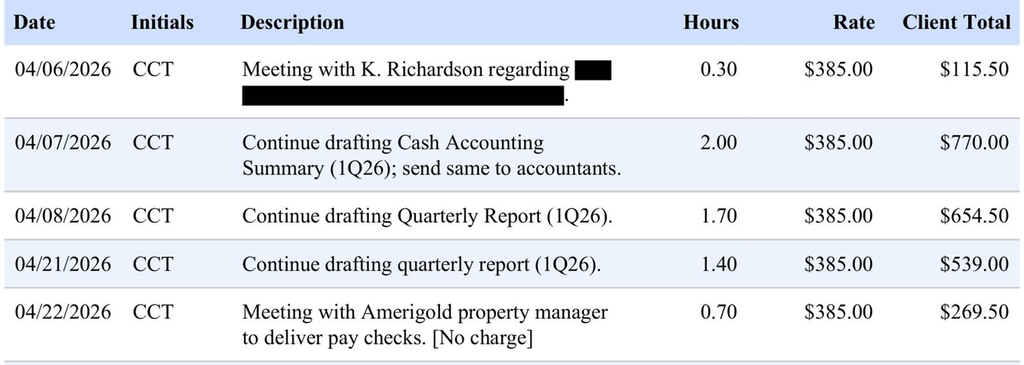
The Fifteenth application contains a particularly clear example. An April 22, 2026 invoice entry describes a meeting with the Amerigold property manager to deliver paychecks. It is marked “No charge,” but shows 0.7 hour at $385 and a $269.50 client total. A June 17 paycheck-delivery entry adds $231. The Receiver’s reply concedes that both were intended to be written off.
| Issue | Amount | What the Receiver acknowledges |
| Seventh application hourly rate | $200.00 | One hour was billed at $475 instead of $275. |
| Fifteenth application entries | $500.50 | Two paycheck-delivery charges were intended to be written off. |
| Eighth proposed order expenses | $2,640.39 | The proposed order includes expenses already paid. |
The contested point is what follows from those admissions. After the $200 correction, the Receiver gives a revised Seventh request of $171,385.97. He then suggests the Court may find that reduction unnecessary because of earlier write-downs. He makes a similar argument for the $500.50. Across the nine applications, he invokes nearly 100 hours, or $38,500, already written off.
Barton sought to answer that rationale in a proposed surreply: time excluded from a bill should not become a credit against an erroneous charge that remains. His request was to correct the payment directions themselves, rather than leave a conceded error in place because other work was not billed. The October 15 ruling on that proposed surreply, alongside a separate property-order request, is examined in Two Requests. Two Denials. One Day.
Why should the estate pay for a grievance response
Some objections concern the purpose of the work rather than arithmetic. Barton disputes billing the receivership for responding to his State Bar grievance against Charlene Koonce, the Receiver’s primary lawyer. The underlying entries identify the subject explicitly.
On July 7, 2025, Koonce billed 6.2 hours at $385, or $2,387, to review a draft grievance response and make extensive revisions and further drafts. On July 23, she billed another 5.8 hours, or $2,233, to continue drafting a surreply to Barton’s grievance response. Those two entries alone seek $4,620 from the estate. They appear in the Twelfth application’s appendix, not in a separate bill addressed to Koonce personally.
Barton’s Twelfth objection identifies $7,997.50 in entries naming the grievance, before additional mixed entries. That is his classification of challenged entries, not a court finding that every dollar in them served only the grievance. His broader objection is that a disciplinary complaint against a lawyer should not automatically become an expense of the estate she represents. He asks what benefit justified charging the estate for that defense.
The Receiver takes the opposite position. His reply calls the grievance baseless and argues that the time was incurred because Barton filed it. He similarly defends appellate work as a consequence of Barton’s challenges to the receivership and property-sale orders. The competing explanations expose the question Barton wants the Court to decide: does the fact that his actions prompted work establish that the estate should pay for it?
The cost of defending the receivership itself
Barton also challenges the benefit of amicus briefs supporting the SEC or continuation of the receivership. An amicus brief is a submission by someone assisting the court without being a principal party to that appeal. In his Eighth objection, Barton identifies $19,466 in amicus-related charges and asks what they added when the SEC was already defending its position.
The Receiver argues that the appeals required this work and prolonged administration of the estate. Barton asks for the benefit of the particular work to be shown. Those are substantive disputes about who should bear the cost. They cannot be resolved simply by adding the hours correctly, and the Receiver’s acknowledgment of smaller billing errors does not decide them.
Professional rates for everyday property work
The entry about stray animals illustrates another recurring objection. On January 7, 2026, lawyer James Hopper recorded one hour to post signs at the Gillespie house to deter stray animals. The work sits inside a 1.6-hour, $480 entry billed at $300 an hour. The sign-posting component is therefore $300; the remaining time concerns a spreadsheet and a conference with the Receiver.
Barton does not need to deny that a property requires maintenance to question whether every task merits an attorney’s rate. His Fourteenth objection seeks disallowance of clerical portions or an appropriate lower rate for compensable nonlegal work. The same question appears in earlier bills for paying utilities, coordinating vendors, and delivering paychecks.
| Recorded task | Allocated amount | Question raised |
| Post signs to deter stray animals, Jan. 7, 2026 | $300.00 | Whether this operational work warrants a lawyer’s $300 hourly rate. |
| Travel to Gillespie to locate a leaking pipe and determine repairs, Apr. 22, 2024 | $300.00 | Whether the 1.5-hour component warrants the $200 attorney rate. |
| Deliver paychecks, June 17, 2026 | $231.00 | Receiver concedes this entry was intended to be written off. |
Table 3. The first two amounts are allocated components of larger entries. They are disputed requests, not findings that the work was improper. The third is one of the Receiver’s conceded write-off errors. These examples are not an additional damages total.
What the descriptions allow anyone to check
Barton also challenges redactions and entries that combine several activities without enough explanation of their purpose or allocation. A bill may show a date, hourly rate, and dollar amount while concealing what the work achieved. His objections ask the Court to inspect complete invoices privately and require enough nonprivileged detail for a meaningful challenge.
The Receiver says redactions protect privileged information or information that could prejudice the estate, and that the descriptions permit a reasonableness determination. He offers unredacted invoices if the Court considers them necessary. On privilege-review work, he also explains that a reviewing lawyer had to travel to a storage facility because of the volume of paper records. Barton disputes the charges and the demonstrated result; the Receiver defends the need for the work.
The review process and the twenty percent safeguard
The fee controls are already written into the case. The operative receivership order, Dkt. 650, requires prior court approval for reasonable compensation and expense reimbursement. It requires service of a complete proposed application, exhibits, and relevant billing information on SEC counsel at least thirty days before filing. It makes quarterly awards interim and subject to cost-benefit and final review. It also permits a twenty percent holdback.
Those are concrete parts of a court-appointed receiver’s duties. Barton’s recurring concern is whether the filed versions received the review contemplated by that order. The applications cite early SEC submissions for their respective quarters, but the filed versions discuss later events. The Seventh certificate, for example, identifies an August 2024 submission, while the filed request includes later Veracity invoices. The applications also record being sent again on September 17, one day before filing.
The Receiver says the SEC received timely initial drafts and received the applications again before filing, and that its review supports approval. Barton asks the SEC to identify what version it reviewed and when. That request concerns the complete filing and its invoices, rather than whether an email was sent at some point.
The SEC’s position on payment is also qualified. The certificates and the Receiver’s reply report that the Commission favors a twenty percent holdback on each application. The Receiver asks the Court to waive it, relying on existing write-offs and the history of going unpaid. The order makes a holdback discretionary, so the SEC’s recommendation does not itself command the result.
The earlier Fourth-application order shows that distinction in practice. In February 2025, Starr recognized the holdback as protection against draining the estate through fees, but declined to impose it because the professionals had gone unpaid. Barton now seeks the safeguard while requesting corrected figures and review of the challenged work. A holdback would reserve part of an otherwise allowed payment for later review; it would not by itself determine that the charge was excessive.
Barton also relies on the SEC’s published Billing Instructions, including their treatment of descriptions, combined tasks, and travel. The Receiver disputes their application to this receivership. Barton’s later proposed surreply acknowledges that Dkt. 650 does not expressly incorporate them and presents them as guidance on reasonableness. The governing order’s own review requirements remain central to his request.
The earlier expense award matters to the new requests
Dkt. 609 is useful because it identifies what the Court previously authorized. Its payment directions award Thomas $12,002.34 for expenses incurred from October 1, 2023 through September 30, 2024. That period includes the Eighth application’s July–September 2024 quarter. The Receiver acknowledges that $2,640.39 already paid was mistakenly included in the Eighth proposed order.
The Ninth application covers October–December 2024, outside that earlier expense period. Its original text nevertheless says the expenses had been covered by the Fourth application and were not sought again. The Receiver’s reply says that statement is incorrect and identifies $101,844.56 as the amount actually sought. The attached proposed order still directs $101,874.56: it lists $13,885.41 for Thomas where the reply uses $13,855.41. Barton asks that the $30 difference be reconciled.
Another $2,256.01 issue concerns accountant expenses presented earlier. The Receiver says those were never paid because the Fourth order omitted them, and seeks payment now. Barton asks that the earlier order be addressed and the expenses supported and reconciled. That is a different dispute from the Eighth amount the Receiver acknowledges was already paid. Prior authorization, an actual payment and a repeated request are different facts.
What changed after the Receiver replied
Barton narrowed one point after reading the reply. His proposed surreply withdraws the Fourteenth application arithmetic objection once he accepts that $4,386 in accountant fees plus $330.37 in expenses equals $4,716.37. That withdrawn point should not be counted as another overcharge.
On October 15, he sought leave to file that surreply, focused on the reply’s write-off rationale and payment corrections. Starr denied leave the same day, finding no exceptional circumstances warranting a surreply. That ruling did not approve the nine applications or decide how each disputed charge should be treated. The original objections remain distinct from the proposed additional response.
The fee dispute therefore adds a financial dimension to Barton’s objections to the process. The latest filings join the Barton case timeline with a specific demand: reconcile the amounts, examine the challenged work and decide what the estate should pay. Barton wants those answers before the money is disbursed.
Further Reading
The dispute over the Receiver’s latest fee applications is part of a broader series of legal and financial challenges in SEC v. Barton. These earlier investigations provide additional background on the disputed expenses, property transactions, and ongoing court proceedings.
- Two Requests. Two Denials. One Day. — Examines Judge Starr’s October 15, 2026, denials of Barton’s requests to file submissions concerning four apartment properties and disputed Receiver fee corrections.
- Fee Applications Unmasked: A Critical Case Against the Receiver’s Exorbitant Charges — Earlier reporting on disputed professional fees, billing transparency, and questions about the financial accountability of the receivership.
- Behind the Numbers: Unjustified Billing in the Receiver’s Fee Application — Investigates questioned billing entries, administrative expenses, and the justification for professional charges submitted to the Court.
- Rock Creek Receivership Sale: $1.4M Deal, $61,836 Cash — Examines how a $1.4 million property sale generated just $61,836.12 in new closing cash, alongside substantial financing costs and professional-fee concerns.
- A Closed Case That Keeps Moving: The Docket Says Closed, the Record Says Active — Explores continuing motions, court orders, and receivership supervision despite the case’s administrative closure.